


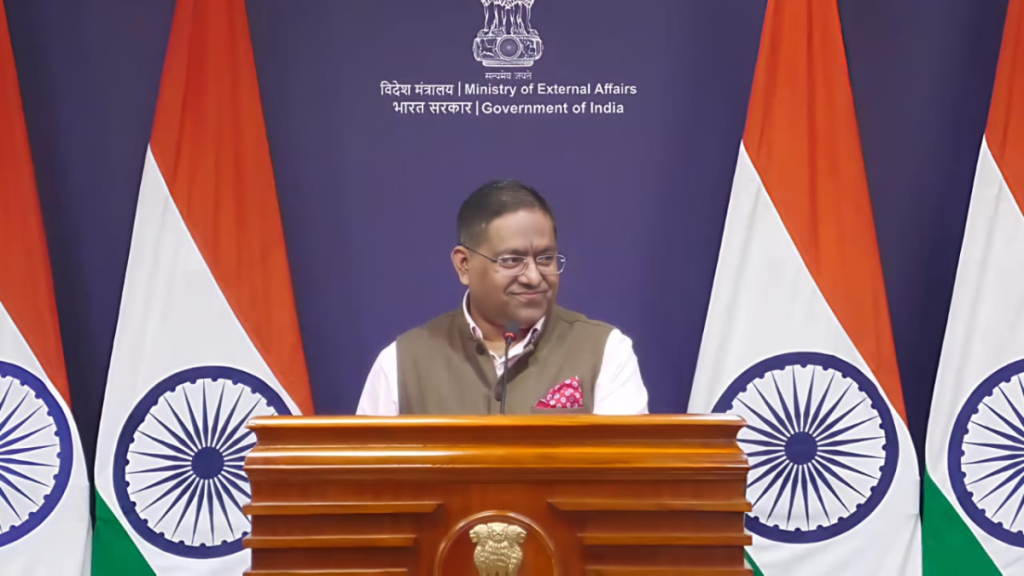
New Delhi: India on Tuesday signalled that it was closely assessing the security implications of the newly signed Mecca Joint Defence Agreement between Pakistan, Saudi Arabia and Turkiye, saying New Delhi would take “all necessary steps” to safeguard national security and preserve peace. The carefully worded response came days after the three countries entered into a collective-defence arrangement under which an armed attack on one would be considered an attack on all three.
Responding to questions at a media briefing, the Ministry of External Affairs spokesman, Randhir Jaiswal, stopped short of publicly characterizing the pact as directed against India but made clear that New Delhi would protect its interests. The agreement, signed in Mecca on August 7, has attracted particular attention in India because it brings Pakistan into a formal defence framework with two influential regional military powers.
The pact brings together Saudi Arabia’s financial and strategic weight, Turkiye’s sizeable military and defence-industrial capabilities and Pakistan’s armed forces and nuclear arsenal. Its collective-defence provision has invited comparisons with Nato’s Article 5, although its eventual military mechanisms and the circumstances under which the clause may be invoked remain unclear.
The agreement has also emerged at a time of considerable strategic flux in West Asia, with regional powers reconsidering their security arrangements after prolonged conflict and instability. Saudi Arabia, Turkiye and Pakistan have presented the framework as defensive and aimed at strengthening collective security rather than as an alliance directed against a specific country.
The MEA briefing also addressed China, with New Delhi reiterating that Arunachal Pradesh was an integral and inalienable part of India and that no assertion to the contrary could alter that reality. India has repeatedly rejected Beijing’s claims over the northeastern state and has maintained that attempts by China to rename places there have no bearing on sovereignty.
At the same time, the ministry pointed to continued efforts to stabilize ties with Beijing, saying India remained committed to dialogue for resolving outstanding issues along the line of actual control (LAC). It described the border question as serious and said diplomatic and military mechanisms, including the Working Mechanism for Consultation and Coordination on India-China border affairs, would be used to prevent and address misunderstandings.
The latest remarks follow the 36th meeting of the WMCC in New Delhi on August 6, when India and China reviewed the situation along the border and agreed to maintain communication through diplomatic and military channels. The two sides emphasized peace and tranquillity along the frontier as an essential condition for the broader bilateral relationship.
In another indication of the cautious thaw between Asia’s two largest countries, Jaiswal confirmed that India-China border trade had resumed. Trade through Nathu-la in Sikkim restarted on August 1 after remaining suspended for more than six years, while the two sides have also been working towards restoring commerce through other designated border passes.
On ties with the United States, the MEA said discussions on tariffs were progressing well and that the commerce ministry would provide further details on the negotiations. The statement came as New Delhi and Washington continued talks aimed at ironing out tariff and market-access differences and advancing a bilateral trade agreement.
The negotiations have assumed importance following US tariff measures affecting several Indian export sectors, prompting an Indian parliamentary panel to urge the government to accelerate efforts to conclude a trade agreement with Washington. The panel has also called for safeguards for labour-intensive industries and more predictable market access for Indian exporters.
The ministry also referred to a meeting between the US ambassador and India’s national security adviser, saying the two sides reaffirmed their commitment to expanding cooperation in trade, defence and critical minerals. Critical-mineral supply chains have become an increasingly important element of India-US strategic cooperation as both countries seek more resilient sources for materials essential to advanced manufacturing, clean energy and defence technologies.
The MEA, meanwhile, sharpened its criticism of Pakistan over human rights, saying Islamabad had “much to answer for” and must be held accountable for its record. India has repeatedly raised concerns over reported rights violations in territories under Pakistani control and has called on the international community to hold Islamabad accountable.
The comments come as Pakistan faces renewed international scrutiny over restrictions on foreign media and reporting from sensitive areas, including Pakistan-occupied Kashmir. New regulations introduced by Islamabad have drawn criticism from journalists and rights groups, which say they could further constrain independent reporting.
On Nepal, India said the relationship remained close despite differences that could occasionally emerge and maintained that such issues should be handled through dialogue and discussion. The MEA also said India had invited the prime minister of Nepal, Balendra Shah, to visit soon after he assumed office.
The remarks came after Shah met India’s ambassador to Nepal, Naveen Srivastava, in Kathmandu on August 10, ending a period in which the Nepalese prime minister had avoided individual meetings with foreign envoys. His meeting with the Indian envoy was followed by an engagement with the Chinese ambassador, reflecting Kathmandu’s continuing effort to manage ties with its two large neighbours.
India also highlighted continuing engagement with Bangladesh, saying the Indian high commissioner had met a senior member of the government and discussed matters of mutual interest. New Delhi has invited Bangladesh’s prime minister, Tarique Rahman, to attend the BRICS summit in September in his capacity as the current chair of Bimstec.
The MEA said several countries and leaders had been invited to participate in the BRICS summit as India seeks to broaden engagement during its chairship of the grouping. The diplomatic outreach comes as New Delhi attempts simultaneously to manage difficult relations in its neighbourhood, rebuild stability with China and sustain strategic and economic engagement with the United States.
The ministry also said it was expanding its public diplomacy through newer digital platforms, including Snapchat, to reach different sections of the population. The effort reflects the growing emphasis on communicating India’s foreign-policy positions directly to younger and increasingly mobile-first audiences.