


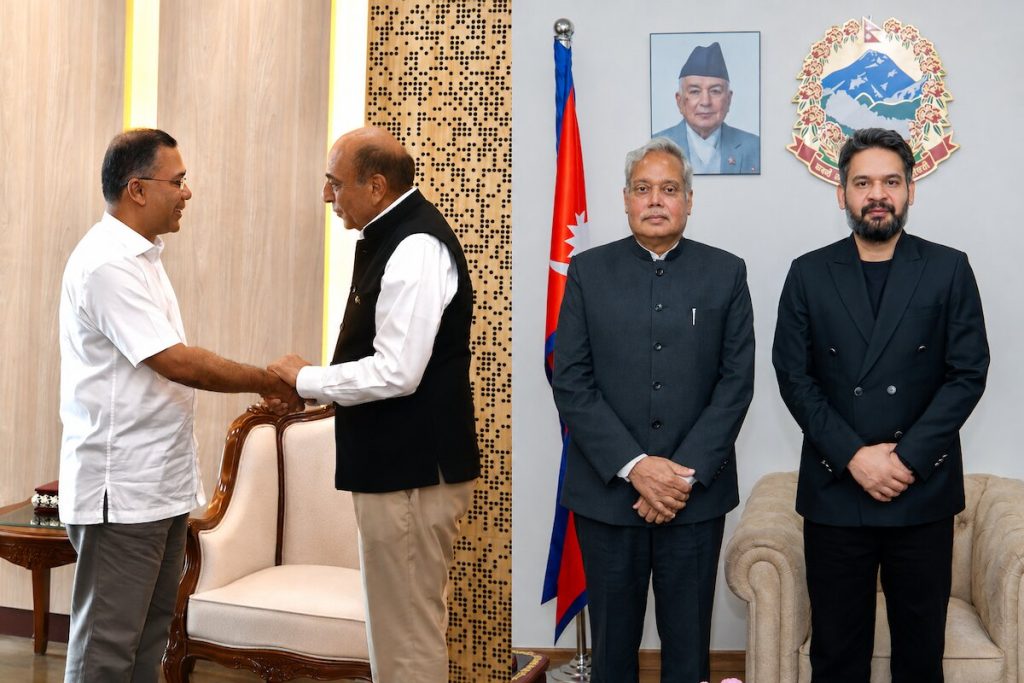
New Delhi: India stepped up diplomatic engagement with two important neighbours on Monday, with its envoys in Dhaka and Kathmandu meeting the prime ministers of Bangladesh and Nepal at a time when New Delhi’s relations with both capitals are navigating fresh strains. Though the two meetings were unrelated, their coincidence on Monday, underscored India’s preference for direct dialogue as it seeks to steady ties with Bangladesh after the latest Sheikh Hasina controversy and manage renewed sensitivities with Nepal over the boundary question.
In Dhaka, India’s high commissioner to Bangladesh, Dinesh Trivedi, met the prime minister, Tarique Rahman, in an engagement that assumed greater significance after a fresh bout of friction triggered by Hasina’s virtual media appearance in New Delhi on August 5. Bangladesh’s foreign minister, Khalilur Rahman, who had held a one-on-one meeting with Trivedi on Sunday, was also present during Monday’s talks.
Dhaka had reacted sharply to Hasina’s appearance, arguing that allowing the former prime minister to make political statements from Indian soil could damage efforts to rebuild bilateral relations following her ouster in August 2024. India has sought to distance itself from the episode, with the Ministry of External Affairs saying the event had been organized by a private media entity, that the government had no role in it and that New Delhi did not endorse remarks made there concerning the government of Bangladesh.
The dispute has complicated what had been a cautious attempt by the two sides to reset relations after Rahman’s government took office earlier this year, succeeding the interim administration headed by Muhammad Yunus. Hasina, who has remained in India since leaving Bangladesh in 2024 and was sentenced to death in absentia by a Bangladeshi tribunal in 2025, remains one of the most difficult unresolved issues between the two governments, with Dhaka continuing to seek her extradition.
Ahead of Monday’s meeting, Trivedi had publicly stressed the value of direct political engagement, saying problems between the neighbours could be addressed when their leaders spoke to each other. His remarks also came as India awaits Bangladesh’s decision on whether Rahman will travel to New Delhi for the BRICS summit on September 12-13, to which he has been invited in his capacity as the current chair of Bimstec.
The summit could provide an opportunity for Rahman to meet the prime minister, Narendra Modi, although Bangladeshi media reports have suggested that the Hasina controversy has complicated the prospect of his participation. New Delhi had separately invited Rahman for a bilateral visit after he assumed office, while Trivedi has repeatedly argued that a meeting between the two prime ministers could help move pending issues towards resolution.
Trivedi meets Rahman
The outreach in Bangladesh comes alongside a significant diplomatic engagement in Kathmandu, where India’s ambassador to Nepal, Naveen Srivastava, became the first foreign envoy to hold a one-on-one meeting with the prime minister, Balendra Shah, since Shah assumed office on March 27. The meeting at Singha Durbar covered bilateral relations, development partnership, mutual interests and possible areas of cooperation, according to the prime minister’s secretariat.
Shah told Srivastava that Nepal wanted to deepen its “historic relationship” with India and work together in areas of shared interest, while the Indian ambassador conveyed New Delhi’s commitment to strengthening bilateral cooperation. The engagement marked a departure from Shah’s earlier practice of receiving Kathmandu-based foreign diplomats collectively rather than meeting individual ambassadors.
The change, however, is part of a broader diplomatic opening by the Nepalese prime minister rather than an India-specific move: Shah was also scheduled to meet the Chinese ambassador, Zhang Maoming, separately on Monday and the US chargé d’affaires, Scott Urbom, on Tuesday. Significantly, the meeting with Srivastava was scheduled ahead of the Chinese envoy’s engagement, a sequence that Nepalese officials have described as reflecting Kathmandu’s stated foreign-policy priority while maintaining close ties with both its giant neighbours.
The talks also come after India-Nepal relations encountered renewed friction over their long-running territorial differences involving Kalapani, Lipulekh and Limpiyadhura, an issue Shah brought back into sharper political focus after taking office. India rejected suggestions of a role for third countries in resolving the disagreement and reiterated that established bilateral mechanisms were the appropriate forum for dealing with boundary matters.
The boundary dispute has periodically tested an otherwise unusually dense relationship built around an open border, extensive people-to-people links, trade, employment, energy cooperation and defence connections. Shah’s willingness to open a direct channel with the Indian ambassador therefore carries political significance, even as Kathmandu continues its longstanding effort to maintain strategic space between India and China.
In Bangladesh, New Delhi has adopted a similarly engagement-heavy approach despite differences over Hasina, border management and other pending bilateral questions, appointing Trivedi – a former Union minister and veteran politician rather than a career diplomat – to the sensitive Dhaka mission earlier this year. His appointment was a rare diplomatic choice and came as India sought to rebuild political trust with Bangladesh following nearly two years of turbulence after Hasina’s fall.
Taken together, Monday’s developments point less to an immediate breakthrough than to an attempt to prevent disagreements with two strategically important neighbours from hardening into prolonged diplomatic distance. With Dhaka weighing a possible high-level visit to New Delhi and Kathmandu reopening direct engagement at the prime ministerial level, India appears to be placing renewed emphasis on political contact as the first step towards managing some of the most sensitive relationships in its immediate neighbourhood.