


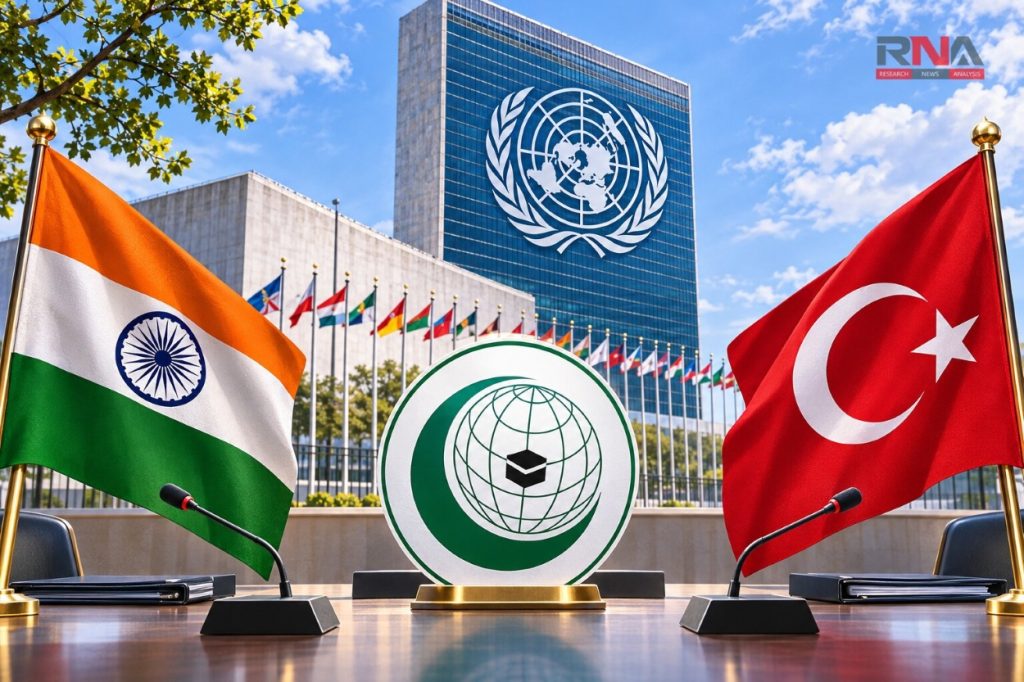
New Delhi: India has launched a sharp diplomatic attack on Turkiye at the United Nations, accusing Ankara of deliberately excluding it and several other countries from negotiations on a resolution concerning cooperation between the UN and the Organisation of Islamic Cooperation (OIC). The dispute has exposed serious disagreements over the transparency of UN negotiations, the OIC’s growing diplomatic ambitions and the use of the 57-member Islamic grouping to advance contentious political positions, particularly on Jammu & Kashmir.
The confrontation unfolded at the UN general assembly in New York on Monday, when India voted against the resolution after accusing Turkiye, which facilitated the negotiations, of deliberately disregarding established diplomatic procedures. The resolution, formally introduced by Iraq, was nevertheless adopted with 112 countries voting in favour, six against and 39 abstaining.
India joined Armenia, Cyprus, Greece, Israel and the United States in opposing the measure, producing an unusual alignment of countries with differing geopolitical interests but objections to the resolution or the manner in which it was negotiated. Cyprus and Greece separately criticized Turkiye for restricting participation, while the European Union complained that its efforts to influence the draft had been disregarded.
India’s deputy permanent representative to the UN, Yojna Patel, delivered a strongly worded explanation of vote, accusing the OIC’s permanent observer mission of excluding Indian diplomats and other delegations from successive rounds of draft circulation. She said the omissions persisted despite objections from affected countries, suggesting that the exclusions were intentional rather than administrative errors.
Patel argued that countries holding conflicting positions must nevertheless be allowed to participate in discussions on matters placed before the general assembly, where all member states enjoy sovereign equality. She described the exclusion as a dangerous precedent that could enable particular groups of countries to shape multilateral decisions without allowing opposing delegations to scrutinize or challenge their proposals.
The Indian diplomat also accused the facilitators of disregarding objections and failing to acknowledge submissions from affected delegations, undermining the credibility of the negotiations. She urged the president of the general assembly to investigate the conduct of the consultations and take measures to prevent similar practices in future.
Kashmir references compound India’s objections
Beyond the procedural dispute, New Delhi questioned the substance of the resolution, particularly its references to OIC declarations containing positions on India’s internal affairs. Patel objected specifically to a reference to the ninth OIC Ministerial Conference on Women, held in Islamabad in July 2026, whose declaration and accompanying resolution India rejected.
New Delhi maintains that Jammu & Kashmir is an integral part of India and that the OIC has no standing to intervene in matters concerning its sovereignty or domestic affairs. Patel accused an unnamed OIC member state – an apparent reference to Pakistan – of repeatedly exploiting the organization to introduce allegations against India into documents subsequently cited in international forums.
The disagreement reflects a longer-running diplomatic confrontation between India and the OIC, whose Kashmir contact group includes Pakistan and Turkiye alongside Azerbaijan, Niger and Saudi Arabia. As RNA Media reported earlier, New Delhi had also rejected the grouping’s references to Jammu & Kashmir following the OIC Council of Foreign Ministers’ meeting in Baghdad in October.
India also challenged the proposed expansion of the OIC’s involvement in resolving international conflicts, questioning the justification for assigning the grouping a broader political role through cooperation with the United Nations. Patel pointed out that the OIC is not a regional organization in the sense envisaged under Chapter VIII of the UN Charter, which addresses cooperation with regional arrangements in maintaining international peace and security.
EU also challenges Turkiye’s approach
The controversy extended beyond India’s objections, with the European Union raising its own concerns about the negotiating process and the resolution’s political implications. In an official statement delivered by Ireland on Monday, the bloc said several European delegations had been excluded from important communications despite requesting participation.
The EU disclosed that it had submitted substantive observations on the initial draft on September 14 but found that several longstanding objections remained unresolved in the final document. Its principal concerns included references to the OIC’s 2025 Programme of Action, particularly provisions relating to Cyprus that Brussels considers inconsistent with relevant UN security council resolutions.
The Cyprus dispute remains a longstanding source of friction between Ankara and several European governments, with Turkiye supporting the Turkish Cypriot administration in the island’s north. The EU recognizes only the Republic of Cyprus and maintains that attempts to confer legitimacy on the breakaway administration contradict security council resolutions 541 and 550.
The United States, meanwhile, expressed concern over what it regarded as unnecessary and contentious provisions in the resolution, calling for future drafts to concentrate on practical areas of cooperation capable of securing broader agreement. These objections demonstrated that opposition to the measure was not confined to India or its disagreements with Pakistan and Turkiye.
Why the diplomatic confrontation matters
The dispute is significant because resolutions concerning cooperation between the UN and international organizations can provide diplomatic recognition and visibility to political declarations adopted outside the UN system. Although such resolutions do not automatically make every referenced OIC position legally binding, their wording can become a point of contention when governments believe politically sensitive claims are being introduced into broader multilateral documents.
For India, the episode raises two distinct concerns – the exclusion of dissenting delegations from negotiations and the possibility of OIC positions on Kashmir gaining greater international visibility through UN resolutions. It also highlights how disagreements involving Pakistan, Turkiye and India can spill into discussions ostensibly concerned with institutional cooperation rather than bilateral territorial disputes.
Nevertheless, the resolution’s adoption by a substantial majority demonstrates that objections from India and several western countries did not prevent the general assembly from endorsing continued UN-OIC cooperation. The outcome also underlines the distinction between supporting engagement with the Islamic grouping and accepting all its political positions, a distinction several delegations sought to emphasize during the debate.
India’s demand for an investigation now places the negotiating process itself under scrutiny, although no subsequent decision by the general assembly president to initiate such an inquiry was confirmed in the material available through Wednesday. The larger question is whether future UN-OIC negotiations will accommodate dissenting member states more transparently, or whether procedural disagreements will continue to complicate cooperation between the two organizations.