


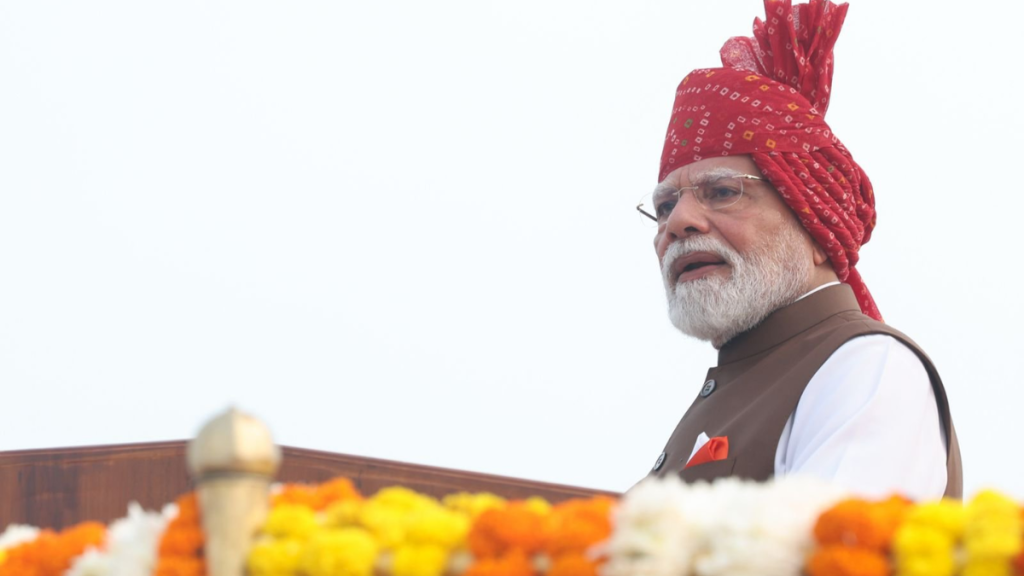
New Delhi: The prime minister, Narendra Modi, on Saturday laid out an ambitious blueprint for the next phase of India’s development, combining a seven-point framework called “Sapta Dhara” with a series of new initiatives on artificial intelligence, education, sports, semiconductors, nuclear energy and defence. Setting a five-to-seven-year window for work that has remained unfinished for decades, Modi said India must change its pace of execution if it is to realise the vision of a Viksit Bharat by 2047.
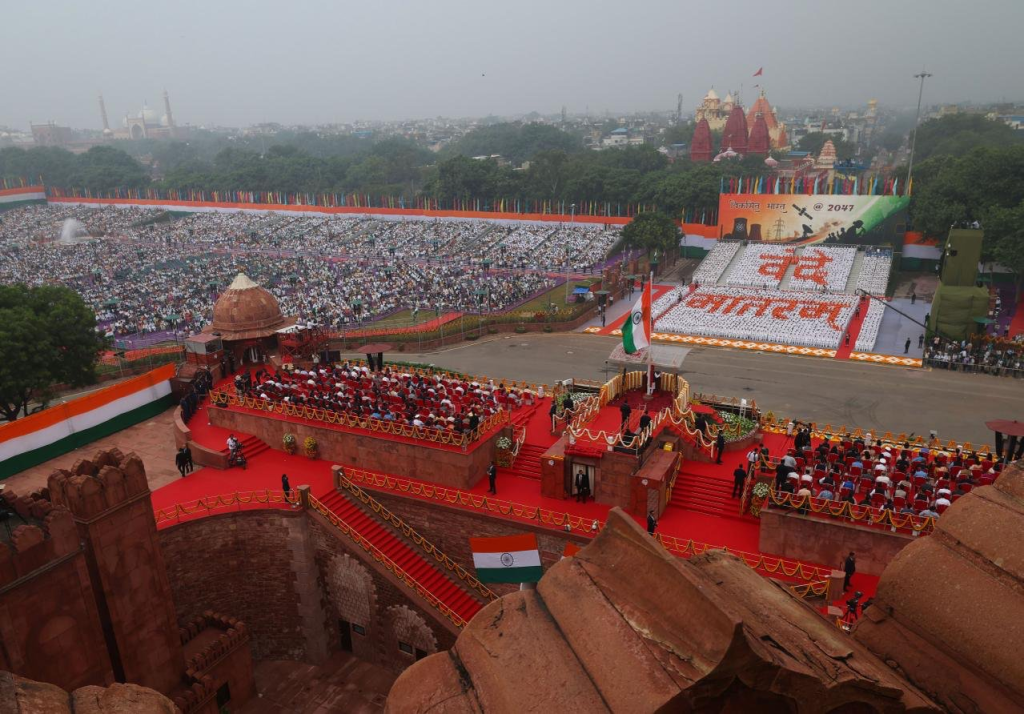
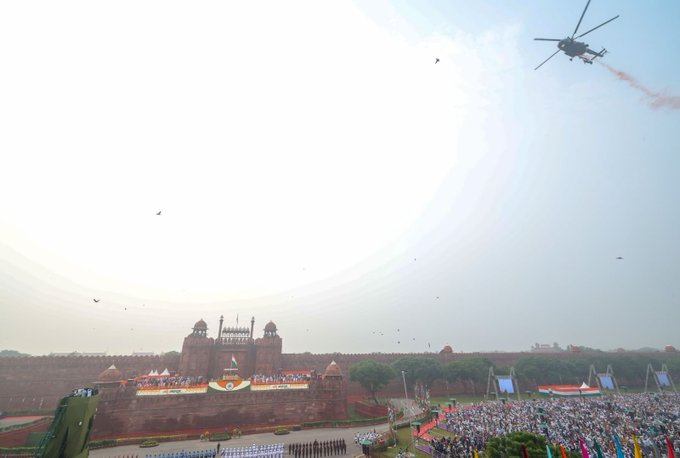
Speaking from the Red Fort on the 80th Independence Day, Modi said the world was entering a period of economic and strategic uncertainty in which countries were increasingly protecting their resources and supply chains. India, he said, could not afford to remain dependent on others for critical technologies, energy or manufacturing and would have to build the capacity to compete globally.
AI training, free coaching and sports talent hunt
One of the biggest announcements of the speech was aimed at India’s young population. Modi said one crore young people would be trained in artificial intelligence, as the government seeks to prepare a workforce for an economy increasingly shaped by AI, automation and advanced technologies.
He also announced free online coaching for competitive examinations, seeking to make preparation resources more accessible to students who cannot afford expensive coaching programmes.
In another youth-focused initiative, the government will launch a nationwide hunt for sporting talent among children aged five to 15 years. The programme is aimed at identifying promising athletes early and building a wider pool of talent as India seeks a larger presence across Olympic disciplines.

Semiconductors and nuclear power push
Modi’s economic vision also placed semiconductors and nuclear energy, both critical to India’s strategic autonomy, at the centre of the next phase. Modi said India would soon have seven to eight semiconductor plants, expanding the domestic ecosystem for a technology that underpins everything from smartphones and automobiles to artificial intelligence and defence systems.
Energy security is equally critical to that ambition. Modi announced a target of 100gw of nuclear power capacity by 2047 and said five nuclear reactors would be brought online during the coming decade. He also said that 99 per cent of areas previously classified as “no-go” zones for offshore exploration had now been opened as “go-ahead zones”, as the government looks to strengthen domestic energy supplies.

India as a global manufacturing hub
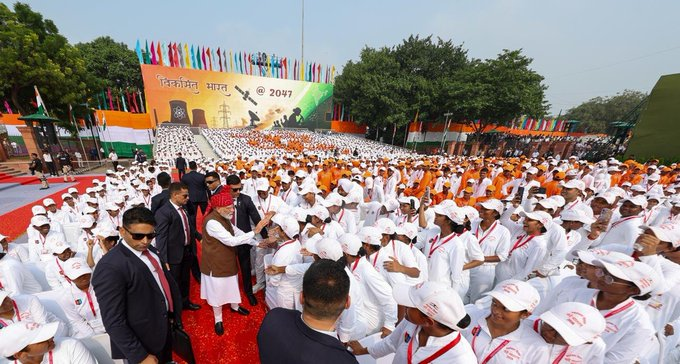
A recurring theme through the address was the need for India to move up the global value chain. Modi said Indian manufacturers must be able to control the entire process, from design to production, rather than depending on imports for critical components. He called for precision manufacturing to become India’s identity and said Indian products would have to compete on cost, quality and scale.
He also linked this ambition to the country’s network of free-trade agreements, saying Indian manufacturers and MSMEs must use greater access to international markets to expand exports.

Drones, hypersonics and cyber security
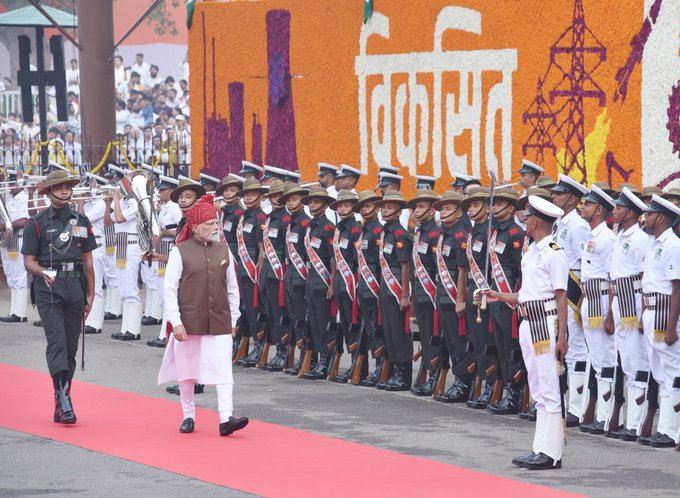
The same approach was extended to defence. He said India could not remain a market for foreign defence companies and should instead emerge as a global supplier of advanced military technologies.
He highlighted drones, counter-drone systems, hypersonic defence technologies and cyber security as areas in which India needs to build stronger domestic capabilities.

Sapta Dhara
Against this backdrop, Modi introduced Sapta Dhara, drawing on the historical reference to “Sapta Sindhu” to describe seven streams of national strength. The framework brings together manufacturing, agriculture and food processing, technology and innovation, Gati Shakti, defence, the green and blue economy, and soft power.
Rather than presenting them as independent government schemes, he described the seven areas as mutually reinforcing. Better infrastructure can support manufacturing and exports, technology can strengthen defence and industry, clean energy can power new industries, while India’s cultural influence can create opportunities in tourism and creative sectors.

Agriculture, Gati Shakti and port-led growth
Modi also called for a shift in the way India approaches agriculture. Indian farmers, he said, should be able to reach international markets, with products such as millets, spices, fruits, flowers and traditional foods being developed to meet global standards.
Infrastructure is expected to support that export ambition. Under Gati Shakti, Modi called for faster connectivity between cities and stronger transport networks, while arguing that India’s ports should become engines of economic growth rather than merely places where cargo is loaded and unloaded.
The green economy is expected to create another layer of opportunity through renewable energy, green hydrogen, energy storage and green mobility, while the country’s long coastline offers scope for fisheries, coastal tourism and ocean technology.

India’s soft power push and faster reforms
Modi highlighted yoga, Ayurveda, spiritual tourism, handicrafts, films, VFX, animation, gaming and digital content as sectors that can take India’s soft power to global audiences. Greater international tourism, he said, could also become a source of growth, with India’s national parks, forests and cultural heritage offering significant untapped potential.
The announcements were tied together by Modi’s repeated call for speed. He said India must complete tasks that had remained pending for decades within the next five to seven years and change its work culture to match the scale of its ambitions.
The prime minister also spoke about Naxalism, what he termed “dimagi Naxals”, and the need for a stronger civil defence network equipped with modern technology. These references placed internal security alongside economic and technological security in the larger development agenda.
As also reported by RNA Media, the speech presented Viksit Bharat 2047 as a project that will require simultaneous progress in manufacturing, technology, energy, defence, infrastructure and human capital.