


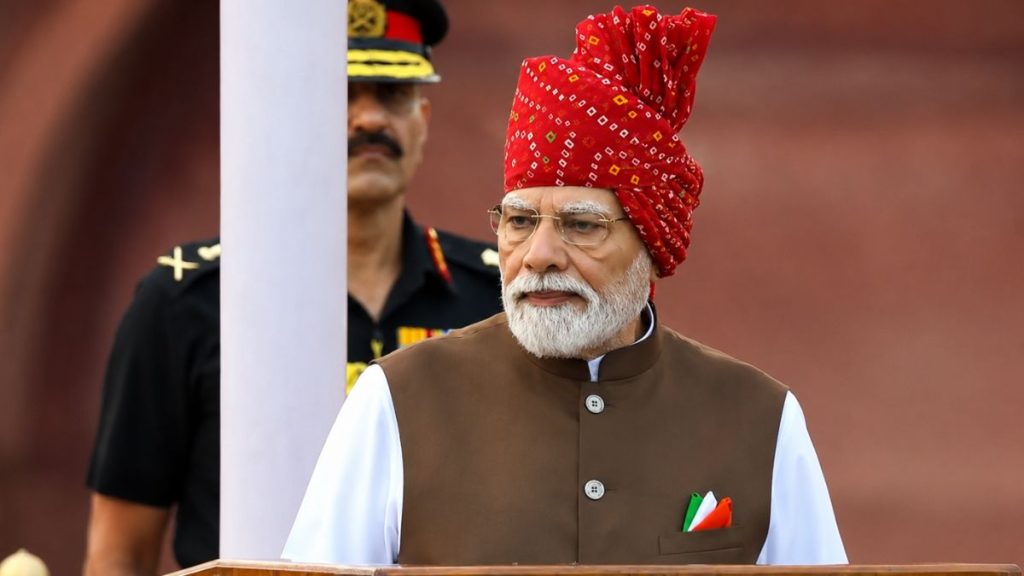
New Delhi: The prime minister, Narendra Modi, on Saturday called for a rapid transformation of India’s work culture, manufacturing capability and technological skills, setting a five-to-seven-year timeframe for completing work that had remained unfinished for decades. Addressing the nation from the ramparts of the Red Fort on India’s 80th Independence Day, he said the country could not allow the pace of development to slow and must undertake reforms with greater urgency.
“Our speed cannot come to a halt,” Modi said, calling for a change in the country’s work culture and pace of implementation. He said reforms would continue in the coming years and urged every section of society to align itself with the objective.
The address placed Atmanirbhar Bharat, or self-reliant India, at the heart of the government’s response to an increasingly fragmented global economic order. Modi said the world had stopped talking about globalization with the same confidence and warned that some countries were weaponizing resources to exert economic and strategic pressure.
Had India not embarked on the path of self-reliance, it would not have been able to overcome these challenges, he said, linking domestic industrial capacity with national security and supply-chain resilience.
Energy security, nuclear power
Energy security formed a prominent part of the address. Modi said chips, artificial intelligence and data centres all require electricity, making reliable energy supplies critical to India’s technological ambitions.
He referred to the passage of the SHANTI Act in Parliament and said India was aiming for 100 gigawatts (GW) of nuclear power capacity by 2047, while also targeting the launch of five nuclear reactors in a decade.
Modi also said 99 per cent of the areas earlier classified as “no-go” zones for offshore exploration had now been opened up as “go ahead zones”, as part of efforts to strengthen energy security.
Semiconductors, AI and critical minerals
The prime minister said India would soon have three new semiconductor plants and was working to secure access to critical minerals.
He said India should become a global hub for digitalization and innovation and take the lead in next-generation communication technologies. He also announced that one crore young people would be trained in artificial intelligence, placing AI skills within the broader push to prepare India’s workforce for emerging technologies.
Modi cited the growth of several sectors since 2014. Defence production, he said, had increased 4 times, electronic manufacturing 7 times and railway coach production 21 times. He also cited a 4-times increase in patent grants.
The prime minister said India’s bioeconomy had grown from around ₹2 lakh crore in 2014 to ₹20 lakh crore, while the number of electric vehicles had increased from around 2.5 lakh to 25 lakh. He also highlighted the development of the aviation sector.
Manufacturing and global competitiveness
Modi said India must be able to own the entire manufacturing value chain, from design to manufacturing, and called for Indian industry to compete beyond global benchmarks.
“We should be able to give the world better things than what it gives us,” he said.
“Precision manufacturing should become India’s identity,” Modi said, adding that trust and quality should become India’s hallmarks.
He also presented political stability and democracy as economic advantages. India had a stable government and a vibrant democracy, he said, adding that the world had started recognising this. This, he said, had helped India sign important agreements, including free-trade agreements.
Naxalism and civil defence
On internal security, Modi said India needed to finish addressing its internal challenges in the 21st century. He referred to Naxalism, saying it had affected people for four decades and that more than 3,000 police personnel had died as a result of it.
He said the government had taken the decision in 2014 to eradicate Naxalism and claimed that India was now on the verge of eliminating it.
Modi also used the expression “dimagi Naxal”, or “intellectual Naxalite”, and said the country needed to identify and get rid of such elements.
He mentioned Mission Sudarshan Chakra and said India would establish a civil defence network, with personnel trained in advanced technologies and equipped with the capabilities needed to make the network more effective.
Women, disasters and Viksit Bharat
The prime minister spoke about women’s empowerment, saying the “daughters of the nation” had excelled in every field.
He also referred to natural disasters that have affected several parts of the country this year and said families affected by them had the support of the nation.
Modi reiterated the goal of making India a Viksit Bharat by 2047, describing India as the fastest-growing major economy and presenting the developments of the past 12 years as part of the transformation needed to achieve that target.
The address began with a reference to Vande Mataram, as India marks 150 years of the national song.
Modi’s address was his 13th consecutive Independence Day speech from the Red Fort, making him the second prime minister after Jawaharlal Nehru to reach that milestone. The 78-minute address was his shortest Independence Day speech in four years. This year’s official celebrations commemorated 150 years of Vande Mataram and highlighted the role of young people in India’s journey towards becoming a developed country by 2047, according to the Ministry of Defence.