


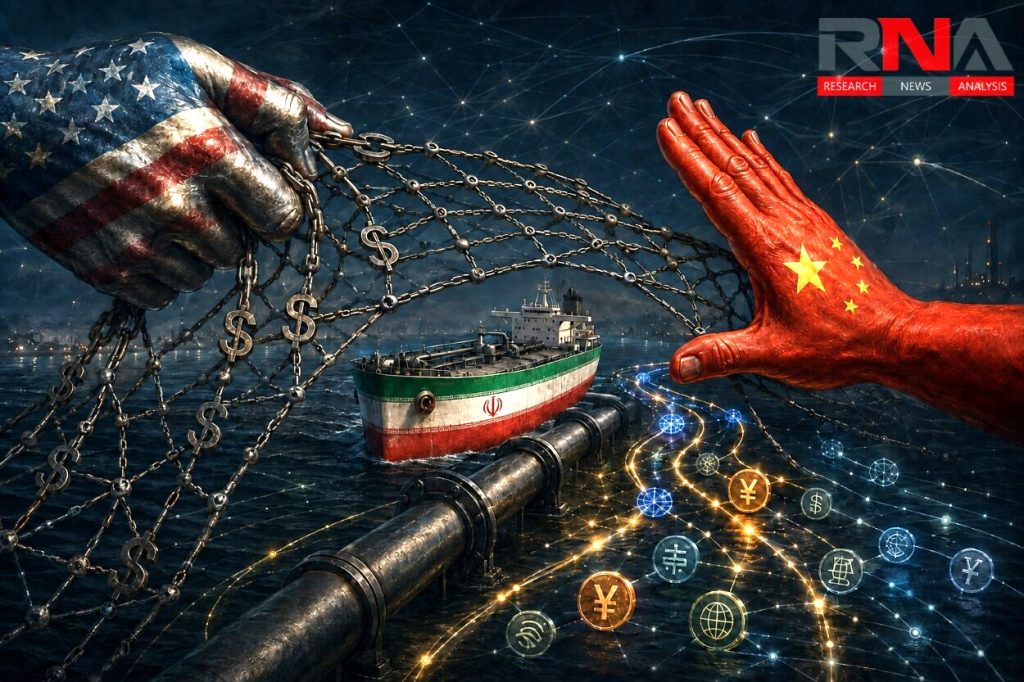
New Delhi: China warned the United States on Monday against interfering in its lawful trade with Iran and vowed to take all necessary measures to defend its interests, a day after Washington threatened countries maintaining economic links with Tehran. Beijing’s defiance has immediately exposed the central weakness in the American campaign that Iran cannot be comprehensively isolated unless China, its biggest oil customer and economic partner, either cooperates or is forced to retreat.
The Chinese foreign ministry said cooperation between China and Iran had always been conducted within the framework of international law and should not be obstructed by a third country. Its spokesman, Lin Jian, described American secondary sanctions as illegal unilateral measures and warned that Beijing would act to protect the legitimate rights of Chinese companies.
The warning followed the launch of Operation Economic Outcast by the US treasury secretary, Scott Bessent, on Monday. The Trump administration has characterized the campaign as an “economic D-Day” intended to sever Iran’s remaining financial and commercial connections, although Washington had so far announced only limited sanctions against Tehran’s foreign partners.
As RNA Media had reported earlier, the US treasury’s foreign assets-control office designated nearly 60 individuals, companies and vessels in India, China, Hong Kong, Malaysia, Singapore, the United Arab Emirates and other jurisdictions. Washington accused them of facilitating Iran’s oil exports, cyberoperations, shadow shipping, sanctions evasion and procurement of technology for its missile and nuclear programmes.
The treasury also expanded the range of Iran-related transactions that could expose foreign businesses to secondary sanctions in five sectors − digital assets, technology, gold, aviation and shipping. Several general licences authorizing certain remittances and Iranian access to American cultural and academic programmes were suspended as part of the operation.
However, the measures fell short of the sweeping financial offensive promised by the US president, Donald Trump, and Bessent in the days preceding the announcement. No major Chinese financial institution suspected of processing Iranian oil payments was immediately sanctioned, while Washington declined to identify which governments or companies would face penalties next.
Bessent said countries would be given defined but individually determined periods to wind down the Iranian activities identified by Washington. Asked why the Treasury had not immediately imposed secondary sanctions on Iran’s principal trading partners, he replied: “Why would I want to blow up the global financial system?”
The statement acknowledged the wider risks that could follow if the United States targeted a large Chinese or Gulf financial institution with extensive international operations. Bessent nevertheless warned that any bank helping Iran launder money could be removed from the dollar-based financial system and insisted that no country was beyond Washington’s reach.
The US treasury said Trump had been making telephone calls to foreign leaders with specific demands to end dealings with Iran. Countries failing to act within the prescribed period would face unilateral American measures, it added, without disclosing the deadlines or the governments contacted.
China has been the largest buyer of Iranian oil for several years, absorbing between 80 and 90 per cent of Tehran’s shipped crude before the latest wartime disruptions. Independent refiners, intermediaries, small banks and commodity traders have allowed much of this commerce to continue despite longstanding American restrictions.
Washington has previously sanctioned Chinese “teapot” refineries and companies involved in Iran’s shadow tanker fleet, but it has avoided imposing its most disruptive measures on systemically important Chinese banks. The latest sanctions followed the same pattern, targeting some Chinese businesses without striking the financial institutions at the heart of the wider trading relationship.
The omission is particularly significant because Trump and the Chinese president, Xi Jinping, are expected to meet in Washington in September. Sanctions against a major Chinese bank could derail that engagement and provoke retaliation involving rare-earth exports, tariffs, financial markets and industrial supply chains.
Iran also rejected the American campaign, expressing confidence that China, Russia and other trading partners would resist Washington’s pressure. The Iranian economy minister, Ali Madanizadeh, said Tehran was prepared to respond, while military officials threatened attacks on US interests and regional energy infrastructure if Iranian facilities were targeted.
The United Arab Emirates has already suspended trade and financial transactions with Iran, although its decision followed renewed missile threats and reflected its own security concerns. Turkiye, another important trading partner and a Nato member that has criticized the US-led campaign against Tehran, had not announced comparable restrictions when Washington unveiled the operation.
The measures come nearly six months after the United States and Israel launched military operations against Iran, severely degrading its conventional forces and damaging parts of its nuclear infrastructure. The offensive nevertheless failed to secure Tehran’s surrender, end its nuclear activities or produce the political collapse initially predicted in Washington.
An interim agreement between the United States and Iran in June briefly reduced hostilities but soon faltered, after which Tehran resumed attacks on commercial shipping and Washington renewed its blockade of Iranian ports. The Strait of Hormuz has remained largely restricted, disrupting energy supplies and imposing economic costs on Iran, Gulf countries and oil-importing nations.
Provisional ship-tracking data cited by Reuters showed that about five million barrels of oil passed through the strait on Monday, compared with more than 20 million barrels a day before the war. Elevated energy prices have also created domestic political difficulties for Trump ahead of the US congressional elections in November.
Iran’s economy is already struggling under decades of sanctions, wartime disruption, high inflation and the loss of oil revenue. The rial fell to approximately 2.02 million against the dollar on the open market as Washington announced the latest measures, further increasing the cost of food, medicines and industrial imports.
Bessent said the combined effect of the blockade and financial restrictions would leave Iran with a choice between a subsistence economy and eventual reintegration into the global system. The US defence secretary, Pete Hegseth, meanwhile, said further military strikes had not been ruled out, indicating that economic coercion remains part of a wider strategy rather than a complete replacement for force.
Why American sanctions may not deliver promised result
The United States retains the ability to inflict substantial economic damage on Iran, but causing hardship is different from compelling a government to change its strategic behaviour. Sanctions can reduce oil revenue, weaken a currency and obstruct access to technology, yet they cannot by themselves guarantee regime change, nuclear concessions or a settlement on Washington’s terms.
America’s principal advantage remains the size of its economy and the central position of the dollar in international finance. Foreign banks and companies may have limited commercial exposure to Iran, but most cannot afford to lose access to American consumers, dollar clearing, US correspondent banks or capital markets.
Secondary sanctions exploit that imbalance by forcing foreign businesses to choose between Iran and the United States. Their effectiveness, however, depends upon Washington’s willingness to penalize important companies and governments even when doing so harms American interests, unsettles markets or triggers retaliation.
The new operation is not itself a UN security council-authorized sanctions programme, although nuclear and missile-related UN restrictions on Iran were restored through the snapback mechanism in September 2025. The US’s new “Operation Economic Outcast” goes considerably further by threatening penalties against a broad range of commercial relationships that may be lawful under the domestic legislation of the countries concerned.
That distinction affects both the legitimacy and enforceability of the campaign outside American jurisdiction. Governments legally required to implement UNSC measures are not automatically obliged to adopt every additional US restriction on shipping, aviation, technology, digital assets or ordinary commerce.
The pressure surrounding the 2015 Iran nuclear agreement was more effective partly because the United States acted with European partners and benefited from broad international backing. The current campaign relies more heavily on the threat of exclusion from the American financial system at a time when several countries openly oppose Washington’s use of unilateral economic coercion.
US allies also have national interests that do not necessarily coincide with an effort to eliminate every Iranian economic connection. Gulf states may want to contain Tehran, but they must also protect oil terminals, shipping routes, tourism, investment and critical infrastructure from Iranian retaliation.
Saudi Arabia and other regional powers have invested in diplomatic engagement with Iran and may be unwilling to support a prolonged campaign explicitly linked to regime collapse. Iraq depends on economic and energy connections with its neighbour, while Turkiye values cross-border trade and has repeatedly presented itself as an advocate of negotiation rather than isolation.
The UAE’s suspension of trade represents an important success for Washington, particularly because Dubai has served as a major re-export and financial hub for Iran. Even so, rigorous enforcement against every shell company, exchange house and intermediary could conflict with the Emirates’ commercial model and expose it to further Iranian military pressure.
China is an even more formidable obstacle because it possesses the economic weight and political determination to resist American demands. Beijing buys Iranian crude at discounted prices, strengthens a strategically useful partner and simultaneously demonstrates that Washington cannot dictate every major international trading relationship.
Targeting Chinese banks, ports and refiners could undoubtedly constrain Iran, but it would also carry significant costs for the United States. China could retaliate by restricting critical minerals, disrupting supply chains, penalizing American companies or reducing cooperation on other strategic and economic issues.
Daniel Fried, a former US assistant secretary of state and sanctions coordinator, said the initial announcement had not matched Washington’s rhetoric, although he considered sustained economic pressure preferable to another major military offensive. He argued that the campaign would require patience, cooperation from Gulf governments and possibly American concessions to persuade reluctant partners.
Tom Keatinge, the director of the Centre for Finance and Security at the Royal United Services Institute, said Washington could have demonstrated greater resolve by targeting a major Chinese or Emirati institution helping Iran move money. The decision not to do so showed how an aggressive sanctions campaign could collide with the need to preserve global financial stability.
Iran has also accumulated extensive experience in adapting to sanctions imposed since the 1979 Islamic Revolution. Its methods include front companies, informal exchange houses, frequently renamed vessels, ship-to-ship oil transfers, barter arrangements, gold, cryptocurrencies and transactions routed through small banks with little exposure to the United States.
Closing one company or financial channel therefore does not necessarily stop the underlying commerce. Khalid Azim of the Atlantic Council described sanctions enforcement as a game of “whack-a-mole”, in which activity shifts to a new entity or mechanism whenever Washington identifies and closes an existing route.
The transformation of international payment systems has made that process easier than it was during earlier sanctions campaigns. The dollar and the western financial network remain dominant, but countries facing American restrictions now possess more alternatives for conducting limited trade outside traditional correspondent banking.
SWIFT is particularly important but frequently misunderstood because it does not itself transfer or settle funds. It is a Belgium-based financial messaging cooperative that allows banks to exchange standardized payment instructions and must comply with European Union law, as SWIFT explains.
Removing a bank from SWIFT can severely obstruct its international operations, but it no longer guarantees complete isolation. Payments can be rerouted through bilateral banking arrangements, informal systems, digital assets or alternative platforms such as China’s Cross-Border Interbank Payment System and Russia’s domestic financial messaging network.
China’s CIPS processed RMB 175.49 trillion in transactions during 2024, an increase of about 43 per cent over the previous year. Its growth does not make it a complete replacement for SWIFT or the dollar system, but it provides Beijing and its partners with an expanding infrastructure for settling renminbi-denominated transactions.
The use of national currencies in international trade is also gaining momentum, particularly among BRICS members and countries seeking to reduce their exposure to dollar-based sanctions. India has established a mechanism for invoicing and settling trade in rupees, while Iran has advocated national-currency settlements with Iraq, Russia, China and other partners.
BRICS governments are discussing greater interoperability between national payment systems and central-bank digital currencies rather than creating an immediate common currency. Their 2025 Rio de Janeiro declaration also rejected sanctions lacking UNSC authorization, reflecting broader concern about the extraterritorial use of national economic restrictions.
These changes have reduced the ability of the United States to treat access to SWIFT and the dollar as an absolute financial switch. They have not, however, displaced the dollar’s advantages in liquidity, convertibility, legal certainty, capital-market depth and worldwide acceptance.
SWIFT data for July 2026 showed that the dollar accounted for 59.58 per cent of international payments excluding intra-eurozone transactions, compared with 2.34 per cent for the renminbi. The dollar also constituted 57.13 per cent of disclosed global foreign-exchange reserves in the first quarter of 2026, while the renminbi represented only 1.99 per cent, according to the IMF.
Alternative financial channels are therefore better understood as pressure-release valves rather than complete substitutes for the western system. They can keep essential commerce moving and help Iran earn limited revenue, but usually at higher costs, with reduced transparency, fewer counterparties and greater exposure to fraud or seizure.
There is also a wider strategic paradox in Washington’s repeated use of financial sanctions. The dollar remains powerful enough to punish targeted countries, but each attempt to weaponize access gives other governments an additional reason to build local-currency arrangements and payment systems that could gradually reduce American leverage.
Sanctions may further weaken Iran, raise the cost of its military programmes and restrict its access to advanced components. Their political result will nevertheless depend on whether the Iranian leadership considers compromise less dangerous than continued economic hardship – a calculation that Washington cannot determine through financial pressure alone.
Iran’s rulers have survived more than four decades of sanctions, often shifting the cost to ordinary citizens while preserving military, security and patronage networks. Intensified restrictions could therefore worsen inflation and shortages without generating the popular or elite pressure required to overturn the government’s strategic decisions.
The ultimate weakness of Operation Economic Outcast is the absence of a clearly defined and consistently expressed political objective. Bessent has spoken about collapsing the Iranian regime, while other American officials have presented sanctions as leverage for renewed negotiations over Tehran’s nuclear programme and the Strait of Hormuz.
Those goals require different strategies, timelines and potential concessions. A campaign intended to secure a negotiated settlement must eventually offer sanctions relief, whereas one designed to produce regime collapse could continue indefinitely and increase the danger of Iranian military retaliation.
Washington’s new measures will almost certainly hurt Iran and complicate its foreign trade, but their capacity to produce a decisive American victory remains doubtful. Without Chinese cooperation, sustained support from reluctant allies and a credible diplomatic endgame, the “economic D-Day” could become another costly phase of a conflict in which coercion creates suffering and leverage without delivering resolution.