


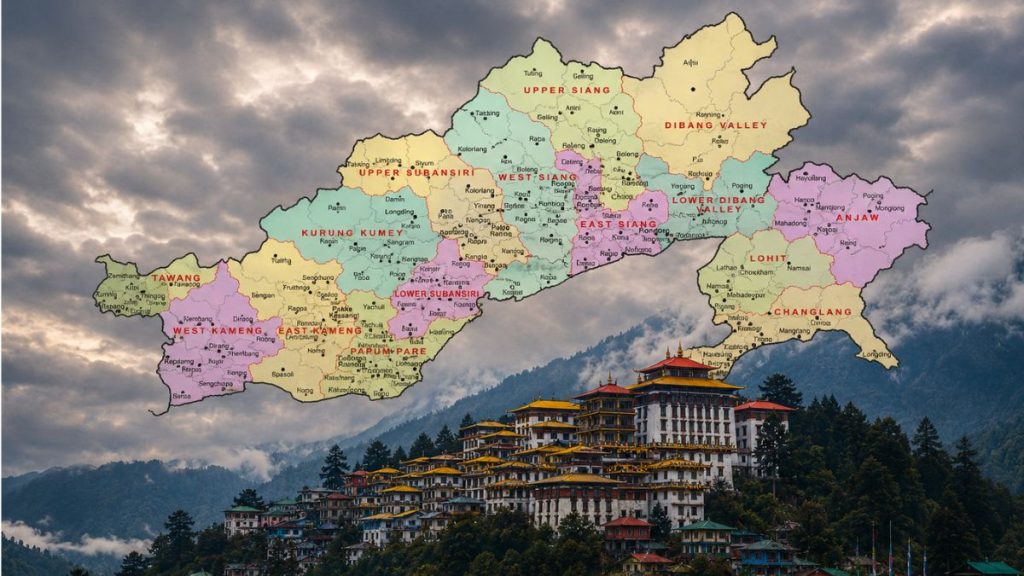
New Delhi: China’s state-run media has reacted sharply to India’s decision to formally standardize the names of 27 places and geographical features in Arunachal Pradesh, warning that the move could complicate the recent improvement in bilateral relations. The criticism comes despite Beijing having conducted six rounds of its own renaming exercises in the Indian state since 2017, a practice New Delhi has repeatedly rejected as an attempt to manufacture territorial claims.
In a report carrying an unusually pointed response to the Indian exercise, the Global Times quoted Chinese academics as describing New Delhi’s move as “self-deception” and arguing that it could undermine the atmosphere for negotiations between the two countries. The report, however, did not cite a fresh response from the Chinese foreign ministry to India’s latest action, relying instead on Chinese scholars and Beijing’s previously stated position on Arunachal Pradesh.
As RNA Media had reported, India announced on Friday that in consultation with the Arunachal Pradesh government, it had formally identified 27 locations by their standard place and feature names on official Survey of India maps. The Ministry of Home Affairs said the exercise was intended to facilitate accurate identification of the locations and improve public awareness of their geographical significance.
The list comprises 21 land areas, four mountain passes – Dzo-la, Riza-la, Pukur-la and Thag-la – besides Sambho Sarovar lake and the Sher-e-Thapa Memorial. Other locations include Longju, Maja, Bisa, Bara Kundun, Chhota Kundun, Jaswant Garh, Baisakhi, Shivaji Nagar, Sunpura and Kamlang Nagar.
The Chinese reaction is significant because Beijing has for years pursued precisely the kind of geographical nomenclature exercise it is now criticizing India for undertaking. Global Times itself acknowledged that China’s civil affairs ministry has released six batches of what it calls “standardized” names since 2017, covering 112 locations by April this year, including villages, mountain passes, rivers and peaks.
China claims Arunachal Pradesh as part of what it calls “Zangnan” or southern Tibet, a position firmly rejected by India, which administers Arunachal Pradesh as one of its constituent states. New Delhi has consistently maintained that Arunachal Pradesh is an integral and inalienable part of India and that assigning Chinese names to its geographical features cannot alter that reality.
The latest Global Times report quoted Qian Feng, director of the research department at Tsinghua University’s National Strategy Institute, as arguing that the Indian action ran against the improving momentum in bilateral relations. Another academic, Guo Xuetang of Shanghai International Studies University, claimed the move was intended to strengthen India’s position in future boundary negotiations and could damage mutual trust.
That argument closely mirrors the objection New Delhi raised only four months ago when China carried out its own latest renaming exercise. On April 12, the Ministry of External Affairs said Beijing’s attempts to assign fictitious names to places in Indian territory detracted from efforts to stabilize and normalize India-China relations and urged China to avoid actions that injected negativity into the relationship.
India had taken a similarly categorical position in May 2025 after another Chinese renaming exercise, describing Beijing’s repeated attempts as “vain and preposterous”. The MEA said then that creative naming could not change the reality that Arunachal Pradesh “was, is, and will always remain an integral and inalienable part of India”.
Beijing’s latest criticism also comes at a sensitive moment in attempts by the two sides to stabilize their relationship following years of tension along the line of actual control (LAC). As RNA Media had reported, the 36th meeting of the Working Mechanism for Consultation and Coordination on India-China Border Affairs was held in New Delhi on Thursday, just a day before India announced the Arunachal Pradesh naming exercise.
At the meeting, India and China discussed boundary delimitation, border management, mechanism-building and trans-border cooperation, while stressing that peace and tranquillity along the frontier were essential for the wider development of bilateral relations. The two countries have been gradually rebuilding political and diplomatic engagement after the prolonged military standoff that followed the deadly Galwan valley clash in June 2020.
For India, however, the standardization exercise differs fundamentally from Beijing’s practice of assigning Chinese names to locations inside an Indian-administered state over which China asserts sovereignty. The 27 names have been formally incorporated into maps maintained by the Survey of India, the country’s national mapping authority, following consultation between the central and Arunachal Pradesh governments. Interestingly, of the 27 names, three sites are under illegal Chinese occupation today, as RNA Media had reported.
China has maintained that issuing names for places in Arunachal Pradesh falls within its sovereign rights, while India has repeatedly dismissed that contention as having no bearing on the state’s status. The latest exchange shows that geographical nomenclature has now become another arena in the wider India-China boundary contest – and, this time, New Delhi’s decision to put its own standardized names firmly on the official map has clearly drawn Beijing’s attention.