


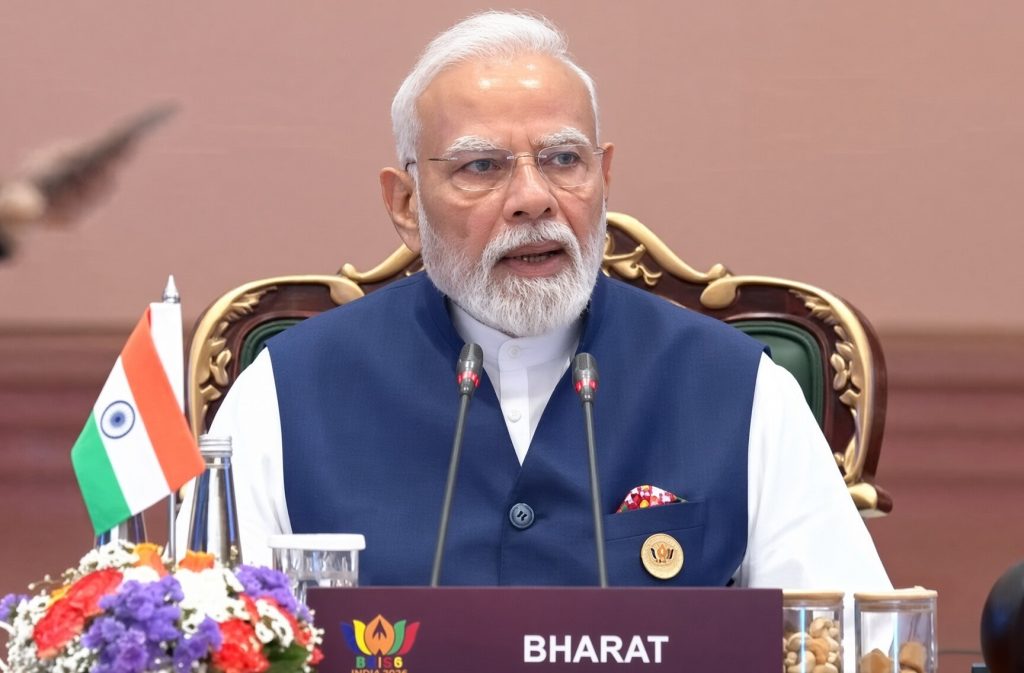
New Delhi: The prime minister, Narendra Modi, said BRICS has increasingly succeeded in converting a common political vision into practical, mutually beneficial cooperation, as the grouping concluded its 18th summit in New Delhi. His assessment, made on Sunday, came against a backdrop of India’s effort to give the expanded bloc a more action-oriented role in economic cooperation, global governance and the concerns of the global south.
Modi said the grouping’s growing relevance was reflected in the increasing level of trust among its members and in the wider participation of emerging and developing economies. India has used its 2026 chairmanship to emphasise resilience, innovation, cooperation and sustainability, while seeking to move BRICS beyond broad declarations towards initiatives with more tangible economic and institutional outcomes.
The New Delhi summit was significant because BRICS now operates on a considerably larger platform than the original Brazil, Russia, India, China and South Africa grouping. The expanded membership includes Egypt, Ethiopia, Indonesia, Iran and the United Arab Emirates, while partner countries have also been brought more closely into the bloc’s deliberations, giving BRICS a broader constituency across Asia, Africa, the Middle East and the developing world.
India’s approach has been to translate that wider representation into practical cooperation rather than allowing BRICS to remain primarily a forum for political messaging. More than 350 meetings and high-level engagements were held across India during the year under the country’s chairmanship, covering the bloc’s political and security, economic and financial, and cultural and people-to-people pillars.
Several initiatives discussed during the chairmanship underline that shift. They include work on a BRICS incubator network, a startup innovation fund and a logistics and supply-chain cooperation framework – areas designed to connect businesses, support innovation and improve resilience in an increasingly fragmented global trading environment.
The emphasis on economic resilience has acquired added importance as geopolitical conflicts, trade restrictions and disruptions to major transport routes have exposed vulnerabilities in global supply chains. India has also placed particular emphasis on freedom of navigation, secure sea lanes and the safety of seafarers, issues that have gained greater urgency as instability in West Asia threatens commerce through strategically important maritime routes.
The summit also demonstrated that BRICS is becoming an increasingly important diplomatic arena for managing differences among countries that do not necessarily share the same strategic interests. Iran and the UAE, for example, backed a joint BRICS statement calling for restraint in the Middle East despite the sharp tensions between Tehran and Washington and the wider regional conflict.
For New Delhi, the political value of that diversity lies partly in BRICS’ ability to bring competing powers into the same diplomatic framework. Modi has argued that the global south should not merely participate in institutions created by earlier generations of powers but should have a greater role in shaping the rules governing the international system.
That argument was reflected in the New Delhi declaration, which reaffirmed the members’ support for a more representative and equitable international order and called for reform of the multilateral system. The declaration also backed greater participation by emerging markets and developing countries, reinforcing India’s attempt to position BRICS as a platform for a wider global south constituency.
The summit’s diplomatic significance was also underlined by Modi’s bilateral engagement with several major BRICS members and partners. His meetings with the Russian president, Vladimir Putin, and the Iranian president, Masoud Pezeshkian, focused not only on bilateral ties but also on the wider role of BRICS, while India and China used the summit to pursue a cautious effort to stabilize relations after years of severe strain.
The Modi-Xi Jinping meeting was particularly consequential for India’s wider strategic calculations. Both sides signalled an interest in preventing differences from turning into confrontation, but the diplomatic reset remains constrained by the unresolved boundary question, trade concerns and the broader strategic competition between the two Asian powers.
The challenge for BRICS now is to demonstrate that its growing membership can produce cohesion as well as scale. Its members differ sharply on security alignments, economic models and foreign-policy priorities, making consensus more difficult as the grouping expands.
India’s chairmanship has therefore sought to define BRICS less as an anti-Western coalition and more as a negotiating platform through which emerging powers can pursue greater influence while retaining room for independent foreign policies. Modi’s description of a shared vision becoming “win-win” cooperation captures that ambition, although the durability of the model will ultimately depend on whether the bloc can convert political consensus into sustained projects, trade and institutional reform.
China will take over the BRICS chairmanship next year, giving Beijing an opportunity to shape the grouping’s next phase. For India, the more immediate achievement is that New Delhi has used its presidency to strengthen BRICS’s profile as a global south platform while simultaneously demonstrating that its expanding membership need not prevent practical cooperation.