


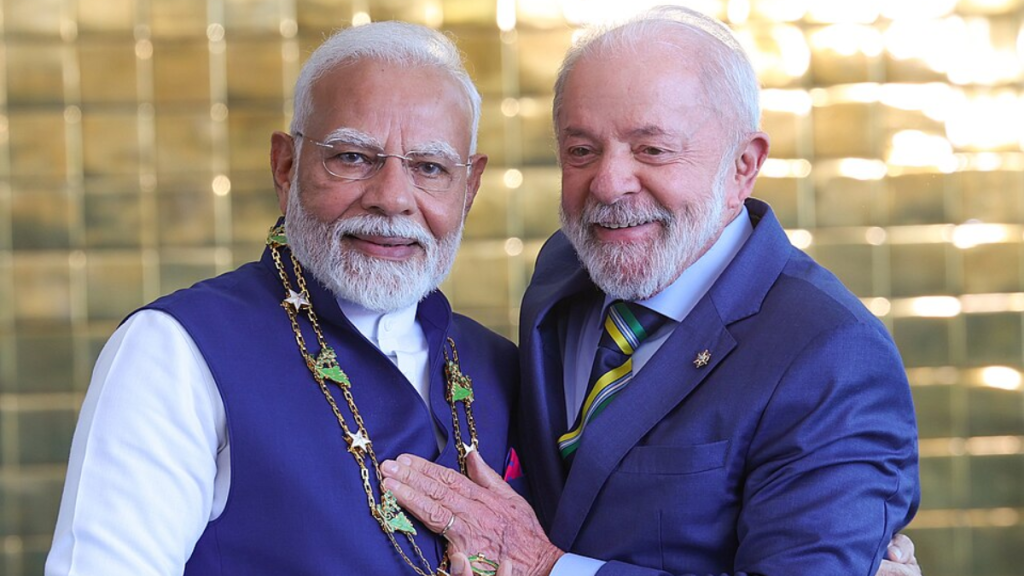
New Delhi: The Brazilian president, Luiz Inacio Lula da Silva, has secured an unprecedented fourth presidential term after defeating the far-right senator, Flavio Bolsonaro, in Sunday’s runoff. According to Tribunal Superior Eleitoral, Lula received 51.79 per cent of valid votes, against Bolsonaro’s 48.21 per cent. The result keeps Latin America’s largest economy under left-wing leadership and marks a setback for the United States president, Donald Trump, conservative allies in the region.
The victory followed an unexpected first-round setback on October 4. Bolsonaro had secured 47.03 per cent of valid votes, compared with Lula’s 45.16 per cent, as RNA Media earlier reported. Lula eventually overturned a deficit of around 2.2 million votes and won by approximately 4.4 million votes. He became the first candidate in Brazil’s presidential election history to finish second in the first round and win the runoff.
The contest exposed deep divisions over economic policy, public security, corruption and Brazil’s international position. Lula’s victory also preserves his government’s emphasis on social welfare and an independent foreign policy.
From poverty to presidency
Lula’s journey to Brazil’s presidency began in Pernambuco, a poor northeastern state where he was born in 1945. He entered the workforce at a young age, earning money as a shoeshine boy and peanut seller. He later trained as a metalworker, but a factory accident in the 1960s cost him a finger. His work in the metal industry eventually led him into trade union activism, making him a prominent voice for workers during Brazil’s military dictatorship.
After three unsuccessful attempt Lula’s won his first election in 2002 and took office the following year. Re-elected in 2006, he oversaw a period of economic expansion and welfare initiatives that helped millions escape poverty.
Lula’s political career was affected by corruption investigations linked to state oil company Petrobras. In 2017, he was convicted in a corruption case and began serving a prison sentence in 2018. Brazil’s supreme federal court annulled his convictions in 2021, ruling that the court that handled the cases lacked jurisdiction. The court also upheld a finding that the judge overseeing one of the cases had been biased against Lula. The rulings restored his eligibility to contest elections.
In 2022, Lula defeated then-president Jair Bolsonaro in a closely fought election and returned to office in January 2023. His latest victory marks another major turnaround in a political career that has spanned more than four decades.
How Lula overcame setback
Lula’s age raised question about his health and ability to serve, prompting him to share videos of himself exercising and jogging to reassure voters about his fitness for office. He also increased his social media activity through informal videos and selfies.
His campaign focused on social welfare, including the Bolsa Família assistance programme, debt relief, free weekend public transport and student support. However, concerns over crime, corruption and living costs remained key issues.
Modi Congratulates Lula
The prime minister, Narendra Modi, on Monday congratulated Lula da Silva on his re-election, calling it a remarkable victory. Modi said he looked forward to working closely with Lula to strengthen the India-Brazil strategic partnership.
In his message, Modi said both countries would expand cooperation across various sectors and work together on the shared priorities of the Global South. He also stressed the need to build a more inclusive, equitable and sustainable world.
India and Brazil maintain close ties through BRICS, the G20 and the India-Brazil-South Africa (IBSA) forum. Their partnership covers trade, defence, energy, agriculture, space and digital technologies, with both countries seeking a greater role for developing nations in global decision-making.
Lula’s re-election provides an opportunity for New Delhi and Brasília to build on their existing ties. Both countries have also been working to expand bilateral trade and cooperation in critical minerals, while coordinating on international issues and the interests of the Global South.
How Lula’s victory could affect Trump
Lula da Silva’s victory is a setback for Trump, who had supported former president Jair Bolsonaro and his family. Trump defended Bolsonaro during his legal troubles and praised his son, Flávio Bolsonaro, after he performed strongly in the first round of voting. However, Trump did not publicly endorse a candidate.
Reuters earlier reported, that two US state department officials, Darren Beattie and Ricardo Pita, pushed measures aimed at weakening Lula and helping the Bolsonaro family return to power. After Jair Bolsonaro was sentenced to 27 years in prison, the officials reportedly shifted their support to Flávio. It was unclear whether the two officials were acting on the White House’s instructions.
Trade tensions have remained a key issue between Washington and Brazil. In July, Trump directed the imposition of a 25 per cent tariff on certain Brazilian goods under Section 301 of the Trade Act of 1974, according to the office of the US trade representative (USTR).
The USTR said the move followed an investigation into Brazil’s policies on digital trade, intellectual property, anti-corruption enforcement, ethanol market access and illegal deforestation, which Washington said unfairly restricted US commerce. The tariffs add to tensions between the two countries as Lula begins his new term.