


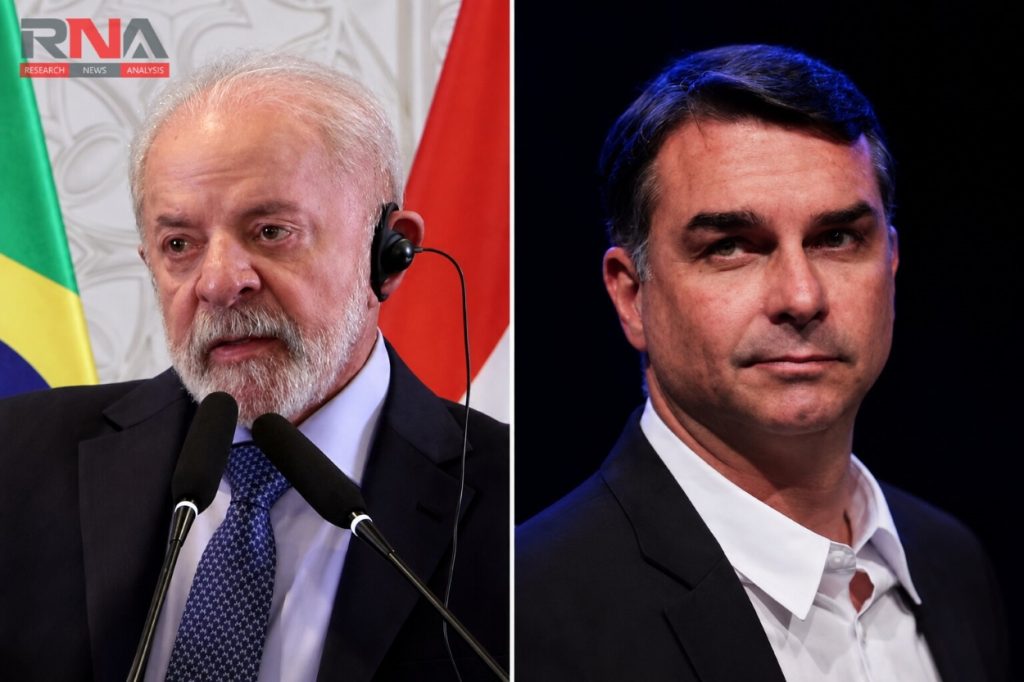
New Delhi: Brazilians voted on Sunday, in a closely contested presidential runoff between the leftist incumbent, Luiz Inacio Lula da Silva, and the far-right senator, Flavio Bolsonaro. The election offers sharply different choices on social welfare, public security and foreign relations, with the Bolsonaro family seeking a return to the presidency four years after losing power.
Bolsonaro entered the decisive vote after finishing ahead of Lula in the first round on October 4, overturning the order suggested by many opinion polls. He secured 47.03 per cent of valid votes against Lula’s 45.16 per cent – a lead of approximately 2.2 million votes, but short of the majority required for an outright victory.
The final surveys suggested that the contest remained open despite Bolsonaro’s numerical advantage. A Datafolha poll published on the eve of voting put him at 51 per cent of valid votes and Lula at 49 per cent, within its margin of error of two percentage points.
The distinction between valid votes and overall voting intentions matters because blank and invalid ballots do not count towards the result. Datafolha’s figures for all respondents were 48 per cent for Bolsonaro and 47 per cent for Lula, with the remainder undecided or intending to cast blank or invalid ballots.
Turnout has therefore become central to Lula’s effort to recover from his first-round setback, when abstention reached 21.08 per cent. His campaign has stepped up appeals to younger and poorer voters, while the final Datafolha survey showed Bolsonaro performing better among respondents considered more likely to vote.
The electoral divide also has a pronounced regional character, with Bolsonaro winning the southeast, south and centre-west in the first round. Lula prevailed in the northeast and north, making both the preservation of regional strongholds and gains in the populous southeast important to the outcome.
For Lula, the economic challenge has been to persuade households that improvements in employment and inequality outweigh the pressure of expensive essentials, debt and insecurity. Bolsonaro has used those frustrations to argue for a change of government, while Lula has defended his social programmes and promised additional help for indebted families.
Lula’s campaign has offered debt relief, free weekend public transport and assistance for students, combining immediate household support with his record on poverty reduction. Bolsonaro has emphasized spending cuts and stronger action against criminal gangs, seeking to attract voters dissatisfied with both economic conditions and public safety.
The political future of Bolsonaro’s father, the former president, Jair Bolsonaro, remains a defining issue in the contest. Lula defeated him in 2022, and his subsequent conviction for plotting to overturn that result has made his son’s promise to secure his release a major campaign commitment.
According to Le Monde’s examination of the runoff campaign, Flávio Bolsonaro has also advocated constitutional changes and the removal of supreme court judges whom he accuses of persecuting his father. These proposals have intensified concerns among opponents about institutional checks on presidential power, while his campaign presents its programme as a response to judicial overreach and entrenched insecurity.
The next president will face a Congress strengthened on the right by the legislative elections held alongside the first round. That balance could help Bolsonaro advance his agenda or make it more difficult for Lula to negotiate legislation if he wins another term.
Foreign policy provides another dividing line, with Bolsonaro favouring closer relations with the US president, Donald Trump, and Lula emphasizing Brazilian sovereignty. Lula has accused Washington of attempting to influence the election, an allegation the US administration denies.
For India, the result concerns a strategic partner with which it works through BRICS, the G20 and the India-Brazil-South Africa dialogue forum. Cooperation in defence, energy, agriculture, space and digital technologies gives New Delhi interests that extend beyond the political preferences of either candidate.
Voting across Brazil follows a synchronized schedule of 8am to 5pm Brasília time, with those already queuing at the deadline entitled to cast their ballots. Results can be followed through the electoral court’s official results portal after polling closes – 1.30am IST on Monday.