


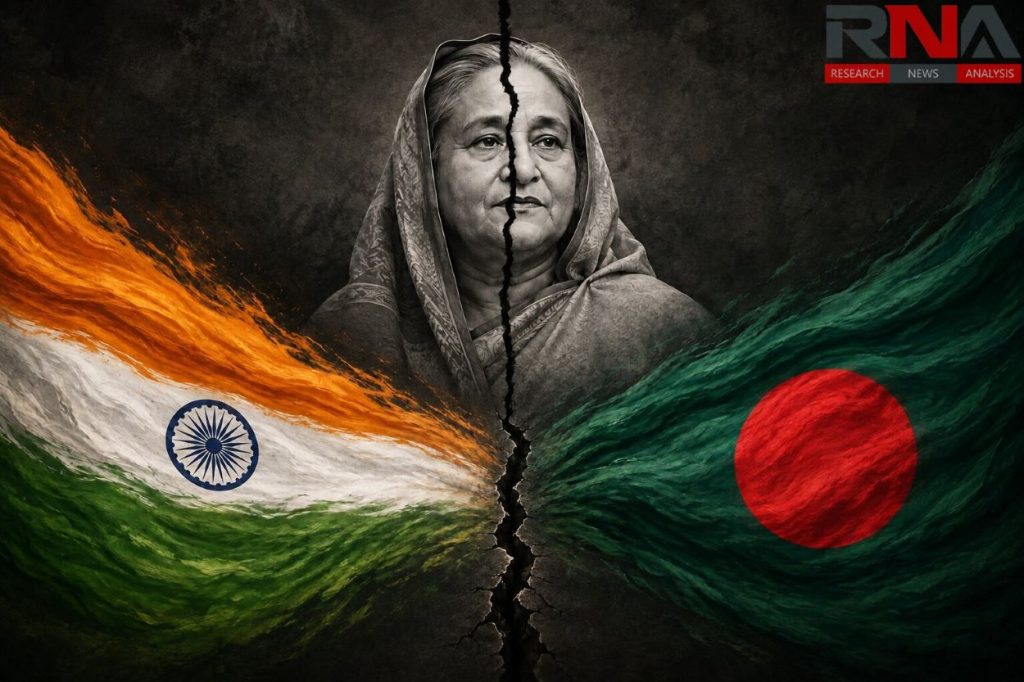
New Delhi: Bangladesh has said it is in no hurry to send the prime minister, Tarique Rahman, to India, signalling that efforts to repair one of South Asia’s most consequential bilateral relationships remain stuck over political trust and the future of Sheikh Hasina. Dhaka says it wants constructive ties with New Delhi but will not arrange a summit merely to create the appearance of normalization before substantive differences have been addressed.
The country’s junior foreign minister, Humaiun Kobir, said on Saturday that preparations and negotiations must precede any meeting between the two prime ministers. While responding to queries from journalists after paying homage to the fallen during the 1971 Liberation War at the Bangladesh National Memorial in Savar, which is about 24 kilometres (15 miles) northwest of Dhaka, Kobir said “There is no rush here,” adding that Rahman could travel within weeks if the two sides reached an understanding consistent with Bangladesh’s national interests.
Kobir said Dhaka wanted a “positive and effective” relationship with India because geography made sustained engagement unavoidable. However, he argued that bilateral cooperation could not be advanced by compromising Bangladesh’s sovereignty or disregarding the expectations of its people.
His comments followed weeks of speculation that Rahman could make his first official visit to New Delhi between August 23 and 25 after taking office in February. Rahman’s media secretary, AAM Saleh, subsequently said that no decision had been taken, while New Delhi declined to confirm any dates.
As RNA Media had reported earlier, India has invited Rahman for a bilateral visit as well as the BRICS summit scheduled in New Delhi on September 12 and 13. Dhaka has not rejected either invitation, but its public insistence on a “conducive” or “propitious” environment suggests that it wants movement on politically sensitive matters before committing to a high-profile engagement.
Foremost among them is Bangladesh’s demand for the extradition of the former prime minister, Sheikh Hasina, who fled to India on August 5, 2024, as a student-led uprising ended her 15-year rule. Hasina was sentenced to death in absentia in November 2025 for her alleged role in the violent suppression of the protests, although she has rejected the proceedings as politically motivated.
Bangladesh has repeatedly asked India to return Hasina and other people wanted in criminal cases, citing the extradition treaty between the two countries. New Delhi has acknowledged receiving the requests and says they are being examined under Indian law and established legal procedures.
The immediate setback came after Hasina addressed journalists in New Delhi on August 5 demanded the restoration of her banned Awami League and said she intended to return to Bangladesh in December. Dhaka condemned the event as an affront to its sovereignty and argued that allowing a convicted former leader to conduct political activity from Indian territory was incompatible with friendly relations.
The Ministry of External Affairs said the interaction had been organized by a private media organization and that the Indian government had neither arranged it nor endorsed Hasina’s remarks. That clarification was welcomed in Dhaka as a beginning, but it did not remove the wider dispute over her continued presence and political activity in India.
Kobir said the extradition question was not a newly invented precondition but an existing bilateral issue tied to public sentiment in Bangladesh. In a separate interview with the state-run Bangladesh Sangbad Sangstha, he argued that a prime-ministerial visit would require mutual trust, respect for sovereignty, diplomatic preparation and what he described as a dignified invitation.
New Delhi has responded in similarly measured but firm language. The external affairs minister, S Jaishankar, said on Saturday that a sustainable relationship must satisfy the test of mutual interest, meaning it must work for Bangladesh as well as India rather than exclusively serving either side.
The parallel statements show that both governments recognize the cost of prolonged estrangement, but they also reveal different definitions of what must happen first. India appears to favour top-level engagement as a means of resolving disagreements, while Bangladesh wants sufficient progress on those disagreements to justify the engagement domestically.
Why normalization is proving harder this time
India and Bangladesh have overcome serious disputes before, including disagreements over river waters, undocumented migration, border deaths, trade imbalances, insurgent sanctuaries, maritime jurisdiction and access to transit facilities. Even when political relations deteriorated, the disputes were generally treated as specific policy problems that could be negotiated, deferred or separated from cooperation in other fields.
The present crisis is different because it concerns not merely policy but the political legitimacy of the order that replaced Hasina. For many participants in the 2024 uprising, India is associated not only with a neighbouring government but with the external power that remained close to Hasina as her rule grew increasingly authoritarian.
That perception, whether accepted by New Delhi or not, has transformed India into an issue in Bangladesh’s domestic political debate. A Chatham House analysis noted that India’s close identification with the Awami League fuelled allegations that it enabled Hasina’s government and neglected engagement with other political forces.
Hasina’s presence in India gives that historical grievance a continuing and highly visible form. Previous disputes could be handled through technical committees or diplomatic compromises, but her extradition involves criminal law, political asylum, competing accounts of the 2024 violence and the survival of the Awami League as a political organization.
Neither government therefore has an easy compromise available. Extraditing Hasina could expose India to criticism that it abandoned a long-standing partner without ensuring a judicial process it regards as credible, while refusing indefinitely would allow Rahman’s opponents to accuse his government of failing to defend Bangladesh’s sovereignty.
Domestic politics further narrows Rahman’s room for manoeuvre despite the Bangladesh Nationalist Party’s commanding parliamentary majority. Post-uprising organizations and Jamaat-e-Islami have gained political space, and any hurried summit with India could be portrayed as a return to the unequal relationship that Hasina’s opponents say existed before August 2024.
India faces domestic pressures of its own, particularly over attacks on Hindus and other minorities in Bangladesh, illegal migration and security along the 4,096-kilometre border. Bangladeshi authorities maintain that many attacks described as communal were connected to political reprisals, but the violence and intimidation have nevertheless become important issues in Indian public and parliamentary debate.
The border has also acquired a sharper political character because of fencing disputes and allegations that people have been forcibly sent into Bangladesh without formal nationality verification. Although the border forces agreed in June to coordinate patrols and improve intelligence-sharing, Dhaka’s allegations over attempted “push-ins” have reinforced the belief that India sometimes relies on geographic and economic asymmetry instead of negotiated procedures.
Economic measures that might once have remained administrative matters are now interpreted through this trust deficit. India withdrew a transshipment facility for Bangladeshi exports in April 2025 and later restricted the entry of several Bangladeshi products through land ports, while Dhaka had already imposed limitations affecting some Indian goods.
These actions have not dismantled economic interdependence, but they have weakened its role as a political stabilizer. Bangladesh continues to depend on Indian supplies of electricity, fuel, food, cotton and industrial inputs, while India benefits from transit, connectivity and access through Bangladesh that can significantly reduce the cost of linking its northeastern states to the mainland and the Bay of Bengal.
Strategic competition adds another layer that was less pronounced during earlier periods of tension. China has long been Bangladesh’s largest defence supplier and a major infrastructure partner, but its prospective involvement in the Teesta basin, ports and other strategically located projects has attracted growing concern in New Delhi.
Dhaka is simultaneously rebuilding relations with Pakistan and considering broader economic or defence arrangements involving Pakistan, Saudi Arabia and Türkiye. Bangladesh describes this as a balanced “Bangladesh First” foreign policy, but New Delhi fears that China and Pakistan could exploit the bilateral rupture to expand their political and security presence on India’s eastern flank.
The river-water question is also becoming more urgent rather than easier to postpone. The 30-year Ganges Water Sharing Treaty expires in December 2026, while an agreement on the Teesta remains blocked despite years of negotiations and its importance to agriculture in northern Bangladesh and West Bengal.
Bangladesh said in August that it was awaiting India’s response to a proposal for fresh talks on the Ganges treaty, according to the Daily Star. Failure to produce a credible renewal framework would reinforce Dhaka’s longstanding complaint that India expects security and connectivity concessions while moving too slowly on issues central to Bangladesh.
Past normalization was possible partly because leaders could compartmentalize contentious questions and demonstrate progress elsewhere. The 1996 Ganges treaty survived political hostility, the two countries accepted the 2014 maritime arbitration award, and India’s Parliament unanimously enabled the 2015 Land Boundary Agreement, resolving the enclave problem after decades of delay.
From 2009, Hasina’s government also acted against insurgent networks that had used Bangladeshi territory against India and permitted expanded road, rail, river and port connectivity. In return, New Delhi supplied power, credit and development assistance, although the failure to conclude the Teesta agreement remained a significant source of resentment.
That model delivered practical gains but became too dependent on personal trust between the two leaderships and insufficiently rooted in broader political consent inside Bangladesh. When Hasina fell, much of the diplomatic architecture associated with her government lost legitimacy in the eyes of those who believed India had prioritized access and security over Bangladeshi democracy.
The current relationship consequently lacks the shared political foundation that once allowed unresolved problems to be managed. Every technical disagreement – whether over trade, visas, water, fencing or fugitives – is now interpreted as evidence in a larger argument about sovereignty, interference and unequal power.
A durable reset will require both countries to move away from a relationship identified with particular parties or leaders. India will need sustained engagement with Bangladesh’s full political spectrum, while Dhaka will have to provide credible reassurance on minority protection, border security and the prevention of anti-India militant activity.
Progress is more likely to emerge through a sequence of limited, verifiable agreements than through a single summit. Cooperation on the Ganges treaty, formal procedures for returning undocumented migrants, the restoration of selected trade facilities and restraint over political activity by exiled figures could gradually rebuild enough confidence for a Rahman visit.
Geography and economics make permanent estrangement unrealistic, but they do not make reconciliation automatic. The two countries have previously normalized relations by bargaining over disputes; this time, they must first rebuild the political trust that makes bargaining possible.