


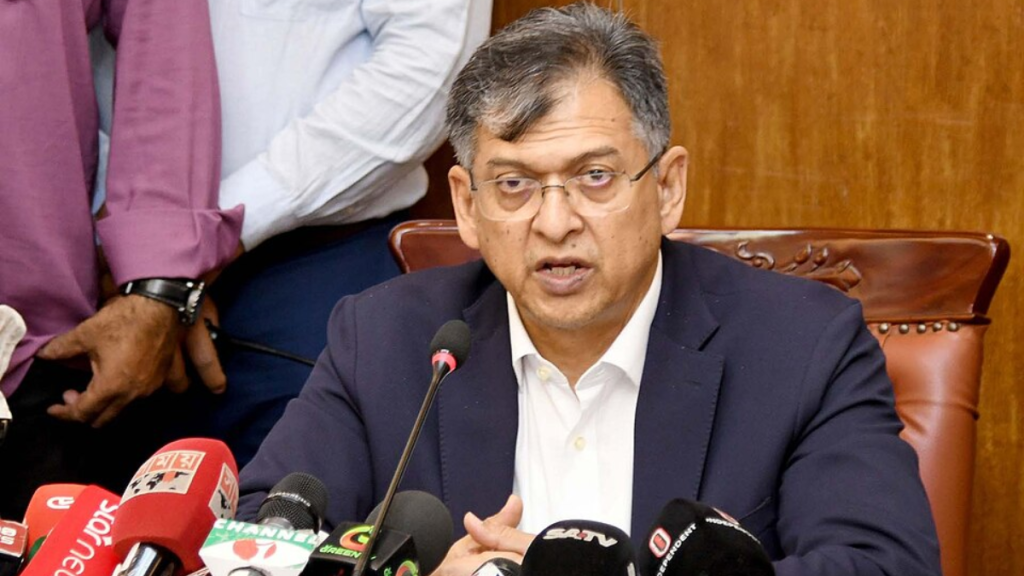
New Delhi: Bangladesh’s home minister, Salahuddin Ahmed, has criticized India over Sheikh Hasina’s political statements from Indian soil. He said allowing the ousted prime minister to speak to the international media while seeking friendly ties with Dhaka was contradictory.
Speaking at Dhaka University on Saturday, Salahuddin said Bangladesh wanted stable relations with India but expected those ties to be based on equality, sovereignty and mutual respect. He argued that continued political statements by Hasina from India were creating an obstacle to that relationship.
“Those two things are contradictory,” Salahuddin said, referring to India’s ties with Bangladesh and what he called the “Hasina card”.
He said, “You [India] will play the ‘Hasina card’ while seeking a friendly relationship with Bangladesh. Those two things are contradictory. I hope the Indian authorities and government understand this.”
The comments followed Hasina’s media interaction in New Delhi on Wednesday, when she spoke publicly to journalists for the first time in a full news conference since leaving Bangladesh in August 2024. Joining remotely from the United States, her son Sajeeb Wazed Joy also used the interaction to attack the political direction of Bangladesh under the post-Hasina administration.
Hasina said she intended to return to Bangladesh in December and was ready to face arrest or imprisonment. She also called for the restoration of media freedom, judicial independence and constitutional order, while maintaining that her return would be aimed at correcting the country’s political course rather than seeking office.
As RNA Media reported earlier, Joy made a more direct warning about Bangladesh’s security environment, alleging growing space for Islamist groups and Pakistani intelligence influence. He said Bangladesh could become “another Pakistan” on India’s eastern frontier and warned that the country could become a source of future terrorism.
Hasina has been staying in India since fleeing Bangladesh in August 2024 following the fall of her government.
Salahuddin, however, questioned why India continued to provide Hasina a platform despite the allegations against her. Referring to a UN finding that more than 1,400 people were killed during the 2024 crackdown, he asked whether India could still regard her as a figure of democratic culture.
Dhaka has strongly objected to the appearance, while India has maintained that the event was not a government programme. As RNA Media had reported on Friday, MEA spokesman Randhir Jaiswal said New Delhi had neither organized nor participated in the private media event and did not endorse statements made there about Bangladesh.
Salahuddin said that explanation addressed only part of Dhaka’s concern. He questioned why Hasina, whom Bangladesh accuses of responsibility for the deadly crackdown on the 2024 protests, continued to receive a platform to communicate with international audiences from India.
He also rejected attempts to draw a parallel between Hasina’s presence in India and BNP leader Tarique Rahman’s political activities while he was based in London. Salahuddin said the circumstances of the two leaders’ exile were fundamentally different.
The dispute comes as India is simultaneously attempting to build a working relationship with Rahman’s government. RNA Media had reported on August 4 that Jaiswal confirmed New Delhi had invited the Bangladeshi prime minister, Tarique Rahman, for a bilateral visit following his assumption of office in February.
Rahman has separately been invited to the BRICS outreach session in New Delhi on September 12-13. India has said the invitation follows the established practice of inviting leaders of regional groupings, with Rahman attending in his capacity as Bimstec chair. His participation in the summit has not been confirmed so far.