


New Delhi: India and New Zealand have taken another step towards converting their recently upgraded strategic partnership into practical defence cooperation, placing maritime security and joint training at the centre of high-level talks in Wellington. The second India-New Zealand Defence Strategic Dialogue, held on Monday, also reviewed progress towards implementing the two countries’ Roadmap to 2030.
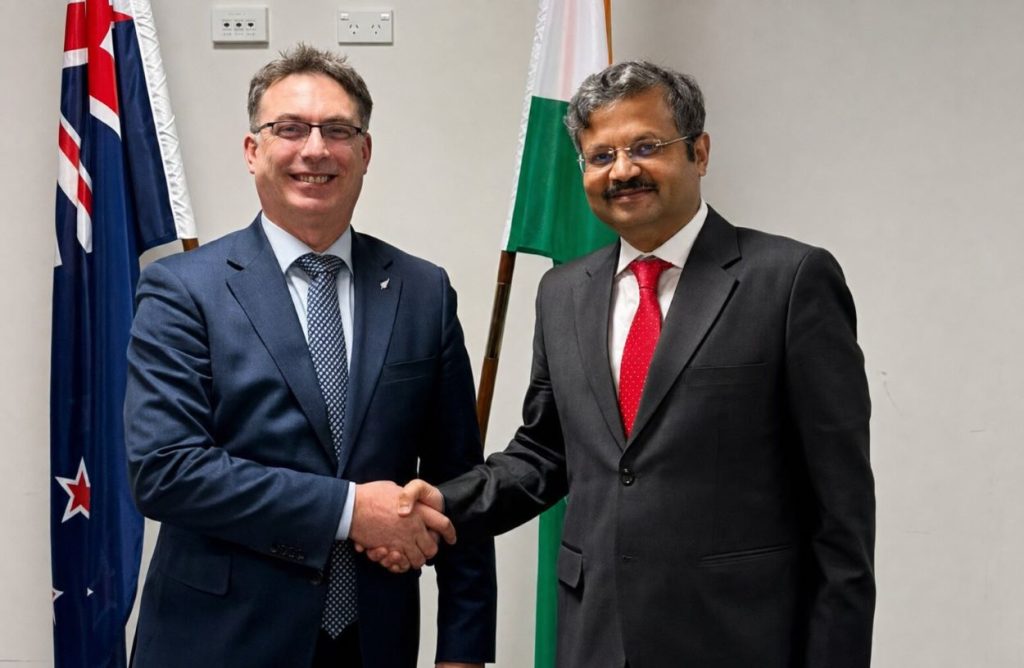
A joint secretary in Ministry of Defence, Amitabh Prasad, and a deputy secretary in New Zealand’s defence ministry, Richard Schmidt, co-chaired the dialogue. The Indian delegation was received by the high commissioner of India to New Zealand, Muanpuii Saiawi.
The MoD said the discussions were aimed at advancing maritime security, defence cooperation and joint training while supporting the objectives laid down in the bilateral roadmap. Its brief account did not announce any new agreement, suggesting that the meeting was primarily intended to identify areas for implementation and sustain institutional contact between the two defence establishments.
The roadmap was unveiled on July 11 when the prime minister, Narendra Modi, and his New Zealand counterpart, Christopher Luxon, elevated bilateral relations to a strategic partnership during talks in Auckland, as RNA Media had reported at that time. Modi’s visit was the first by an Indian prime minister to New Zealand in four decades and gave political impetus to a relationship that had traditionally been driven by trade, education, migration and cricket.
Defence and security form one of the six pillars of the Roadmap to 2030, alongside political engagement, trade, people-to-people relations, technology and regional cooperation. The framework envisages military exercises, visits by naval, land and air units, short-term personnel exchanges, staff-college cooperation and more frequent high-level defence consultations.
The two countries also intend to establish an annual Maritime Security Dialogue and expand navy-to-navy engagement, including through a regular bilateral naval exercise. Other priorities include counterterrorism, cyber security, action against narcotics trafficking, law-enforcement cooperation and disaster resilience.
The Wellington meeting builds on a memorandum of understanding on defence cooperation signed during Luxon’s visit to India in March 2025. That agreement provided a framework for strategic dialogue, defence-industry engagement, technology discussions, education and military training, with the inaugural India-New Zealand Defence Strategic Dialogue subsequently held in New Delhi on August 5, 2025.
Naval engagement has already supplied much of the substance to the emerging relationship. The chief of the Royal New Zealand Navy, Rear Admiral Garin Golding, accompanied Luxon to India in March 2025, met the chief of the naval staff, Admiral Dinesh K Tripathi, and joined the New Zealand leader during a visit to the Indian Navy’s indigenously built destroyer INS Surat in Mumbai.
The Royal New Zealand Navy frigate HMNZS Te Kaha was also in Mumbai during Luxon’s visit, providing an operational backdrop to the political discussions. India and New Zealand had earlier signed an agreement on the exchange of white-shipping information, enabling the sharing of data on commercial maritime traffic and improving awareness of potentially suspicious activity at sea.
The two navies have also worked together in Combined Task Force 150, the Bahrain-based multinational maritime formation that monitors some of the world’s busiest sea lanes and counters illicit trafficking. Five Indian Navy personnel, including the task force’s deputy commander, served on its staff when the Royal New Zealand Navy led the formation between January and June 2025.
Although India and New Zealand are geographically distant, both depend heavily on secure sea routes and an open maritime trading system. India occupies a pivotal position in the Indian Ocean, while New Zealand sits in the South Pacific and maintains strong security relationships with Australia, the United States and other regional partners.
For New Delhi, closer cooperation with Wellington complements its wider effort to strengthen maritime partnerships across the Indo-Pacific without entering a formal military alliance. Engagement with New Zealand can improve information-sharing, interoperability, humanitarian-assistance capabilities and coordinated responses to illegal fishing, trafficking, natural disasters and other non-traditional security threats.
For Wellington, India offers a growing political, economic and maritime partner whose Navy has an extensive presence across the Indian Ocean. New Zealand has said its security and prosperity depend on a stable Indo-Pacific, making practical cooperation with India increasingly relevant as strategic competition and pressure on regional sea lanes intensify.
The India-New Zealand Defence Strategic Dialogue therefore represents more than another diplomatic consultation, although the eventual value of the process will depend on measurable follow-through. Regular exercises, training exchanges, maritime-domain awareness and workable arrangements between the two navies will determine whether the strategic partnership develops an operational character or remains principally a political declaration.