


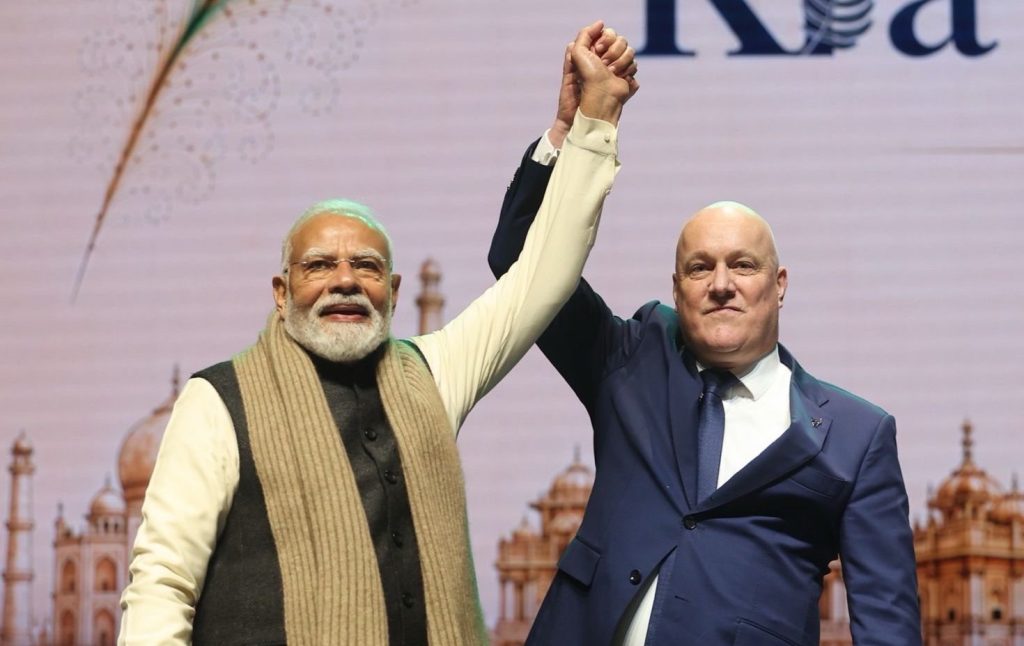
New Delhi: The prime minister, Narendra Modi, and his New Zealand counterpart, Christopher Luxon, on Saturday elevated bilateral relations to a strategic partnership and exchanged 18 agreements and arrangements spanning defence, maritime security, disaster management, culture and sport. The outcomes capped the first visit by an Indian prime minister to New Zealand in four decades.
The visit formed the final leg of Modi’s three-nation Indo-Pacific tour, which earlier took him to Australia for the third Australia-India Annual Leaders’ Summit in Melbourne with Anthony Albanese. That meeting produced its own package of agreements on critical minerals, clean energy and regional security, with a target of taking bilateral trade to $100 billion by 2030.
Modi landed in Auckland on Friday evening, where Luxon received him at the airport with a guard of honour and an embrace. On Saturday morning, Modi was accorded a traditional Maori powhiri ceremonial welcome at Government House, an experience he later described on X as “a moving reflection of New Zealand’s rich heritage and traditions”.
Delegation-level bilateral talks followed. “We will move forward across every sector with clear goals and concrete outcomes,” Modi wrote afterwards, listing trade, technology, investment, agriculture, dairy, food processing, healthcare and traditional medicine among areas covered. External affairs ministry spokesperson Randhir Jaiswal said the discussions covered trade and commerce, defence and security, education, sports and culture, and that the two leaders “decided to elevate the bilateral ties to strategic partnership”.
Defence and security outcomes
The two sides unveiled the “India-New Zealand Strategic Partnership: Roadmap to 2030”, a blueprint that places heavy emphasis on maritime security, counter-terrorism and cyber defence under what officials termed its Pillar II framework. An arrangement on mutual logistics support was signed between the Indian Navy and the New Zealand Defence Force, allowing each side access to the other’s bases for refuelling, repairs and replenishment during operations.
India and New Zealand also agreed to set up a joint working group on counter-terrorism to institutionalize intelligence-sharing, and to hold an annual maritime security dialogue led by the external affairs ministry and New Zealand’s ministry of foreign affairs and trade. New Zealand additionally nominated maritime security as its priority pillar under the Indo-Pacific Oceans Initiative, a move India welcomed, with both sides citing illegal, unreported and unregulated fishing as a shared concern. Neither leader referred directly to China in public remarks, though the broader contest over Indo-Pacific influence formed the backdrop to the security discussions.
Other agreements included a memorandum of cooperation between India’s National Disaster Management Authority and New Zealand’s National Emergency Management Agency, an arrangement on cultural cooperation built around the theme “Vikas bhi, Virasat bhi” (development along with heritage), and a joint action plan on sport covering rugby, rowing, athletics, golf and bowls. Arrangements on tourism and animal husbandry were also exchanged, according to the external affairs ministry’s list of outcomes.
Trade agreement and business engagement
The talks built on the India-New Zealand free trade agreement, signed in after what both governments called record-time negotiations of roughly nine months. Modi and Luxon set a target of doubling bilateral trade to seven billion New Zealand dollars, about ₹35,000 crore, by 2030. Luxon has previously said the deal would eliminate tariffs on 57 per cent of New Zealand’s exports to India from day one, with reductions phased in on the rest.
Addressing CEOs and business leaders at the “India-New Zealand: A Winning Partnership” event in Auckland, Modi said India was no longer only a consumer market. “India is not only a market; India is a launchpad for global growth,” he said, pointing to policy stability and reform-driven governance. At a separate business and sports engagement event, Modi thanked Maori business leaders, saying shared values around nature, community and sustainability between India and Maori could shape “a unique model of inclusive global trade”, and noted that specific provisions for Maori enterprises had been written into the FTA.
Diaspora event and protests
The day’s principal public engagement was the “Kia Ora Modi” community reception at Spark Arena, which ran from 4pm to 8.30pm and had sold out weeks in advance, with organizers expecting more than 10,000 attendees. The programme featured cultural performances representing Punjab and Tamil Nadu, a fusion of Carnatic and Hindustani classical music, and a rendition of Vande Mataram, which Modi called “a vibrant celebration of India’s rich cultural heritage” in a post on X. Luxon attended despite the event falling outside the formal state programme, and opposition Labour leader Chris Hipkins was also expected to call on Modi during the visit.
The reception was not without friction. More than 100 protesters gathered outside Spark Arena, including anti-immigration demonstrators from a group calling itself Remigration New Zealand, who called for reduced immigration, and Sikh separatist activists, with roughly 100 police officers deployed to manage the crowd, the New Zealand Herald reported. Modi supporters countered with chants outside the venue. Modi’s visit has also drawn comment from critics of his government in New Zealand’s academic community, who have linked it to concerns over Hindu nationalism and press freedom in India, even as they acknowledged the significance of the deepened trade relationship.
Kiwi-Indian economic activity contributed an estimated $37.3 billion to the New Zealand economy in the year to March 2025, according to figures cited by community organizations ahead of the visit, underlining the scale of the diaspora link that both governments sought to highlight through the day’s events. Modi was scheduled to depart Auckland later on Saturday night, concluding a compressed, Auckland-only itinerary that both sides described as a marked step up in a relationship largely dormant at the leader-to-leader level for four decades.