


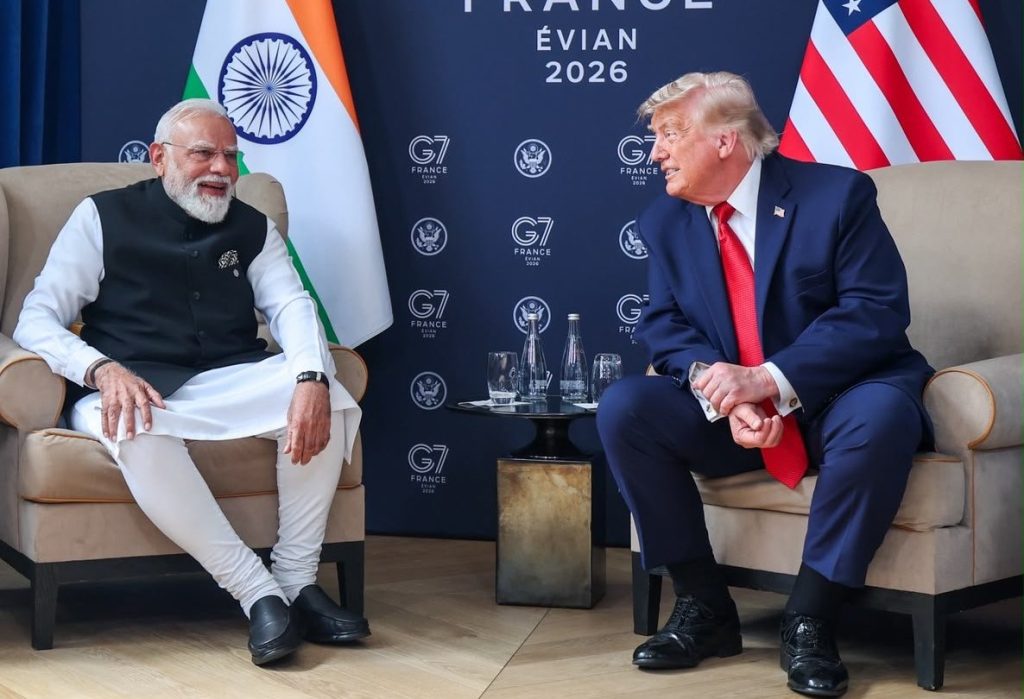
New Delhi: In a striking public endorsement of India-United States strategic ties, the US president, Donald Trump, said Washington would come to New Delhi’s assistance if India is attacked under the leadership of the prime minister, Narendra Modi. He made the remark during a meeting with Modi on the sidelines of the 52nd G7 Leaders’ Summit in Evian-les-Bains, France on Wednesday.
Responding to a reporter’s question on India-US defence relations, Trump said the bilateral relationship was “great” before offering what amounted to an informal security assurance.
“If they were attacked, we would be there to help them,” Trump said, gesturing towards Modi. “If anybody attacks that man, we’re going to be there. Now, if there’s a new leader, I’m not sure about it … But if they’re attacked and he’s the leader, we’re gonna be there to help.”
The comment was followed by a light-hearted exchange between the two leaders, who shared a low-five as journalists looked on.
Although the US and India do not have a mutual defence treaty comparable to Washington’s alliances with countries such as Japan, South Korea, Australia, or members of Nato, Trump’s remarks are likely to attract attention in strategic circles because of their unusually direct nature and because they come at a time of growing geopolitical competition in the Indo-Pacific.
The statement also underscored the increasingly close strategic relationship between New Delhi and Washington, which has expanded significantly over the past two decades through defence cooperation, technology partnerships, intelligence sharing, and growing military interoperability.
Remark amid expanding defence ties
Trump’s comments came during his first direct meeting with Modi in around 16 months. The interaction took place on the margins of the G7 summit, where global leaders discussed the war involving Iran, the future of energy security, sanctions on Russia, artificial intelligence governance, and broader geopolitical challenges.
India attended the summit as an outreach partner. This marked Modi’s seventh consecutive appearance at the G7 and India’s 13th participation as a guest nation.
The Modi-Trump meeting focused on a range of bilateral issues, including negotiations over a proposed India-US trade agreement and strategic cooperation.
While neither side announced any new defence pact, Trump’s remarks reflected the depth of a partnership that has steadily evolved through agreements such as the Logistics Exchange Memorandum of Agreement (Lemoa), the Communications Compatibility and Security Agreement (Comcasa), and the Basic Exchange and Cooperation Agreement (Beca), which have enabled closer military coordination and information sharing.
The two countries are also partners in the Quad grouping alongside Australia and Japan, a framework increasingly viewed as central to maintaining stability and balance in the Indo-Pacific region.
No obligation, but strong signal
Strategic analysts are likely to distinguish between Trump’s personal assurance and a formal American security commitment. Unlike treaty allies of the US, India remains a strategic partner rather than an alliance partner. Any military response by Washington in a future crisis involving India would still depend on decisions taken by the US administration and Congress at the time.
Even so, public statements by American presidents carry political and diplomatic weight. What makes Trump’s speech even more remarkable is that no American leaders had ever before used such language to indicate that their country would offer any security assurances to nations outside its alliance structure.
Read also: US restores Pacific Command name, raises questions over Indo-Pacific strategy
Furthermore, the significance of the timing should not go unnoticed since India was experiencing serious security dilemmas on its border with China as well as dealing with the repercussions of terrorism supported by Pakistan. Against that backdrop, Trump’s remarks are likely to be interpreted as a signal of continued American support for India’s role as a major security partner in Asia.
These remarks have followed the continued improvement of defence relations between the two nations. It is worth mentioning that the US has established itself as a key defence supplier to India, delivering a number of items from maritime surveillance aircraft to attack drones.
Cooperation has increasingly shifted beyond buyer-seller arrangements towards technology transfer, co-development, and joint production initiatives. Programmes involving jet-engine technology, advanced unmanned systems, semiconductor cooperation, and critical and emerging technologies have become major pillars of the relationship.
Ukraine, Iran, AI
The summit also produced renewed commitments by G7 countries to support Ukraine and tighten pressure on Russia’s energy sector through additional sanctions. To escalate pressure on the Russian war economy, G7 nations agreed to strengthen sanctions targeting the oil and gas sectors.
Trump announced on Tuesday that the US will soon be in a position to reimpose sanctions against Russian oil exports. European countries tried to impress on Trump during the meeting that the situation on the battlefronts has tilted towards Ukraine and that there needs to be a concerted effort by the G7 to negotiate with Putin.
One of the dominant themes was the emerging US-Iran peace framework intended to end the conflict that began in February this year. Trump informed fellow leaders that he expected the Strait of Hormuz to be fully reopened in the coming days and said the US had ordered an end to its blockade of Iranian ports as part of the evolving arrangement.
For India, any reopening of the Strait of Hormuz carries significant strategic and economic implications. The strait plays an important role not only in the transport of international crude oil but also in India’s energy imports. Stability in the region would help reduce pressure on energy markets and secure maritime supply routes.
Alongside geopolitical and economic discussions, as reported by RNA Media on Tuesday, the summit devoted unprecedented attention to artificial intelligence governance, bringing together world leaders and executives from leading AI firms to discuss regulation, safety, and digital security.
Implications for India
The Modi-Trump interaction took place against the backdrop of major international developments discussed at the summit. For New Delhi, Trump’s comments are likely to be viewed less as a formal policy declaration and more as a political signal regarding the direction of the bilateral relationship under his administration.
The traditional tendency in India was to shy away from joining any military alliances and to emphasize its strategic autonomy as one of the principles of foreign policy. Yet, it is true that relations between the US and India in terms of security have been gaining momentum due to the growing importance of China for both countries.
The public exchange between Modi and Trump, therefore, highlighted the extent to which India-US relations have moved beyond transactional engagement and become a central feature of the evolving security architecture in the Indo-Pacific.
Whether Trump’s remarks translate into specific policy initiatives remains to be seen. However, his willingness to publicly declare that the US would help India in the event of an attack is likely to be one of the most closely scrutinized moments of the summit from New Delhi’s perspective.