


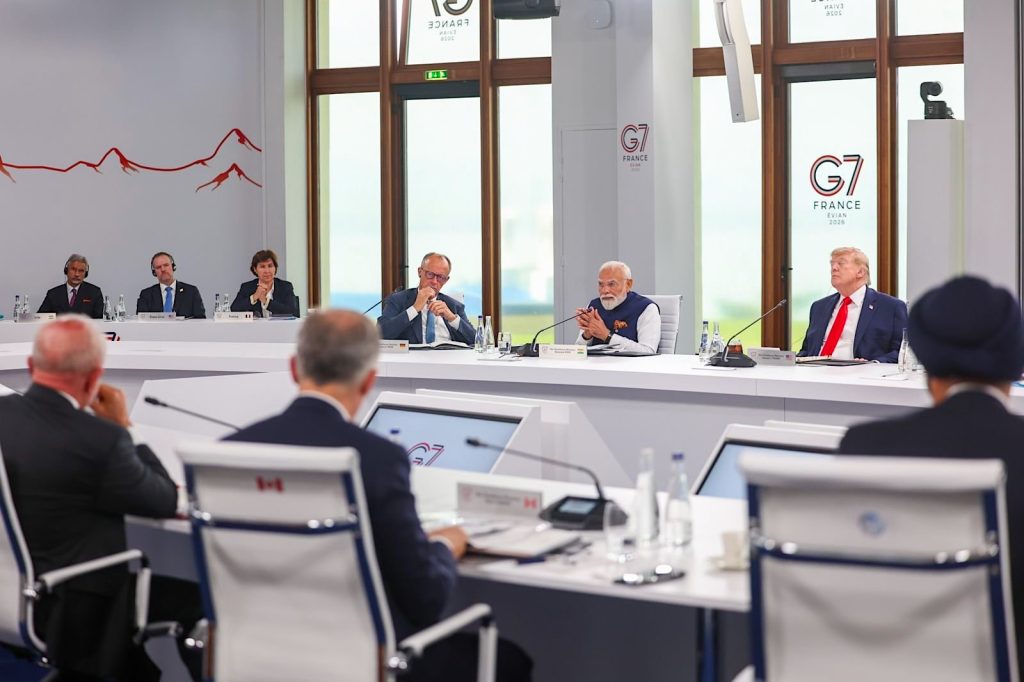
New Delhi: The 52nd G7 leaders’ summit, hosted by France in the resort town of Évian-les-Bains has opened on Monday against one of the most fraught strategic backdrops in the forum’s history. The G7 now has the daunting task of handling a still-smouldering United States-Iran war, a grinding fifth year of fighting in Ukraine, deepening anxieties about China’s industrial dominance, and a global race to regulate artificial intelligence before it outruns governance.
For India, present as an invited partner for the 13th time, the summit is as much a diplomatic proving ground as a policy forum.
Iran endgame and Hormuz
The single most consequential development at Évian is the preliminary US-Iran ceasefire and peace framework, announced ahead of the summit and hailed by the White House as a diplomatic triumph. The conflict, which erupted in February, has severely disrupted tanker traffic through the Strait of Hormuz, driving up energy costs across Asia and straining India’s import bill. The US president, Donald Trump, arriving in France with characteristic fanfare, told reporters that oil prices were already easing and pledged that the US naval blockade on the strait would be lifted by the week’s end.
European leaders, including the French president, Emmanuel Macron, have welcomed the ceasefire in principle but are using Évian to press for firm timelines, independent verification mechanisms and regional security guarantees before tanker traffic resumes at scale. The leaders of Egypt, Qatar and the UAE have joined the G7 for the Iran discussions, underscoring the regional stakes. For New Delhi, a durable resolution would ease immediate pressure on energy security and maritime operations in the Indian Ocean region, although South Block will be watching closely whether any constraints on Tehran push Iran further into the embrace of Beijing or Moscow.
Ukraine: European anxiety, American drift
The summit’s other dominant security thread is Russia’s war against Ukraine, now in its fifth year, with European capitals visibly unsettled by signs that Washington’s attention is shifting toward the Iran endgame. The Ukrainian president, Volodymyr Zelensky, is in Évian for a dedicated session on sustainable peace, at which European leaders are pressing Trump to resist any settlement that legitimizes Russia’s territorial seizures.
European Commission president Ursula von der Leyen has argued that Ukraine is now “on the front foot” – increasingly self-sufficient in advanced defence production, while Russian war-fighting capacity is eroded by sanctions. That narrative serves a clear purpose: to undercut the case for a hasty deal on Moscow’s terms. Yet there is a tacit acknowledgment among G7 diplomats that the forum must at least begin sketching parameters for eventual talks with the Russian president,Vladimir Putin, even if no formal roadmap emerges from Évian.
India, which has maintained ties with Russia through the war while publicly calling for dialogue and respect for territorial integrity, will parse any emerging settlement language carefully for openings that reduce escalation risk without endorsing aggression.
Economics of insecurity
Beyond the hot wars, Évian is grappling with a structural economic argument that France has placed at the centre of its presidency: that chronic global imbalances, like China producing too much, the US consuming too much, Europe investing too little, have become security vulnerabilities and not just macroeconomic curiosities. G7 finance ministers, meeting in Paris ahead of the summit, endorsed concerted action against the distorting effects of Chinese industrial overcapacity and non-market policies, and warned that current trade patterns pose systemic risks to financial stability and political cohesion.
The trade picture is complicated by the reality that Washington itself bears some responsibility for global imbalances. France has pushed this line pointedly, positioning the Évian summit as a moment for honest reckoning rather than a simple anti-China communiqué. Leaders are expected to endorse a menu of responses – targeted trade remedies, coordinated investment programmes, supply-chain resilience frameworks, although differences over how explicitly to adopt an “economic security” doctrine remain sharp, particularly between Brussels and Washington.
One area of relative consensus is critical minerals. G7 trade ministers have flagged serious concerns about economic coercion through selective export restrictions – a direct reference to China’s recent curbs on rare earths and processing materials. France is advocating a “common toolbox” covering joint procurement, price-floor mechanisms, diversification requirements and support for mining and refining projects with trusted partners.
India’s recent bilateral critical-minerals initiative with France positions New Delhi as a natural interlocutor in this effort, and as a potential processing hub that can help G7 economies derisk supply chains without simply transferring dependence from one bloc to another.
Modi’s agenda and bilaterals at Évian
The prime minister, Narendra Modi, arrived in Évian on Tuesday after a state visit to Slovakia, and joined partner leaders from South Korea, Brazil and Kenya for the summit’s outreach sessions. The External Affairs Ministry has billed this as Modi’s seventh consecutive G7 participation – a figure New Delhi deploys as evidence of India’s growing centrality to conversations that the rich democracies can no longer conduct among themselves.
India’s stated priorities at Évian cluster around four themes: energy security and equitable transition pathways, AI governance grounded in digital public infrastructure, resilient supply chains for critical minerals, and the disproportionate vulnerability of global south economies to crises manufactured elsewhere. Modi’s formal engagements cover three outreach sessions on international solidarity, balanced economic growth and the governance of artificial intelligence.
The most closely watched engagement, from an Indian foreign-policy perspective, is the bilateral with Trump – their first in-person meeting in roughly 16 months. Both sides have trailed an agenda focused on progress toward an India–US trade deal, supply-chain resilience and broader security cooperation. Trump’s schedule places Modi alongside meetings with the UAE president and the South Korean leader, a sequencing that reflects the strategic weight Washington assigns to New Delhi even as the White House navigates difficult relationships with traditional allies.
Interestingly, Modi and Trump were already seen exchanging words on the summit sidelines – the kind of image that gets analysed intensely in both capitals.
Beyond Washington, India has also flagged likely bilaterals with the UK prime minister, Keir Starmer, where the post-Brexit trade relationship and Indo-Pacific security cooperation are on the table; and the Canadian prime minister, Mark Carney, as Ottawa and New Delhi work to stabilize ties that deteriorated sharply after 2023.
Governing the algorithm
Artificial intelligence is the third structural pillar of France’s G7 presidency, which is a reflection of both the technology’s transformative economic promise and its risks for labour markets, security and social cohesion. In a notable move, Macron has invited senior technology executives, including OpenAI’s Sam Altman and Anthropic’s Dario Amodei, to closed-door exchanges with leaders on frontier AI capabilities, safety requirements and the enormous energy demands of large-scale model deployment.
India has consistently argued in G20 and G7 outreach settings for an AI governance framework that is human-centric, inclusive and avoids erecting barriers that lock developing countries out of AI-driven growth. That position aligns with European concerns on safety and ethics while stopping well short of any restrictive regime. Évian offers New Delhi a platform to reinforce this stance as the G7 begins to institutionalize AI governance into mainstream summitry.
What Évian signals
Even without a single joint communiqué – an outcome G7 negotiators have already flagged as unlikely, given sharp transatlantic differences – Évian is likely to lock in three trajectories that matter significantly for India. First, a move toward more formalized economic-security frameworks among wealthy democracies, with critical minerals and supply chains at the core. Second, a gradual but real integration of AI governance into the summit architecture. Third, a rhetorical – if not yet adequately financed – commitment to addressing the global south’s grievances on debt restructuring and development finance.
India’s task is to work these processes from inside the room as an invited partner, without being drawn into an overt west-versus-rest alignment that would undercut its carefully maintained strategic autonomy. How Modi handles the optics and substance of his Trump meeting – and whether it produces any tangible movement on the trade deal or defence technology cooperation – will be studied closely in Delhi’s policy circles as a measure of India’s capacity to shape the emerging order rather than simply adapt to it.