


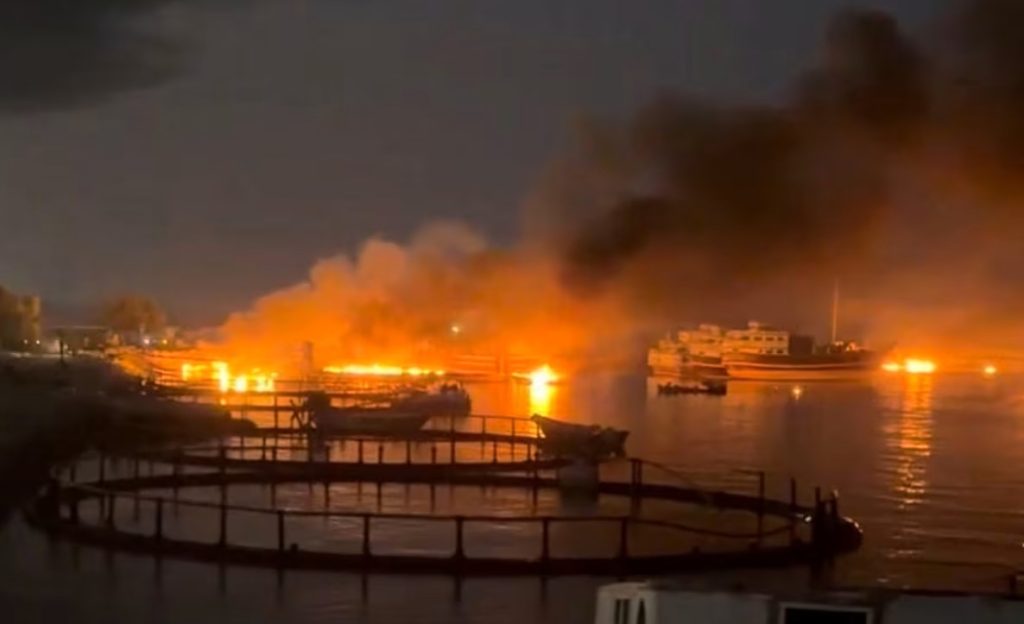
New Delhi: The United States and Iran moved deeper into direct confrontation over the past 24 hours, exchanging fresh military strikes that have further eroded hopes of restoring a fragile interim agreement reached only weeks ago. The latest round of hostilities has expanded the conflict beyond Iranian territory, drawing Bahrain and Kuwait into the firing line and raising renewed concerns over the security of the Strait of Hormuz, the world’s most important energy chokepoint.
Washington launched a second consecutive day of large-scale air operations against military targets inside Iran after accusing Tehran of orchestrating attacks on commercial shipping in the Strait of Hormuz earlier this week. According to the United States Central Command (Centcom), the strikes were aimed at degrading Iran’s missile, drone, naval and logistics capabilities that it said were being used to threaten maritime traffic.
Reports indicated that around 90 military targets were struck, including facilities linked to the Islamic Revolutionary Guard Corps (IRGC), air-defence systems and military infrastructure in southern Iran.
Iranian authorities reported casualties from the attacks, saying at least 14 people had been killed and dozens injured, although independent verification of those figures remains difficult. Explosions were reported near Bandar Abbas, Sirik and areas close to the Bushehr nuclear power plant, while damage was also reported to transport infrastructure.
Tehran responded within hours by launching missiles and drones towards US military facilities in Bahrain and Kuwait. Air-defence systems in both Gulf states intercepted most of the incoming projectiles, triggering air raid sirens and emergency alerts before dawn. Bahrain’s interior ministry instructed residents to seek shelter, while Kuwait’s armed forces confirmed that its air-defence network had intercepted multiple aerial threats. There were no immediate reports of major casualties or significant damage.
The IRGC said it had targeted the headquarters of the US Fifth Fleet in Bahrain and Ali Al Salem Air Base in Kuwait in retaliation for what it described as American aggression. Iranian state media also claimed that a US MQ-9 Reaper drone had been shot down during the operation, although Washington had not confirmed that claim at the time of writing.
The military exchanges effectively shattered any remaining confidence in the interim understanding negotiated in June to halt direct hostilities between Washington and Tehran. The agreement had already come under severe strain after attacks on three commercial tankers in the Strait of Hormuz, which Washington blamed on Iran.
The president of the United States, Donald Trump, declared that the interim arrangement was no longer valid.
“The interim agreement is over,” Trump told reporters on Wednesday, and accused Iran of violating its commitments. He warned that any further attacks would invite a much stronger American military response. He added that Tehran had been “behaving very badly” and indicated that the US had no intention of easing pressure unless Iran fundamentally changed its conduct.
Speaking aboard Air Force One, Trump also claimed Iran still wanted negotiations but insisted Washington would respond with overwhelming force if further attacks continued. “If you strike us, we’ll strike back much harder,” he said, while adding that he did not believe the situation necessarily meant a prolonged regional war.
Iran, however, rejected Washington’s narrative, accusing the US of violating the ceasefire first through its latest bombing campaign.
The speaker of Iran’s parliament and senior negotiator, Mohammad Baqer Ghalibaf, wrote on social media: “The United States still has not learned that bullying and breaking its promises no longer come without consequences.”He added: “If you strike, you will be struck. The Strait of Hormuz will only open with Iranian arrangements, not American threats.”
Iranian officials also warned that further American military action would invite additional retaliation against US military assets across the Gulf, raising fears that regional bases hosting American forces could remain under sustained threat.
The latest escalation has also carried major economic implications. Although oil prices initially surged following the renewed strikes and fears over Hormuz shipping, markets later steadied as traders assessed that the waterway had not yet been completely disrupted. Brent crude remained elevated compared with earlier in the week, reflecting continued concern over the security of global energy supplies passing through the narrow maritime corridor.
The Strait of Hormuz handles roughly one-fifth of global oil trade, making any prolonged military confrontation there a matter of international concern. Shipping companies are reportedly reviewing transit schedules, while insurers continue to reassess war-risk premiums for vessels entering the Gulf.
As RNA Media reported earlier, alongside military operations, Washington has reinforced economic pressure on Tehran. The Trump administration has reinstated sanctions on Iranian oil exports and revoked provisions that had temporarily allowed limited Iranian oil sales under the June interim agreement. US officials argue that the measures are intended to deny Tehran financial resources following what Washington says were repeated violations of the accord.
Diplomatic efforts meanwhile appear to have stalled. Officials on both sides acknowledged that negotiations expected to follow the interim agreement are effectively suspended, with neither government indicating any immediate timetable for returning to formal talks. Analysts note that while both Washington and Tehran continue to leave the door open for eventual diplomacy, neither appears willing to make the concessions necessary to halt the current cycle of retaliation.
Regional governments have continued to monitor developments closely. Bahrain and Kuwait condemned attacks on their territories while maintaining close coordination with the United States over defensive measures. Gulf states remain anxious that a wider conflict could destabilize the region, threaten maritime trade and draw additional countries into direct confrontation.
For India, the renewed instability carries strategic significance beyond immediate security concerns. India imports a substantial portion of its crude oil from the Gulf, while millions of Indian nationals live and work across Bahrain, Kuwait, Saudi Arabia, the United Arab Emirates and Qatar. Any sustained disruption to shipping through the Strait of Hormuz would directly affect India’s energy security, freight costs and broader economic stability. As RNA Media reported earlier, at least nine India-bound oil tankers are stuck in the Gulf.
New Delhi has consistently urged restraint, dialogue and respect for international law while closely monitoring the safety of Indian citizens in the region.
With both sides continuing to exchange military blows and political rhetoric hardening, prospects for restoring diplomacy appear increasingly remote. The immediate concern for regional governments and global markets alike is whether the conflict remains limited to calibrated retaliation or expands into a broader confrontation capable of destabilizing the Gulf and disrupting one of the world’s most critical energy corridors.