


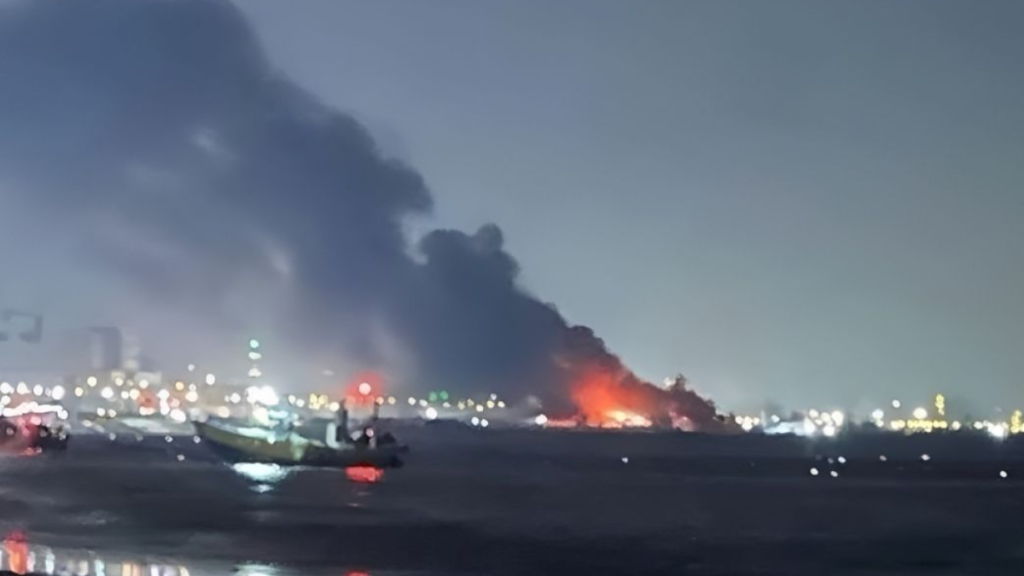
New Delhi: The fragile ceasefire between Washington and Tehran appeared to be unravelling on Wednesday after the US president, Donald Trump, declared the interim agreement with Iran “over” following a fresh exchange of strikes across the Gulf. The trigger was a wave of American strikes on more than 80 targets inside Iran, launched in retaliation for attacks on commercial ships in the Strait of Hormuz, as RNA Media reported earlier.
Tehran responded within hours and hit US military installations in Bahrain and Kuwait.
Trump, speaking on the sidelines of the Nato summit in Ankara, Turkey, said he still believed the ceasefire and the broader interim deal to end the war with Iran were finished, though he would let negotiators keep talking. “It’s just a waste of time dealing with them,” he said. He added that Washington had responded hard to the latest Iranian provocation: “We hit them very hard last night. I told them that every time you hit, we hit.”
The exchange began after Iran was accused of attacking three commercial vessels transiting the Strait of Hormuz on Monday and Tuesday. The ships involved were the Qatari-linked liquefied natural gas carrier Al Rekayyat and the Saudi-flagged crude tanker Wedyan, along with a third vessel whose flag state has been reported inconsistently across accounts.
One tanker caught fire off the coast of Oman, the United Kingdom Maritime Trade Operations centre said, while the other two sustained damage but continued their voyage. No casualties were reported. Iran did not directly claim the attacks, though its state television said one vessel had ignored warnings.
Qatar’s foreign ministry spokesman, Majed al-Ansari, called the strike on the Al Rekayyat an “unacceptable attack” on international navigation. He said Doha held Iran “fully legally responsible”.
The US Central Command (Centcom) said its forces “completed a new round of offensive strikes against Iran” late on Tuesday. It hit Iranian air-defence systems, command-and-control networks, coastal radar sites, anti-ship missile capabilities and more than 60 small boats belonging to the Islamic Revolutionary Guard Corps (IRGC) in and around the strait.
A US official told Axios the strikes were four to five times larger in scope than a similar round conducted 10 days earlier. Centcom said the action was meant “to degrade Iran’s ability to continue attacking international commerce flowing through the international trade corridor,” adding that its forces “remain postured and prepared to hold Iran accountable when the agreement is not adhered to or obeyed”.
Iran’s response came within hours. Air-raid sirens sounded across Bahrain, home to the US Navy’s Fifth Fleet, and Kuwait, which hosts US Army facilities.
The IRGC said it had struck 85 US military installations in retaliation for what it called strikes on “coastal bases and civilian stations” in Iran’s Hormozgan and Mahshahr areas. It warned of a “crushing response” to further aggression. Iran’s top joint military command, Khatam al-Anbiya Central Headquarters, called the US strikes a “blatant act of aggression” and said Tehran would not allow US interference in managing the strait.
Iran’s parliament speaker and chief negotiator, Mohammad Baqer Ghalibaf, accused Washington of multiple breaches of the ceasefire – citing the military strikes, the renewed oil sanctions, and Israeli strikes on Lebanon. “The era of bullying and extortion is over,” he wrote on X. “We don’t fold.”
Iran’s foreign ministry separately said Washington would “bear responsibility for the consequences” and vowed to take “any measure it deems necessary” to protect its interests.
Adding to the pressure, the US treasury on Tuesaday revoked a licence that had allowed Iran to sell crude oil and petrochemical products on the international market through August 21. The licence had been issued on June 22. The revocation takes effect immediately, though Iran has been given until July 17 to wind down existing transactions.
A US official said Iran’s conduct in the strait had been “wholly unacceptable” and would carry consequences. Tehran called the move a violation of the agreement it had reached with Washington. Oil prices rose more than 3 per cent following the announcement, reversing some of the price relief that had followed the original ceasefire.
Regional reaction was swift. The United Arab Emirates’ diplomatic adviser, Anwar Gargash, said Iran’s attacks on tankers and repeated strikes on Bahrain and Kuwait showed Tehran “remains incapable” of committing to de-escalation. Gulf Arab states, he added, “cannot remain a target for Iran’s wavering between the logic of escalation and the path of rationality.”
Qatar’s foreign ministry called the strikes on Bahrain and Kuwait a “blatant violation” of sovereignty and international law, and urged a return to dialogue.
US strikes come after ships hit in Hormuz
Wednesday’s exchange is the second round of tit-for-tat strikes in as many months. It comes at a delicate moment: Iran is in the middle of a week-long state funeral for its supreme leader, Ayatollah Ali Khamenei, 86, who was killed alongside several family members in the opening strikes of the war on February 28.
The funeral, which concludes on July 9, had been widely expected to bring a lull in hostilities. Instead, mourners at the procession have repeatedly called for the deaths of Trump and Israel’s prime minister, Benjamin Netanyahu.
The war itself began after the US and Israel struck Iranian nuclear and military sites in February, following the collapse of nuclear talks and a shorter conflict between Iran and Israel the previous year. Iran retaliated broadly, hitting US bases, shipping and, at various points, Gulf states including the UAE.
Both sides eventually agreed to an interim ceasefire, brokered with Pakistan’s involvement and formally signed by Trump and Iran’s president, Masoud Pezeshkian, on June 17. That agreement gave both sides a 60-day window to negotiate a permanent settlement and committed Iran to its “best efforts” to allow toll-free passage through the strait.
Indirect talks in Qatar last week ended without progress. A near-identical cycle of tanker attacks and US strikes on Bahrain and Kuwait had already occurred in late June.
The Strait of Hormuz remains the crux of the standoff. In peacetime, roughly a fifth of the world’s traded oil and gas passed through the 33km-wide channel.
Iran has insisted that only its own designated route through the strait is safe, and has been suspected of targeting vessels that instead hug the Omani coastline – the route used by the ships attacked this week. Tehran’s control over the waterway has given it significant leverage in talks with a militarily superior adversary, and analysts suggest Iran uses periodic attacks on shipping to remind Washington of that leverage even as it negotiates.
What it means for India
New Delhi has stayed formally neutral through the conflict but has not been insulated from it. Three Indian sailors were killed in June 2026 when a US strike hit a tanker off Oman, prompting the ministry of external affairs to summon the US chargé d’affaires. Earlier, three Indian nationals were injured in an Iranian drone strike on a UAE oil facility.
About 90 per cent of India’s LPG imports transit the Strait of Hormuz. The closure of the waterway earlier this year triggered a domestic cooking-gas crisis, with cylinder prices spiking and long queues at distribution centres across the country.
A renewed round of hostilities, and any fresh disruption to tanker traffic, would revive those concerns – both for Indian consumers and for the broader Asian energy market that depends heavily on Gulf supplies routed through the strait.