


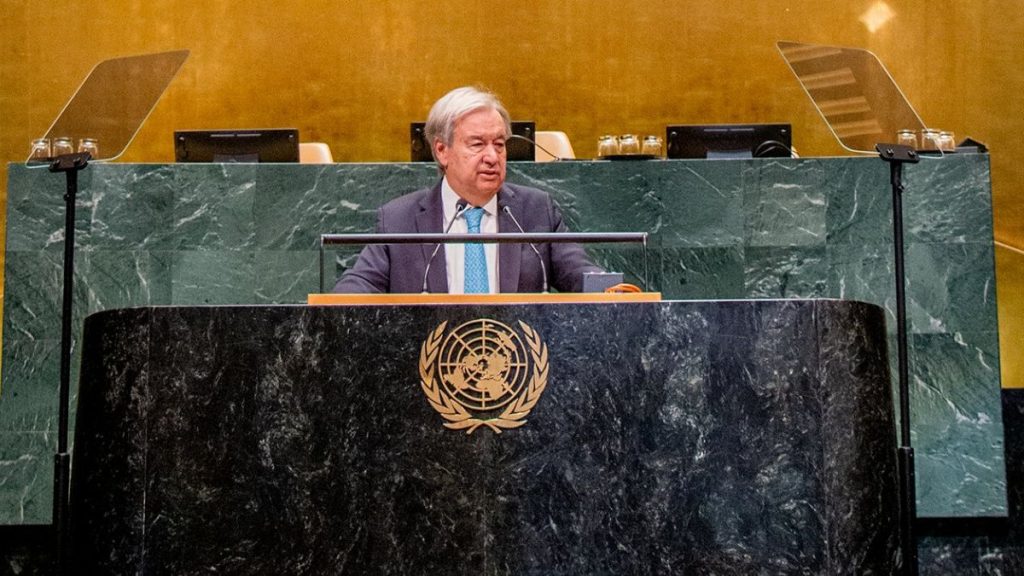
New Delhi: The high level general debate of the 81st United Nations general assembly opened in New York on Tuesday, bringing world leaders together amid wars in West Asia and Ukraine, growing concern over artificial intelligence, climate pressures and questions over the ability of multilateral institutions to respond effectively. Around 130 heads of state and government are expected to address the gathering during the week.
As RNA Media reported earlier, this is Antonio Guterres’s final general assembly as UN secretary general before his term ends in December 2026. In his address on Tuesday, he warned that global “fault lines” were widening and called for renewed international cooperation.
He said military, economic and technological power alone could not resolve challenges that increasingly cross national borders.
Guterres framed war, inequality, climate change and AI as four tests of how power is exercised. He renewed calls for security council reform, stronger climate action and a multilateral framework for managing AI risks, arguing that international institutions still reflected the power realities of an earlier era.
The US president, Donald Trump, struck a different note, highlighting American economic, technological and military strength. As RNA Media reported earlier, he defended US military action against Iran, urged other countries to economically isolate Tehran and called on members of the international criminal court to leave the institution, which he criticized as infringing on US sovereignty. Iran has consistently denied seeking nuclear weapons.
Trump also used the speech to emphasize American leadership in technology, saying US government documents would use the term “super intelligence” instead of artificial intelligence. His remarks came as AI governance moved higher on the UN agenda.
AI governance and UN reform move centre stage
The inaugural UN global dialogue on AI governance in Geneva in July brought together more than 3,000 participants, including delegations from 163 countries. The UN has also established a 40 member Independent International Scientific Panel on AI, while the security council is scheduled to hold a high level discussion on AI and international security on Wednesday.
The gathering comes as the organization faces financial pressure and renewed demands for institutional reform. The UN has 193 member states, but the five permanent veto-holding members of the security council remain US, Russia, China, Britain and France, reflecting the structure established after World War II.
As RNA Media reported earlier, the external affairs minister, S Jaishankar, has called for “reformed multilateralism” in New York, arguing for more representative institutions and greater transparency in global decision making. India also joined the Partners for Multilateralism initiative as an initial co-sponsor, backing a more effective, representative and inclusive multilateral system.
The French president, Emmanuel Macron, is among Tuesday’s speakers, while Ukraine’s president, Volodymyr Zelenskyy, and Iran’s president, Masoud Pezeshkian, are scheduled for Wednesday and the Israeli prime minister, Benjamin Netanyahu, for Thursday.
The general assembly remains the principal forum where all 193 UN member states can set out their positions. This year’s debate opens with a central challenge running through wars, climate change and AI: problems are becoming increasingly transnational even as geopolitical divisions make collective action more difficult.