


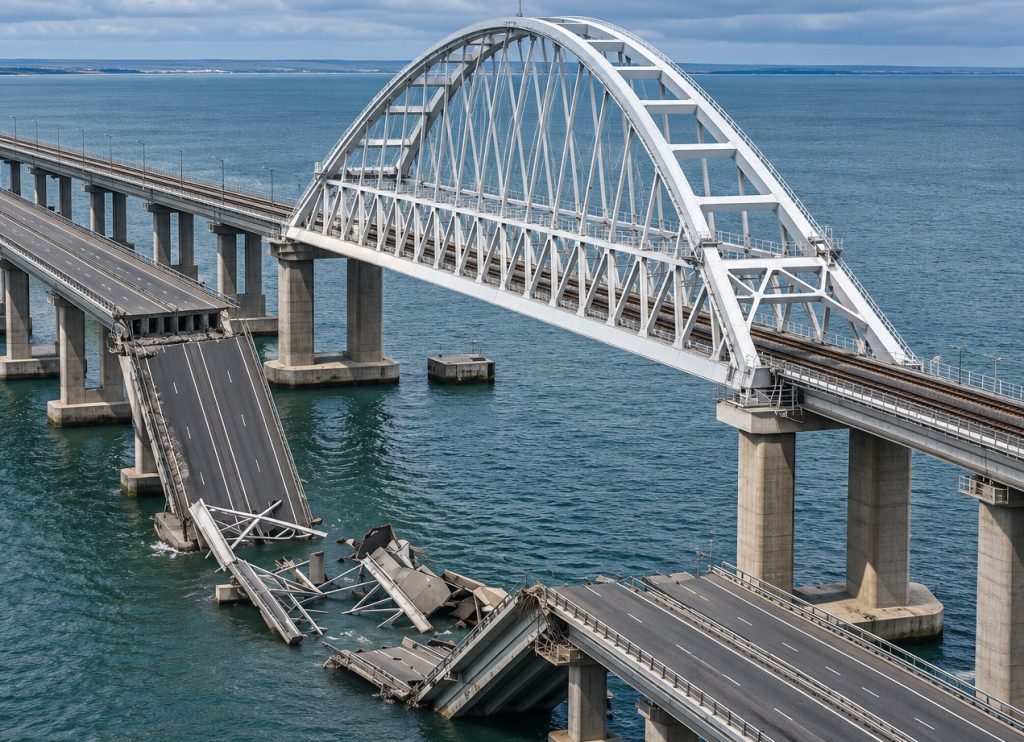
New Delhi: Ukraine has dealt a major blow to Russia’s military logistics network by destroying a central section of the strategically important Kerch bridge connecting the Russian mainland with Crimea, which Russia annexed in 2014, following two consecutive days of coordinated drone and missile attacks. The strikes, which Ukrainian authorities described as the culmination of a carefully planned operation, have disrupted road connectivity, damaged railway infrastructure and raised fresh questions about Moscow’s ability to protect one of its most heavily defended installations.
Images and videos released by Ukrainian authorities on Tuesday showed a massive steel arch and adjoining roadway apparently collapsed into the Kerch Strait, which separates the Black Sea from the Sea of Azov. Ukraine’s general staff confirmed the destruction of part of the road section and damage to the neighbouring railway structure, although independent verification of the full extent of the destruction remained limited.
The Ukrainian president, Volodymyr Zelenskyy, called the assault an unprecedented military operation undertaken in retaliation for Russia’s continuing attacks on Ukrainian infrastructure. He said Ukrainian forces had spent weeks systematically degrading Russian air-defence systems, surveillance radars and electronic warfare installations around Crimea before launching the decisive strikes.
According to Zelenskyy, Ukraine deployed a combination of domestically developed weapons, including Palianytsia missile-drones against the road section and Neptune missiles, Ruta drones and FP-5 systems against the railway infrastructure. Footage published after the attack also appeared to show a Ukrainian-made Flamingo cruise missile approaching the crossing moments before an explosion, although the precise contribution of each weapon could not be independently established.
Russian authorities acknowledged that the bridge had sustained structural damage but offered a more cautious assessment than Kyiv. The Kremlin spokesman, Dmitry Peskov, said the Russian president, Vladimir Putin, had been briefed on the situation and that Moscow would prepare a restoration plan, while Russian investigators opened a terrorism investigation.
The Russian-appointed governor of Crimea, Sergei Aksyonov, said two people had been killed and traffic across the bridge had been suspended following the attacks. Railway services subsequently resumed on Tuesday, but road traffic remained disrupted, with motorists advised to use ferry services across the strait.
Why the Kerch bridge matters to Russia?
Stretching approximately 19 kilometres across the Kerch Strait, the bridge is more than a transport connection between Russia’s Krasnodar region and Crimea. Commissioned after Moscow’s annexation of the Ukrainian peninsula in 2014, it became a powerful political symbol of Russian control, with Putin personally inaugurating its road section in 2018.
The crossing comprises separate road and railway structures and has historically served as a critical supply route for Russian military operations in southern Ukraine. Fuel, ammunition, military equipment and personnel have moved through the corridor, although Russia has progressively shifted some supplies to alternative land routes following earlier Ukrainian attacks.
The latest destruction could substantially complicate those arrangements by eliminating a major direct road connection and increasing pressure on the remaining transport network. Russia must now rely more heavily on the land corridor running through occupied southern Ukraine, including the Melitopol-Mariupol axis, which itself remains vulnerable to Ukrainian long-range strikes.
The consequences could extend beyond military movements because the collapsed arch appears to have obstructed the principal navigation channel linking the Sea of Azov with the Black Sea. The disruption threatens commercial shipping associated with ports such as Mariupol and Berdiansk, and clearing the submerged steel structure could require extensive engineering work.
Andrey Sizov, an analyst with agricultural consultancy Sovecon, told Reuters that the wreckage could significantly delay the eventual resumption of shipping from the Sea of Azov. The practical consequences will depend on the condition of the navigation channel and how quickly Russian authorities can remove the debris.
Carefully prepared assault
The operation also illustrates how Ukraine has increasingly combined long-range drones, precision missiles and attacks on air-defence installations to penetrate strategically important Russian targets. Rather than relying on a single strike, Kyiv appears to have pursued a phased campaign designed to weaken the protective systems surrounding the crossing before attacking its structural components.
Ukraine previously damaged the bridge in October 2022 through a truck-bomb explosion that ignited a fuel train, and again in July 2023 using explosive-laden maritime drones. Those attacks prompted Russia to reinforce security and diversify its supply routes, but the latest operation suggests that even heavily protected infrastructure remains exposed to sustained, coordinated attacks.
Nevertheless, the bridge’s partial destruction does not automatically mean that Russian forces in Crimea will face immediate shortages. Moscow retains alternative road and maritime connections, and the continued operation of the railway section could mitigate some logistical disruption, depending on its structural condition and carrying capacity.
Russia and Ukraine intensify infrastructure warfare
The assault unfolded alongside an unprecedented wave of Ukrainian drone attacks across Russia, highlighting the widening geographical reach of the conflict. Russia’s defence ministry claimed that its forces had intercepted 1,441 Ukrainian drones over 22 regions overnight, exceeding the previous day’s reported record of 1,336, although the figures could not be independently verified.
Russian forces simultaneously attacked key infrastructure in Ukraine, including two major bridges spanning the Dnipro River in Kyiv. The capital’s mayor, Vitali Klitschko, reported damage to transport infrastructure and interruptions to electricity and water supplies, while Ukrainian authorities said Russian strikes had affected energy facilities across eight regions.
The escalation comes despite renewed US-led diplomatic efforts to negotiate an end to the war, including recent talks in Abu Dhabi that produced agreement on a prisoner exchange but no substantial breakthrough on territorial disputes. US President Donald Trump is also expected to discuss the conflict during meetings with Putin and the Chinese president, Xi Jinping, in China later this week.
For Ukraine, the Kerch bridge strike represents both a military achievement and a political message that Russian-controlled Crimea remains within its operational reach. For Moscow, the immediate challenge is restoring transport capacity under the continuing threat of attack, while ensuring that disruption to the peninsula’s supply network does not undermine Russian military operations across the southern front.