


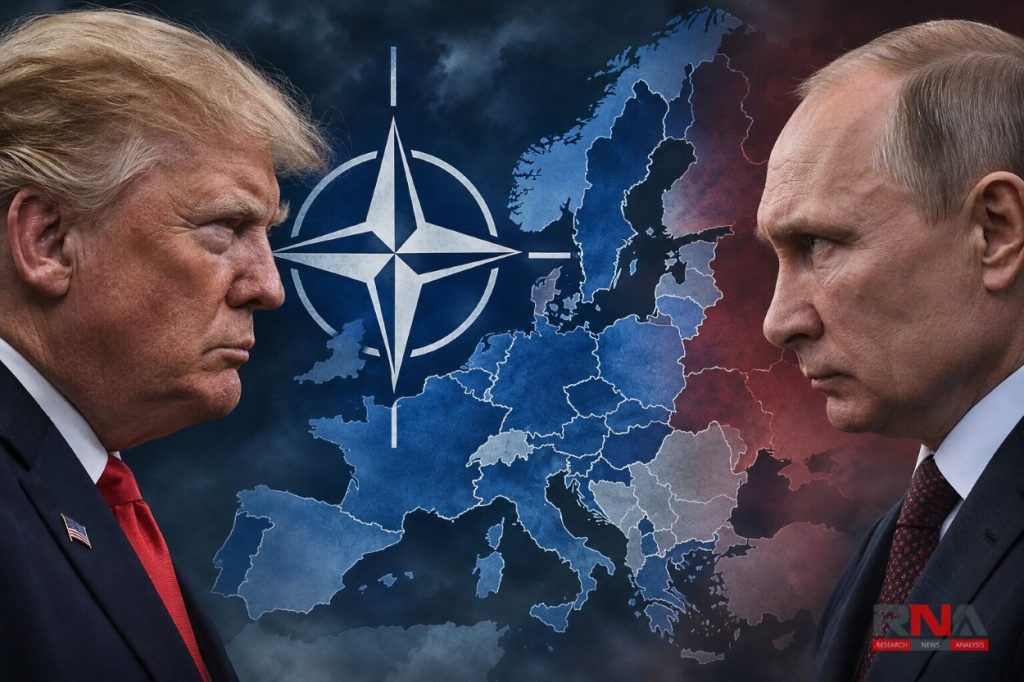
New Delhi: The US president, Donald Trump, on Thursday, revealed that he had urged his Russian counterpart, Vladimir Putin, to scale back military aggression across Europe to facilitate a speedy settlement of the Russia-Ukraine war. The remarks suggest that Washington is increasingly treating the conflict as part of a wider European security crisis rather than a territorial dispute between Moscow and Kyiv alone.
In a post on his Truth Social platform, Trump said he had devoted considerable time to discussing the issue with Putin during their meeting on the sidelines of the Asia-Pacific Economic Cooperation (Apec) leaders’ summit in Shenzhen, China, on November 19. He expressed hope that a Russian military de-escalation would create conditions for an agreement between the two warring countries, Reuters reported.
Trump’s remarks are significant because his appeal to Moscow extended beyond Ukraine to the rest of Europe, where concerns have been mounting over the possibility of the conflict spilling across international borders. However, he did not specify what measures he expected Russia to undertake or whether his appeal included the withdrawal of Russian forces from occupied Ukrainian territories.
The US president maintained that a negotiated settlement remained a distinct possibility, citing the enormous human cost of a conflict that has continued for nearly five years. Nevertheless, there has been no announcement of a breakthrough on the central issues dividing Moscow and Kyiv – territorial control, Ukraine’s postwar security guarantees and Russia’s demands concerning Nato’s military presence in eastern Europe.
Trump and Nato warn against widening the war
Trump’s statement came a day after his meeting with the Nato secretary general, Mark Rutte, at his Mar-a-Lago estate in Florida. In a joint statement released by Nato, the two leaders emphasized the need to prevent any deliberate or inadvertent expansion of the conflict and secure a peaceful settlement at the earliest.
The warning comes against the backdrop of growing friction between Russia and Nato’s eastern European members over alleged airspace violations and acts of sabotage. Poland this week accused Russia of deliberately violating its airspace, while Estonia recently linked an arson incident to Russian military intelligence.
Such incidents have raised concerns about unconventional warfare below the threshold of a direct military confrontation. European governments increasingly regard suspected sabotage, cyberattacks and airspace incursions as security challenges that cannot be addressed solely through a ceasefire in Ukraine.
The danger of miscalculation is particularly acute along Nato’s eastern flank, given the alliance’s collective defence commitments under Article 5 of the North Atlantic Treaty. A military confrontation involving Russia and a Nato member could potentially draw other European countries and the United States into the conflict.
Moscow seeks a new European security order
Trump’s latest intervention also comes as Moscow presses Washington to consider a fundamental restructuring of Europe’s post-Cold War security architecture as part of the peace process.
As RNA Media reported on November 21, Russia has revived elements of the security proposals it presented to the United States and Nato in December 2021, shortly before launching its full-scale invasion of Ukraine. These included restrictions on Nato’s eastward expansion and military deployments in countries that joined the alliance after 1997.
Putin has consistently portrayed Nato’s expansion towards Russia’s borders as a threat to his country’s national security. Western governments reject this argument as a justification for the invasion, maintaining that sovereign countries have the right to determine their own security arrangements and foreign policy alignments.
Trump’s willingness to discuss broader European security arrangements with Moscow has generated both diplomatic opportunities and apprehension among Washington’s European allies. While negotiations could potentially produce reciprocal restrictions on military deployments and mechanisms for preventing armed confrontations, European governments fear that an agreement negotiated principally between Washington and Moscow could compromise their security interests.
Several European countries have consequently been pressing for direct participation in the peace negotiations, arguing that the continent’s future security cannot be determined without their involvement.
Territorial dispute remains the biggest stumbling block
The latest American diplomatic initiative follows the resumption of trilateral negotiations involving Russia, Ukraine and the United States in Abu Dhabi earlier this month. The future of Ukraine’s eastern Donetsk region remains one of the principal obstacles to a settlement, alongside disagreements over the nature and enforceability of postwar security guarantees.
The US special envoy, Jared Kushner, acknowledged that negotiations had encountered difficulties over Ukrainian territory, although he maintained that Putin was interested in reaching a settlement. Meanwhile, the Russian foreign minister, Sergey Lavrov, said Washington appeared receptive to Moscow’s concerns about what Russia considers the underlying causes of the conflict.
However, developments on the battlefield continue to undermine diplomatic optimism. The Ukrainian president, Volodymyr Zelenskyy, warned on Thursday that Ukrainian intelligence had detected preparations for another major Russian attack on the country’s energy infrastructure, raising fears of widespread disruption to electricity, heating and water supplies as winter approaches.
China factor in Trump’s peace diplomacy
Trump’s discussions with Putin in Shenzhen, where he also participated in a trilateral meeting with the Chinese president, Xi Jinping, underline the increasingly global dimensions of his diplomatic initiative. China’s extensive economic ties with Russia give Beijing considerable potential influence over Moscow, although there is no indication that the Chinese leadership has committed itself to pressuring Putin into territorial concessions.
For countries such as India, a durable settlement would carry considerable economic and strategic implications, potentially easing disruptions in global energy markets, reducing geopolitical tensions and creating greater predictability in relations with both Russia and the West.
Ultimately, the prospects of Trump’s peace initiative will depend on whether Washington can reconcile Russia’s security demands with Ukraine’s sovereignty and Europe’s collective defence interests. His latest appeal to Putin indicates a desire to address all three concerns, but it remains unclear whether Moscow is prepared to make the concessions necessary to translate diplomatic engagement into an enforceable peace agreement.