


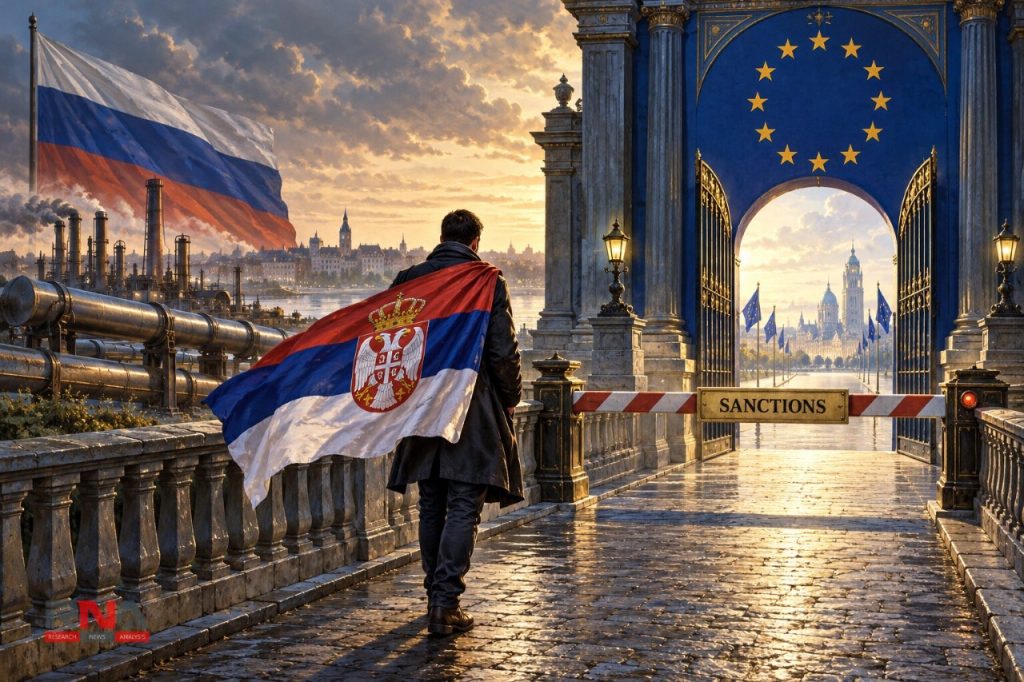
New Delhi: The European Union’s enlargement commissioner, Marta Kos, has warned that Serbia will struggle to advance towards membership unless it aligns with the bloc’s foreign and security policy, including its approach to Russia. Her remarks present an early diplomatic challenge for the country’s election-winning Student List (also referred to as Students’ List in earlier reporting), whose representatives have indicated that they intend to maintain Belgrade’s refusal to impose sanctions on Moscow.
Speaking to TVP World in an interview published on October 27, Kos said a candidate country’s failure to share the EU’s strategic direction would make progress “very, very difficult”. However, she also said substantive discussions on the issue would have to await the formation of Serbia’s new government.
The warning follows the Student List’s victory in the October 25 parliamentary election, which has opened the prospect of a reset in Serbia’s strained relations with Brussels. As of November 1, the movement had yet to choose its prospective prime minister and cabinet, according to RTE.
Kos welcomed the movement’s emphasis on democratic institutions, independent courts, media freedom and combating corruption, describing its victory as an opportunity to revive Serbia’s European ambitions. Her comments nevertheless made clear that political change in Belgrade would not remove the requirements attached to accession.
Election winners resist a sanctions shift
The incoming leadership’s position on Russia suggests that an improvement in relations with Brussels may not immediately translate into agreement on foreign policy. Representatives of the Student List have publicly opposed sanctions, arguing that Serbia should preserve its longstanding relationship with Moscow.
The sociologist and prominent Student List figure, Jovo Bakic, has argued that Serbian sanctions would have little practical effect on Russia while carrying significant symbolic consequences for bilateral relations. Another representative, Radomir Saicic, has said the movement’s programme does not support imposing sanctions and has pointed to Serbia’s own experience of such measures as a reason to favour negotiations.
Those positions, reported by Euronews on October 29, indicate that the dispute over Russia could survive the change of government. The immediate question is how the new administration will reconcile its domestic reform agenda with the EU’s expectation of closer strategic alignment.
Why Russia policy matters to EU membership
Alignment with the EU’s foreign policy is an established part of Serbia’s accession process. The European Commission’s 2024 assessment of Serbia states that the negotiating framework requires Belgrade progressively to align its policies towards third countries with EU positions, including restrictive measures.
That assessment also records distinctions within Serbia’s approach to the Ukraine war: Belgrade supported some EU positions in international forums, provided financial and humanitarian assistance to Ukraine, and cooperated on preventing sanctions circumvention. At the same time, it declined to adopt sanctions against Russia and maintained high-level relations with Moscow, prompting the Commission to question its strategic direction.
Kos’s remarks therefore reinforce an existing accession requirement, while underscoring its political importance during Russia’s war in Ukraine. They concern the conditions for Serbia’s progress towards membership rather than the announcement of EU sanctions against Serbia.
A stalled accession process with wider obstacles
Serbia applied for EU membership in December 2009, received candidate status in March 2012 and began accession negotiations in January 2014. According to the Council of the EU’s accession record, 22 negotiating chapters have been opened and two provisionally closed, with the latest opening of a negotiating cluster dating to December 2021.
Russia policy is only one obstacle to further movement. In its December 2025 conclusions, the council said progress on the rule of law and the normalization of relations with Kosovo would continue to determine the overall pace of accession negotiations, while raising concerns about freedom of expression and the protection of journalists.
Kos said Serbia met the technical conditions for opening cluster three, which covers competitiveness and inclusive growth, but that backsliding on fundamental democratic requirements had prevented political approval from member states. She also said the Student List representative, Ilija Srdanovic, had identified judicial independence, free media, democracy and anti-corruption measures as priorities during a telephone conversation with her.
Energy ties add practical pressure
Serbia’s relationship with Russia also has immediate implications for its energy security. The oil company NIS, which operates the country’s only oil refinery, has depended on US sanctions waivers while efforts continue to resolve its Russian majority ownership.
In a relevant development on October 30, Tanjug reported that the US Treasury’s Office of Foreign Assets Control had extended NIS’s operating licence until December 11. The extension provides temporary breathing space for the company, which remains subject to US sanctions because of its ownership structure.
NIS had requested a new licence on October 24, stressing that uninterrupted operation of its Pancevo refinery was essential to domestic fuel supplies. The issue illustrates the practical energy considerations facing Serbia as its future government weighs relations with Russia and Western partners.
The next scheduled assessment of Serbia’s European prospects is the commission’s annual enlargement reporting, which Kos said would be published on November 4. She expressed hope that the election could help Serbia emerge from years of stagnation but cautioned that substantial work remained before that political opening could produce progress towards membership.