


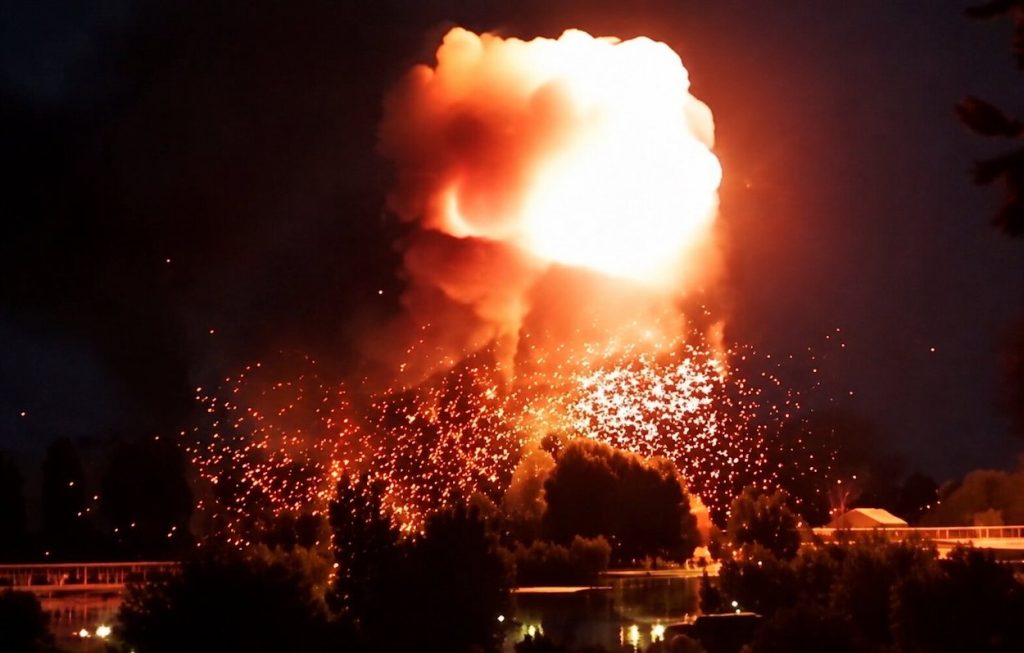
New Delhi: Russian missiles and attack drones tore through the central Ukrainian city of Kryvyi Rih on Sunday, striking a steel plant owned by the Indian-origin industrialist, Lakshmi Mittal, and killing at least two people. The city is the hometown of Ukraine’s president, Volodymyr Zelenskyy, and has repeatedly found itself in the crosshairs of Moscow’s long-range strikes since the war began.
The attack hit ArcelorMittal Kryvyi Rih, one of Ukraine’s largest steelmaking complexes, causing damage to facilities tied to power generation and blast furnace operations. The company said two people were killed and 13 others – a mix of workers and contractors – were injured in the strike.
Production at the sprawling plant was partially suspended in the aftermath, with emergency crews and technical specialists sent in to survey the wreckage. The company described the site as civilian industrial infrastructure and said it was still working out the full extent of the repairs needed. A second strike on Kryvyi Rih later the same evening killed one more person, deepening the toll on a city that has borne the brunt of Russian firepower time and again.
ArcelorMittal, the world’s largest steel and mining company, holds a 95.1% stake in the Kryvyi Rih plant, which has anchored Ukraine’s steel industry for decades. Mittal serves as the company’s executive chairman, while his son, Aditya Mittal, is its chief executive officer. The plant’s fate has now become entangled with the wider war, a reminder that even privately owned industrial giants are not insulated from the conflict raging around them.
Sunday’s bombardment was not confined to Kryvyi Rih. Strikes further afield killed two people in the Zaporizhzhia region, while Kyiv itself was set alight when a Russian strike tore through the historic Petrivka book market near the Pochaina metro station.
Rows of retail stalls burned to the ground, taking with them tonnes of rare and antiquarian volumes collected over years. One bookseller, Dmytro Semenukha, 45, watched all four of his stalls reduced to ash. “There used to be a store. And books, and flags of all the countries, all the countries,” he told a news agency. “Tons of everything. And that’s it.” It was a small, human-scaled tragedy set against a war that has, by now, produced so many.
Hours earlier, as RNA Media had reported, Ukraine had launched one of its largest drone attacks of the war on Russian soil, striking a Wildberries distribution warehouse near Moscow and killing at least six people, according to reports from the Russian side. The exchange underlined how deeply both capitals are now willing to reach into each other’s rear areas, well beyond the contact line that has barely shifted in months.
Reacting to the overnight raids, Zelenskyy said Russia strikes wherever its ballistic missiles can reach, and that civilian infrastructure remains a preferred target. It is a complaint he has voiced often, and one that goes to the heart of a second, no less consequential, development this week – Ukraine’s own quiet march towards a home-grown ballistic missile capability.
Ukraine’s missile tech advance
Ukraine could be in a position to strike Russian territory with domestically produced ballistic missiles within three to six months, the country’s former defence minister, Mykhailo Fedorov, estimated in an interview with an American broadcaster. Kyiv has so far relied chiefly on long-range drones and cruise missiles for its deep strikes into Russia, weapons that are comparatively slow and easier for Russian air defences to track and intercept.
Ballistic missiles present a different order of challenge altogether. Their steep, high-speed trajectories make them notoriously difficult to shoot down, a fact Russia itself has exploited repeatedly against Ukrainian cities over the course of the war.
“We need to defeat Russia in every technological cycle,” Fedorov said, framing the missile programme as part of a broader race for technical advantage that both sides are running in parallel. He conceded that Russia, too, is advancing quickly, leaving Ukraine little room for complacency.
The programme he was referring to is being led by Fire Point, a Ukrainian defence manufacturer that conducted a launch test of its FP7 ballistic missile in June. That missile is now undergoing certification by Ukraine’s defence ministry, a process expected to conclude by September, according to company officials. A larger variant, the FP9, reportedly capable of reaching Moscow, is expected to be ready by late autumn.
Zelenskyy himself has lent weight to the claims, telling state television that Kyiv’s ballistic missiles could be combat-ready within two to three months and potentially used for strikes deep inside Russian territory. It is a significant claim from a leader who has, until now, depended heavily on Western-supplied long-range weapons and on domestically built drones for any retaliatory reach into Russia.
Fedorov, widely credited as one of the architects of Ukraine’s highly effective drone programme, was controversially removed from his post in July. His continued advocacy for the ballistic missile effort, even from outside government, suggests the project enjoys support that runs deeper than any single official’s tenure.
The stakes are rising on the other side of the front as well. A senior Ukrainian commander recently warned that Russia intends to nearly triple its capacity for simultaneous ballistic missile launches, from around 77 to as many as 200, a shift that would place enormous strain on Ukraine’s already stretched air defences.
Kyiv’s arsenal of American-made Patriot interceptors – among the few systems capable of reliably countering ballistic threats – has been thinning even as demand for them grows elsewhere. Talks over licensed production of the Patriot in Ukraine, and parallel efforts with France and Italy on the SAMP/T air defence system, remain works in progress rather than solutions in hand.
Taken together, the two threads of this weekend’s news – a Russian missile tearing into an Indian-owned steelworks in Zelenskyy’s hometown, and Ukraine’s own quiet progress towards ballistic missiles of its own – capture a war that has settled into a grim, technologically escalating rhythm. Neither side appears close to a battlefield breakthrough on the ground. Both, increasingly, are betting on what they can build and launch from far behind it.
For Mittal’s plant, the immediate task is more prosaic: assessing the damage, repairing what can be repaired, and keeping one of Ukraine’s industrial mainstays running through a war that shows no sign of sparing even its steel mills.