


New Delhi: Ukraine launched one of its largest drone attacks on Russia since the war began, killing at least six people and setting fire to a major distribution centre near Moscow overnight on Saturday–Sunday, Russian authorities said. The scale of the assault brought the conflict deep into the Russian heartland and underlined Kyiv’s growing ability to target economic and logistics infrastructure far beyond the front line.
Russia’s defence ministry claimed that its forces intercepted 822 Ukrainian drones across the country during the overnight operation. The mayor of Moscow, Sergei Sobyanin, said about 600 drones had approached the capital region and 201 were destroyed, although the figures could not be independently verified.
The ministry subsequently said Russian air defences had brought down nine cruise missiles and 1,478 drones during the preceding 24 hours. It did not disclose how many aircraft or missiles penetrated the defensive network or reached their intended targets.
The governor of the Moscow region, Andrei Vorobyov, described the operation as one of the largest drone attacks on the area in recent years. An 83-year-old man was killed when a drone struck a private home in the Ramensky district, while at least six people were injured elsewhere in the region.
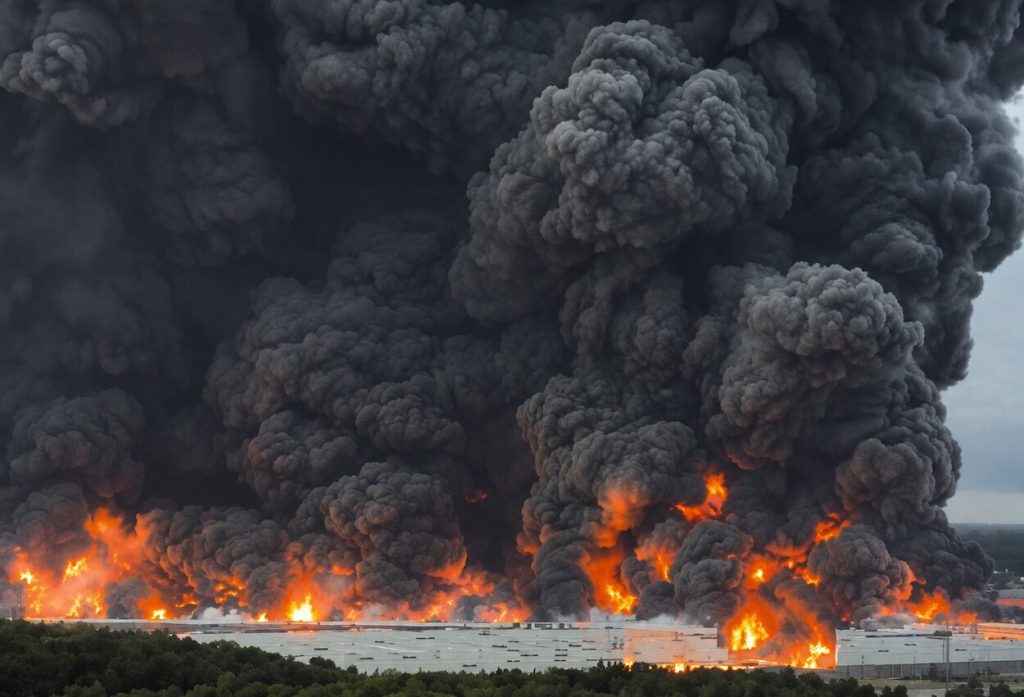
One of the most visible strikes hit a Wildberries distribution centre in the Koledino industrial park near Podolsk, about 45 kilometres south of Moscow. Images and verified video showed thick black smoke rising from the sprawling facility as helicopters and ground crews fought the blaze.
The warehouse, covering about 200,000 square metres, is among the largest operated by Wildberries, Russia’s leading online retailer. Employees were evacuated and no casualties were initially reported inside the complex, although the extent of the damage and the volume of stock destroyed remained unclear.
Another fire broke out at a warehouse in Domodedovo, close to one of Moscow’s principal airports, while other sites across the region suffered damage. Russian aviation authorities temporarily restricted operations at several Moscow airports as air-defence units responded to the incoming drones.
Five people were reported killed in the southern Rostov region, where the regional authorities said about 150 drones had been intercepted. Some early reports carried a lower death toll, however, indicating that casualty figures were still being revised as emergency teams inspected the affected areas.
A separate drone strike on a bus near Belgorod also killed one person, according to the regional authorities, potentially taking the overall toll beyond the six initially reported. Ukraine’s armed forces had not formally commented on the wider operation at the time of publication.
Wildberries has emerged as a frequent target of Ukrainian long-range attacks since July, with close to 20 of its warehouses and associated facilities reportedly struck. Kyiv alleges that the company’s logistics network handles military equipment and other supplies connected with Russia’s war effort, an accusation denied by Wildberries and the Kremlin.
The attacks had already damaged at least seven Wildberries warehouses and destroyed about 10 per cent of its storage capacity by late July, according to Reuters. The losses have also affected tens of thousands of small businesses that use the platform, prompting discussions in Moscow about possible financial support for the company and its sellers.
The latest Ukrainian operation coincided with another wave of Russian missile and drone attacks on Ukraine. Two people were killed and 14 injured at the ArcelorMittal steel plant in Kryvyi Rih, while strikes on Kyiv started fires and injured residents in the capital and surrounding region.
The conflict also produced another breach of Nato airspace when a Spanish F-18 fighter operating from Romania shot down a drone that entered the country from Moldova at about 5.01am. Romanian authorities did not formally identify its origin, although a Nato spokesperson said preliminary indications suggested it was Russian.
The attacks on both sides illustrate how long-range drones are increasingly being used to pressure industrial capacity, commercial supply chains and urban populations far from the battlefield. They also raise the risk of the war spilling across neighbouring borders as air-defence systems confront larger and more complex waves of unmanned aircraft.