


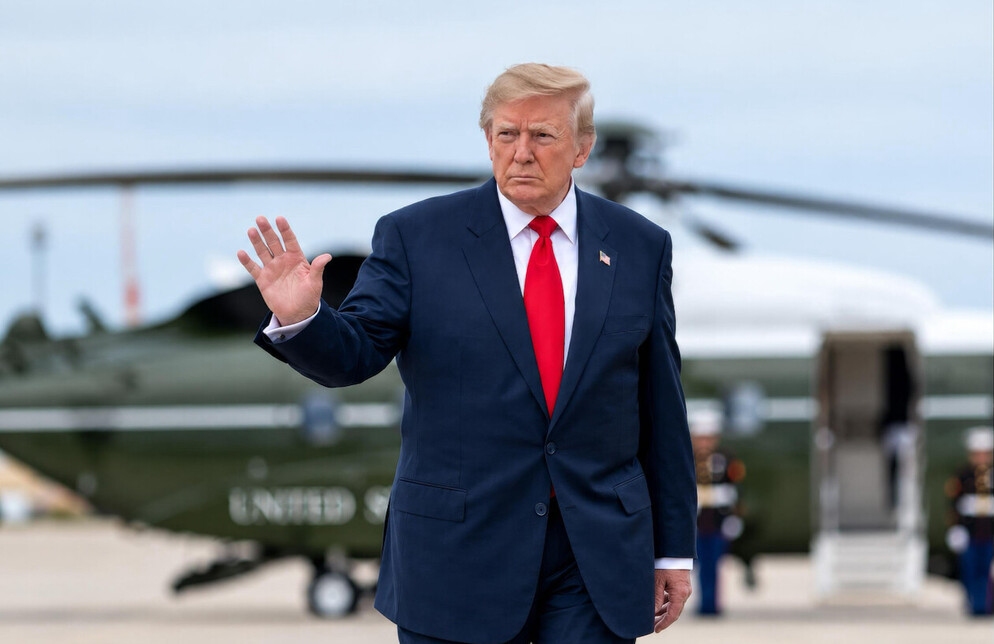
New Delhi: The US president, Donald Trump, has dismissed suggestions that Russia and China are helping Iran in its conflict with the United States and Israel, arguing that both countries would risk too much by backing Tehran. His remarks come despite US sanctions against alleged Iranian procurement networks and continuing reports of foreign assistance to Iran’s military operations.
Writing on Truth Social late on Monday, Trump said he did not believe Moscow or Beijing was providing assistance, while allowing that any involvement might be limited. He maintained that Washington would quickly detect such activity, but offered no supporting intelligence findings in the statement.
Trump attacked those alleging Russian and Chinese assistance to Tehran, writing: “I see so many comments from the Radical Left Morons and Lunatics that China and Russia are helping the ‘wonderful’ Islamic Republic of Iran. [Sic]” He dismissed their claims, arguing that Moscow and Beijing had too much to lose and that Washington would quickly detect any involvement.
The statement repeated a position Trump outlined in July, when he said he trusted assurances from the president of China, Xi Jinping, and the president of Russia, Vladimir Putin, that they would not supply weapons to Iran. Trump said Xi’s undertaking covered Chinese companies as well as the government and warned that involvement by either country would carry serious consequences.
Washington subsequently raised the issue directly with Beijing during Xi’s September visit to the United States. The US ambassador to China, David Perdue, said Trump had described direct or indirect assistance to Iran as unacceptable and had received assurances that Beijing would not provide it.
Nevertheless, Trump’s confidence sits alongside actions by his own administration alleging that overseas suppliers have helped sustain Iranian weapons programmes. On September 29, the US treasury sanctioned 10 individuals and entities accused of procuring weapons and components for Iran’s ministry of defence and armed forces logistics, which oversees military acquisition and organizations developing ballistic missiles and drones.
The treasury announcement identified an Iranian defence ministry representative in Beijing who, it alleged, coordinated purchases of finished weapons and components with civilian and military applications. It also accused a Hong Kong company and its China-based representative of supporting electronics procurement for Iranian military manufacturers, alongside a separate network involving businesses in Pakistan, Saudi Arabia and Turkiye.
Those allegations concern identifiable procurement channels and intermediaries; they do not, by themselves, establish that the Chinese government directed the transactions. Beijing has denied allegations that Chinese entities assisted Iran’s military, leaving an important distinction between alleged commercial or covert supply networks and an officially authorized programme of wartime support.
Separate questions surround Russia’s role, particularly whether it has supplied intelligence or technology that could improve Iranian attacks. Reuters reported that US analysts had examined possible Russian targeting assistance and advanced drone technology following strikes on CIA facilities in the Gulf, while the Washington Post and Wall Street Journal reported allegations of Russian targeting support in March.
Russia’s close relationship with Iran also has defined limits: the two countries signed a 20-year strategic partnership agreement on January 17, 2025, providing for closer security cooperation, military exercises and officer training. However, the treaty contains no mutual defence clause requiring either country to enter a war on the other’s behalf, so the partnership cannot automatically be treated as a commitment to fight alongside Tehran.
The dispute over outside assistance has accompanied a conflict that began with US and Israeli attacks on Iran on February 28, followed by Iranian missile and drone strikes across the region. According to Anadolu, a June memorandum of understanding reached through Pakistani and Qatari mediation has stalled over disagreements that include navigation through the Strait of Hormuz, a critical passage for international energy shipments.
Trump’s latest remarks therefore express his assessment of Russian and Chinese involvement rather than resolve the competing allegations. The distinction remains consequential: weapons deliveries, intelligence sharing and purchases of military components represent different forms of assistance, and the available statements do not establish a single, agreed account of their scale or authorization.