


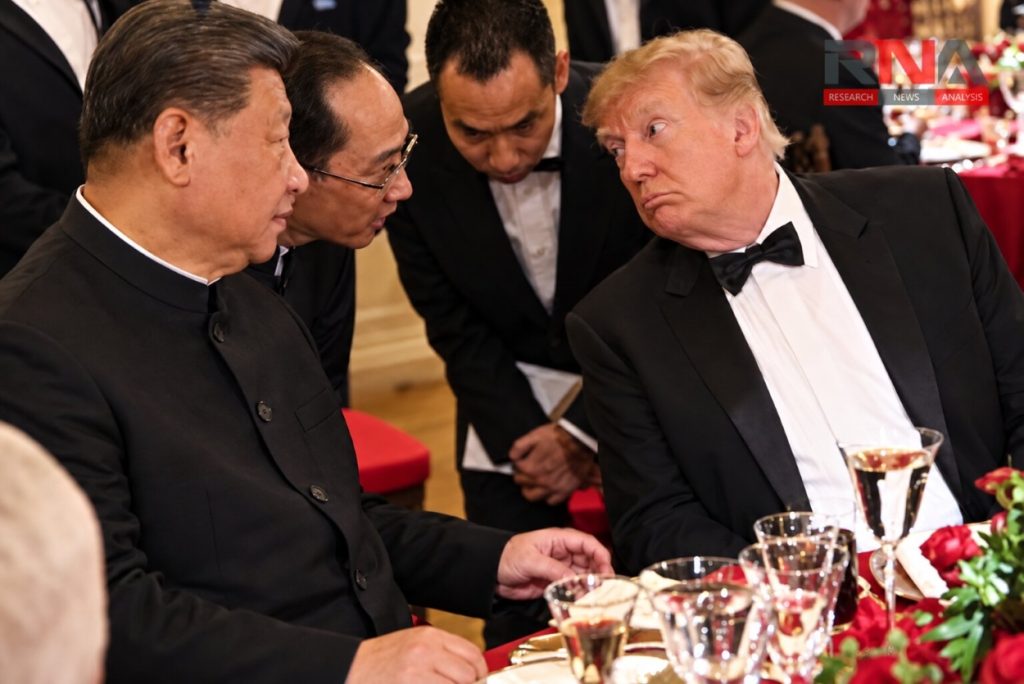
New Delhi: The US president, Donald Trump, warned China’s president, Xi Jinping, that Chinese assistance to Iran during Washington’s military campaign would be “totally unacceptable”, the US ambassador to China said on Friday. The warning, delivered during their White House talks a day earlier, covered intelligence, components and military equipment, placing Beijing’s relationship with Tehran under renewed scrutiny as Washington expands its economic pressure campaign.
The ambassador, David Perdue, told CNBC that Washington had communicated its objections several weeks before the summit and that Trump had personally repeated them. His account indicated that the administration’s concerns extended beyond direct weapons transfers to assistance reaching Iran through indirect channels.
“We made it very clear to them weeks ago that, you know, any help that they would give Iran, whether it be direct or indirect, whether it be intelligence or parts or military equipment, was totally unacceptable,” Perdue said. “President Trump made that very clear again yesterday.”
In a subsequent Fox News interview, Perdue said Washington had received assurances from Beijing and had already observed movement on the issue. Trump separately confirmed on Friday that he had discussed the Iran war with Xi but offered no detailed account of their exchanges or any agreement arising from them.
Perdue nevertheless drew a distinction between American suspicions and evidence concerning the Strait of Hormuz, acknowledging that Washington lacked direct evidence of Chinese assistance to Iran in keeping the waterway closed. In the CNBC interview, he said the two leaders agreed that Iran must not acquire nuclear weapons and that the strait should remain open.
Those reported understandings do not, by themselves, establish that Beijing has accepted Washington’s wider sanctions policy or agreed to curtail its economic relationship with Tehran. China remains an important purchaser of Iranian oil and maintains a comprehensive strategic partnership with Iran, giving its decisions considerable significance for efforts to isolate the country.
The sanctions drive has increasingly targeted businesses outside Iran that sustain its international connections, including aviation services and financial transactions. Under Operation Economic Outcast, announced in August, the US treasury department has sought to disrupt revenue, procurement networks and commercial channels that it says support the Iranian government and the Islamic Revolutionary Guard Corps.
On September 8, 2026, the department announced sanctions against 36 targets linked to Iran’s aviation sector, including 27 Iranian airlines and foreign intermediaries. It accused parts of the aviation network of moving weapons, personnel and illicit cargo, while also suspending three aviation-related authorizations and retaining case-by-case consideration of safety requests.
The treasury secretary, Scott Bessent, subsequently warned that foreign providers of fuel, landing services and ticket sales for Iranian carriers could lose access to the US dollar system. Such secondary sanctions seek to influence third-country businesses by making continued dealings with Iran potentially costly for their access to American finance.
Bessent also said on September 21 that Chinese financial authorities were engaged in discussions about sanctions compliance, including the governor of the People’s Bank of China, Pan Gongsheng. His comments showed that Washington was pursuing cooperation through financial negotiations alongside its warnings about military assistance, although engagement alone did not demonstrate agreement on every American demand.
Beijing’s publicly stated approach has continued to emphasize negotiations and its relationship with Tehran. During talks in Beijing on September 16, the Chinese foreign minister, Wang Yi, told his Iranian counterpart, Abbas Araghchi, that China would maintain continuity in its Iran policy and strengthen cooperation to safeguard what it described as Iran’s legitimate interests.
Wang urged Washington and Tehran to restore negotiations under the Islamabad memorandum of understanding and called for early reopening of the Strait of Hormuz to protect shipping and energy supplies. According to the Chinese foreign ministry’s account, Araghchi said Iran wanted a diplomatic settlement while defending its rights and considered the memorandum still valid.
The Iran dispute also formed part of a broader summit agenda encompassing trade, technology and military tensions. As RNA Media reported, Xi advocated regular military dialogue and stronger crisis communications, while the two governments extended their existing trade arrangement – illustrating their simultaneous efforts to stabilize bilateral relations and manage substantial strategic disagreements.