


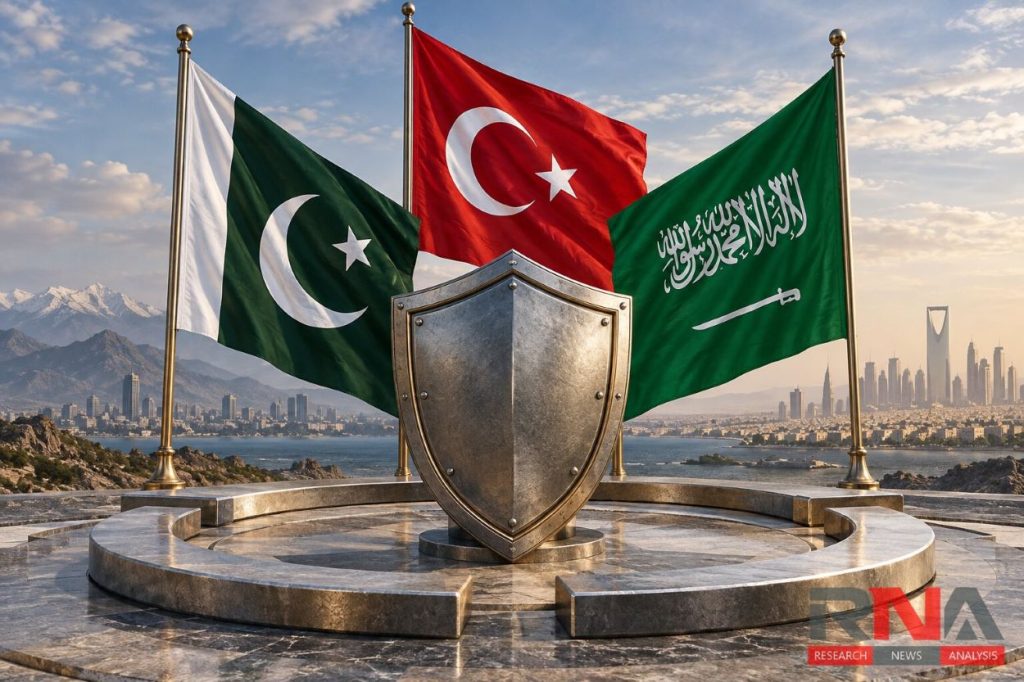
New Delhi: Pakistan has described its new defence alliance with Saudi Arabia and Turkiye as a deterrence-based arrangement intended to strengthen regional security rather than pursue offensive objectives. Islamabad also said the three-member grouping was not considering admitting additional countries at this early stage of its development.
Addressing a weekly media briefing on Thursday, the Pakistani foreign office spokesman, Sajjad Haider Khan, said the Makkah Defence Alliance was “primarily a defensive alliance” designed to discourage aggression. He said Pakistan, Saudi Arabia and Turkiye first needed to consolidate their cooperation and establish the institutional foundations required to make the agreement operational.
Expansion of the alliance was therefore “not on the cards” at present, Khan said. Once the three founding members had developed its structure and coordination mechanisms, they could consider opening the arrangement to countries sharing broadly similar positions and principles.
“There are no discussions regarding the expansion of the Makkah agreement” at this stage, the spokesman said. He added that the three governments were already consulting at different levels, although the schedule for their next formal meeting had not been finalized.
The alliance remains in its formative phase, with its organizational structure, procedures and decision-making mechanisms yet to be fully settled. Khan acknowledged that considerable work remained before the grouping could acquire a clearly defined and durable institutional character.
The clarification indicates that Islamabad wants to temper expectations of the pact’s rapid transformation into a broader regional security bloc. It also suggests that the founders are prioritizing internal cohesion and practical military coordination before contemplating an expansion that could complicate decision-making.
As RNA Media had reported, the Makkah Joint Defence Agreement was signed in the Saudi city on August 7 by the crown prince and prime minister of Saudi Arabia, Mohammed bin Salman; the president of Turkiye, Recep Tayyip Erdogan; and the prime minister of Pakistan, Shehbaz Sharif. The alliance of the three countries was formally named Makkah Defence Alliance later. Its central collective-defence provision states that an armed attack on one member will be regarded as an attack on all three.
Officials from the three countries have maintained that the arrangement is not directed against a particular state and does not replace their existing bilateral or multilateral commitments. The foreign minister of Pakistan, Ishaq Dar, previously said its collective-defence clause was consistent with the right to individual and collective self-defence recognized under Article 51 of the United Nations Charter.
The pact envisages strategic political and military mechanisms involving the three countries’ foreign ministers, defence ministers and senior military commanders. It also provides for joint exercises involving land, air and naval forces and closer cooperation in air defence, unmanned platforms, electronic warfare, artificial intelligence and defence production.
At the alliance’s inaugural meeting in Istanbul on August 31, the members agreed to establish a permanent secretariat in Saudi Arabia to support its work. Pakistan is expected to provide the first secretary general, who will serve an initial three-year term, according to the Dawn report.