


New Delhi: The Israeli prime minister, Benjamin Netanyahu’s, bloc led Wednesday’s partial parliamentary election count but remained short of the 61 seats needed to form a government. His principal challenger, former military chief Gadi Eisenkot, also lacked a majority, leaving Arab-led parties potentially influential in coalition negotiations.
With 72.4 per cent of ballot boxes counted on Wednesday morning, provisional figures indicated 54 seats for Netanyahu’s bloc, 48 for Eisenkot’s opposition grouping and 18 for Arab-led parties, the Times of Israel reported, citing the central elections committee.
The figures remain provisional, with votes cast by soldiers and other absentee voters still awaiting counting.
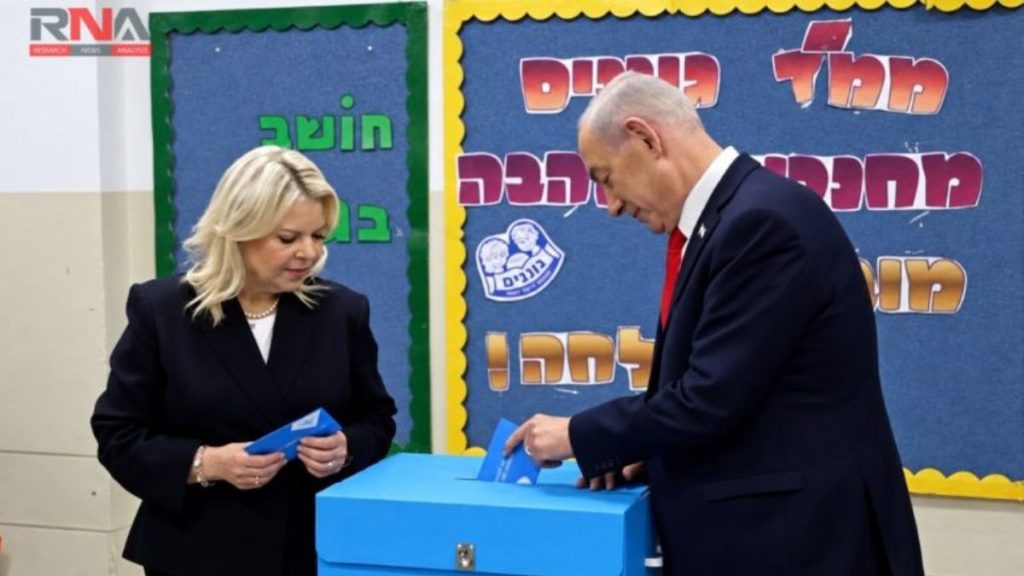
As RNA Media reported during Tuesday’s voting, the election was expected to produce a difficult contest over coalition formation, with neither Netanyahu nor Eisenkot assured of sufficient parliamentary support. Israel’s 120-member Knesset requires a majority of 61 lawmakers to form a government, making negotiations with smaller parties essential.
Addressing supporters in Jerusalem, Netanyahu called for “a strong, right-wing national government”, highlighting Israel’s military achievements during conflicts involving Gaza and Iran. On the other hand, Eisenkot argued that voters had rejected Netanyahu’s leadership and urged him to leave politics.
Voter turnout reached 77.7 per cent, the highest since 1999 and approximately seven percentage points above the 2022 election, according to the central elections committee.
Arab-led parties could influence government formation
The strong performance of Arab-led parties has introduced another obstacle to coalition formation. The joint list and Mansour Abbas’s Ra’am remain separate political formations, but their combined parliamentary strength could prove decisive.
Ra’am leader Mansour Abbas made history in 2021 when his party became the first Arab-led political party to join an Israeli governing coalition. During the latest campaign, Abbas focused primarily on rising crime in Arab communities rather than the wider Israeli-Palestinian conflict.
Netanyahu has ruled out forming a government dependent on Arab-led parties, while Eisenkot has indicated a willingness to cooperate with them under certain conditions. However, such an arrangement could alienate some of his opposition partners, complicating efforts to assemble a governing majority.
October 7 attack and military service shape election
The election was Israel’s first since the Hamas-led October 7, 2023, terrorist attack, which killed approximately 1,200 people and resulted in 251 hostages being taken into Gaza.
Netanyahu has rejected calls for an investigation into the October 7 security failures and blamed the military for the lapses, according to AP. Opposition leaders have demanded a commission of inquiry, arguing that he must also be held accountable for the failures that occurred under his leadership. His supporters, however, credit his government with military achievements against Hamas and other adversaries in Gaza, Lebanon and Iran.
Another contentious issue was the exemption of ultra-Orthodox Jewish men from compulsory military service. Eisenkot pledged to end the exemptions, which religious parties supporting Netanyahu have sought to preserve.
Despite the devastating humanitarian crisis in Gaza, Palestinian statehood received comparatively limited attention during the election campaign. According to AP, no major candidate advocated reviving the long-stalled Israeli-Palestinian peace process, reflecting the limited prominence of Palestinian political aspirations in the contest.
Iran tensions and implications for India
Iran emerged as a late election controversy after reports alleged Netanyahu had sought military action before polling day. His office rejected the allegations, while defence minister, Israel Katz, denied plans for a pre-election strike.
The US president, Donald Trump, who publicly endorsed Netanyahu, remains an important factor in Israel’s regional diplomacy.
With counting still underway, Jewish state’s president, Isaac Herzog, will consult parliamentary parties before asking the lawmaker most likely to secure a governing majority to form the next government. The leader of the largest party is not automatically guaranteed that opportunity.
For Netanyahu and Eisenkot, the decisive challenge now lies in securing support across Israel’s divided political landscape. If neither can assemble a workable coalition, the country could face prolonged political uncertainty and another election, leaving the question of its future leadership unresolved.