


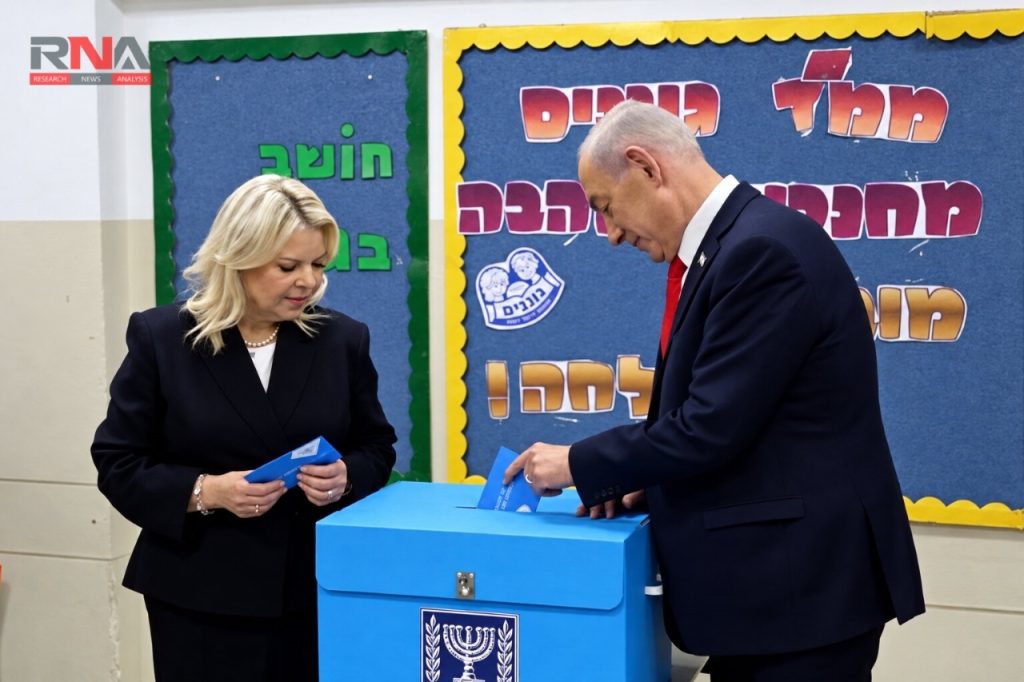
New Delhi: Israelis voted on Tuesday in an election that could end the latest spell in power for the prime minister, Benjamin Netanyahu, but offered no clear assurance that his opponents could assemble a replacement government. His principal challenger, the former military chief, Gadi Eisenkot, was competing in a fragmented political field shaped by the October 7, 2023, attacks, subsequent wars and divisions over accountability and Israel’s future.
The immediate contest was for the 120 seats in the Knesset, Israel’s parliament, but the decisive struggle could come afterwards: securing enough support to govern. Pre-election surveys offered conflicting assessments of the leading parties while pointing towards the same underlying difficulty – neither main camp had a secure parliamentary majority.
Voting was scheduled to close at 10pm Israeli time, or 1.30am in India on Wednesday, with television exit polls expected afterwards. Those projections would provide an initial indication of the outcome, but the distribution of seats and subsequent negotiations could take considerably longer to establish who would lead the next government.
The final surveys reported by Israel’s i24NEWS illustrated the uncertainty: its Direct Polls survey gave Netanyahu’s bloc 59 seats, against 47 for Eisenkot’s camp and 14 for Arab parties. A separate Kan survey put Netanyahu’s bloc at 50 and Eisenkot’s at 52, both short of the 61-seat majority mark.
Even the identity of the largest party remained disputed as i24NEWS projected 26 seats for Likud and 21 for Eisenkot’s Yashar, while Kan placed Yashar ahead with 22 against Likud’s 20. These were pre-election opinion polls, not exit polls or counting trends, and did not justify declaring either leader the likely next prime minister.
Participation nevertheless suggested an electorate deeply engaged with the choice before it. The Jerusalem Post’s election-day coverage reported turnout of 55.7 per cent by 4pm Israeli time, although a high national turnout alone could not establish which camp was benefiting. However, some news agencies are reporting that the turnout has been the highest in Israel’s history.
Arab participation became a particular focus of the closing campaign, with Netanyahu and his far-right allies urging supporters to counter an increase in Arab voting. Arab politicians condemned the appeals as racist and inflammatory, highlighting the tensions surrounding a minority whose ballots could materially affect the parliamentary balance.
Arab citizens comprise about a fifth of Israel’s population, and their parties could complicate Netanyahu’s route back to power even without joining an alternative administration. One possible route for his opponents would be a minority government dependent on support or abstentions from outside the coalition, although political agreement on such an arrangement remained uncertain.
For many Jewish Israeli voters, the central question was whether Netanyahu should remain in office after the security collapse of October 7, 2023, when Hamas-led militants raided Israeli towns and kibbutzim, which resulted in the deaths of about 1,200 people. The militants also took 251 hostages. Netanyahu has resisted demands for an independent inquiry, while arguing that his subsequent military campaigns have strengthened Israel’s security.
That argument has found a sharply different reception in communities directly affected by the attack. Gal Cohen, a resident of Be’eri, told Reuters that “many hearts and minds will be broken” if the government remained, while fellow resident Miri Gad Messika described her difficulty finding a political leader she could trust.
The unease extended beyond the border communities and the immediate question of wartime responsibility. Ruth Epstein, an 81-year-old voter in Ramat Gan who supported the Democrats, told Reuters: “I’m really scared about what will be here.”
Netanyahu’s campaign presented a different interpretation of the same years of conflict, emphasizing his leadership against Israel’s enemies and his relationship with the US president, Donald Trump. Trump’s endorsement reinforced that appeal but could not resolve the domestic arithmetic confronting a leader whose political survival depended on the performance of several allied parties.
Eisenkot’s challenge also centred on military service, particularly exemptions for ultra-orthodox Jewish men while other Israelis faced prolonged demands on their time and livelihoods. He has pledged to end those exemptions, making the issue both an electoral dividing line and a potential obstacle to coalition-building with religious parties.
The wider institutional stakes concern the relationship between elected governments, the judiciary and religious authority. Netanyahu’s allies favour reviving changes that critics say would weaken judicial checks, while the opposition promises to reverse that direction and establish an inquiry into the October 7 failures.
For Palestinians, however, a change of leadership offers no clear promise of a fundamentally different security policy. Both Netanyahu and Eisenkot oppose an independent Palestinian state and insist that Israel retain overriding security control, although they differ over settlement policy and the political partners they would bring into government.
Gaza’s Sami Abu Rumi told the Guardian: “Gaza’s suffering has become campaign fodder.” His assessment conveyed little expectation of relief.
The two leading contenders have made Hamas’s disarmament a condition for Israeli withdrawal from Gaza, and neither has ruled out renewed warfare. Eisenkot has pledged to replace Hamas’s administration within 18 months of taking office, through a US-backed arrangement or military force – a position that limits expectations of a rapid break with existing policy.
In the occupied West Bank, election day coincided with protests against displacement in Hebron, where an Israeli operation followed the killing of two soldiers at a checkpoint on October 23. The United Nations said more than 3,000 Palestinians had been forced from their homes, while Israel said its operation responded to the attack on its troops.
Noura Nassar, a displaced resident who attended the protest, described difficulty obtaining medical treatment because of movement restrictions. “Aren’t we human beings?” she asked Reuters, expressing frustration that an election determining policies affecting Palestinians gave them no equivalent say over those decisions.
There are nevertheless differences that could matter on the ground: Eisenkot has promised action against settler violence and unauthorized outposts, while Netanyahu depends on allies advocating annexation. An opposition-led government could therefore alter enforcement and settlement decisions without embracing Palestinian sovereignty or abandoning a forceful security posture.
The next procedural step, once the results are established, will involve consultations between the president, Isaac Herzog, and party leaders over who has the best prospect of forming a government. Failure to assemble a viable administration could prolong Netanyahu’s caretaker tenure and ultimately send Israelis back to the polls.
The available evidence therefore points to an unresolved contest rather than an identifiable winner: Eisenkot has a credible opportunity to displace Netanyahu, but no assured governing coalition. Netanyahu, meanwhile, retains routes to political survival even if Likud fails to finish first, making the smaller parties and subsequent negotiations central to the outcome.
Judging by their stated programmes, another Netanyahu coalition would likely continue the nationalist and religious direction of the outgoing government, while an Eisenkot-led administration would seek changes in accountability, military-service obligations and institutional governance. Either outcome would leave Israel security-focused and politically divided, with the composition of its coalition determining how far any promise of change reaches Palestinians and the wider region.