


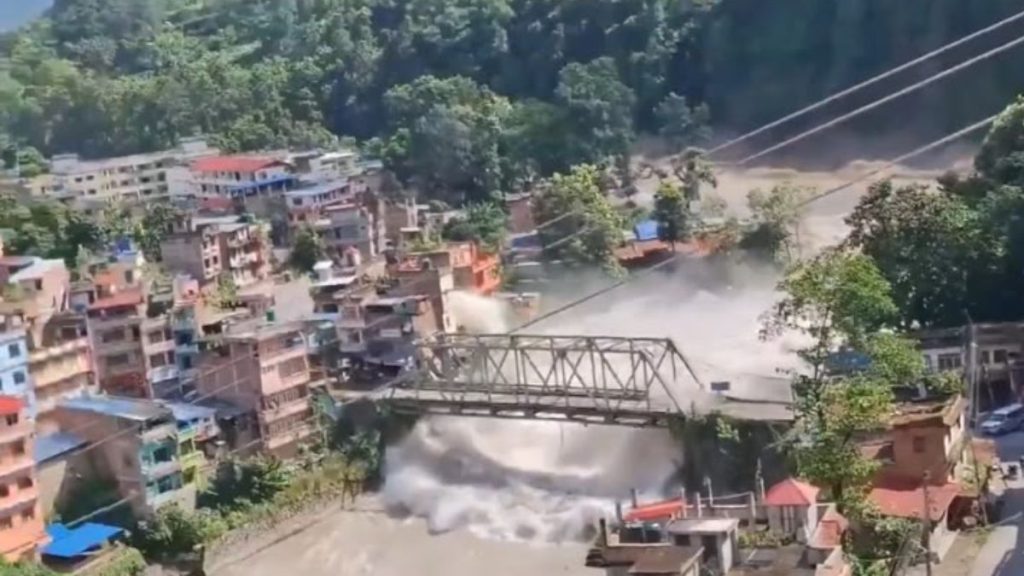
New Delhi: The death toll from the flash floods that tore through northern Nepal rose to at least 95 on Wednesday, as India prepared emergency relief supplies for Nepal and the European Union activated satellite mapping to support the disaster response. Hundreds of people remained missing after floodwaters devastated settlements, roads and power infrastructure in Rasuwa district and adjoining areas near the Nepal-Tibet border.
Reuters reported that rescue teams in Nepal had recovered 95 bodies, citing police, while the toll could rise further as search teams reached areas cut off by damaged roads and high water levels. More than 340 foreign travellers were missing from the affected region, including more than 100 Indians, according to the latest reporting, while dozens of local residents were also unaccounted for.
India steps up relief effort
India has stepped up preparations to send relief material to Nepal by Indian Air Force aircraft, with a C-130J readied to carry medicines, food and other emergency supplies. Additional transport aircraft and rescue personnel have also been kept on standby.
The prime minister, Narendra Modi, spoke to his Nepali counterpart, Balendra Shah, and conveyed his condolences over the loss of lives. Modi said India was ready to provide all possible humanitarian assistance and support Nepal’s rescue and relief efforts.
The Indian embassy in Kathmandu also said it was engaged with Nepali authorities over assistance for Indian nationals affected by the floods. It issued two emergency contact numbers: +977 985 131 6807 and +977 970 910 7500
The embassy said the numbers could be used by those seeking assistance or information about Indian nationals affected by the floods.
The national disaster response force said it had deployed 20 teams across Bihar and Uttar Pradesh as authorities monitored the possible downstream impact of floodwaters from Nepal. Nine teams were positioned in Bihar and 11 in Uttar Pradesh, with additional teams kept on standby.
Authorities in both states were also monitoring river levels and vulnerable low-lying areas as water from Nepal moved downstream through river systems connected to the Gandak and other rivers.
EU activates Copernicus satellite service
The European Union has activated the Copernicus Emergency Management Service to assist the flood response. European commission president Ursula von der Leyen said the service had been activated to help map affected areas in Nepal and support the response on the ground. She also said the EU stood ready to mobilise further assistance.
Copernicus is the European Union’s Earth-observation programme. Its emergency service uses satellite imagery and geospatial data to produce maps that can help disaster-management authorities identify affected areas, assess damage and plan rescue and recovery operations.
The mapping support comes as several roads and access routes in the flood-hit region remain damaged or inaccessible. Rescue helicopters have also faced difficulty reaching some areas because of high water levels, damaged infrastructure and difficult terrain.
More than 100 Indians among those missing
An earlier preliminary list from the Nepal Tourism Board had identified 384 travellers as missing or out of contact, including 105 Indian nationals and 37 NRIs.
RNA Media had earlier reported that the preliminary list included 291 foreign nationals and 93 Nepali citizens.
The tourism-board figure was preliminary and authorities were still checking the identities and whereabouts of those listed. Dozens of local residents were also unaccounted for.
The two figures reflect different stages and classifications in the developing search operation and should not be treated as directly interchangeable.
Villages, roads and power projects swept away
The flood struck the Bhote Koshi and Lhende Khola river system near the Rasuwagadhi border crossing after a huge mass of mud, rock, snow and water surged downstream.
Homes, roads, bridges and hydropower projects were swept away or badly damaged. Television footage and verified videos showed vehicles and buildings being carried by floodwaters as settlements along the river were inundated.
The exact trigger remains under investigation. Preliminary assessments suggested that an ice-rock or snow and rock avalanche may have blocked the Lhende Khola before releasing a debris laden surge downstream. Reuters also reported that a magnitude 4.4 earthquake occurred shortly beforehand, although experts have not established that it caused the avalanche.
Authorities have also warned of the possibility of a second flood because a blockage remains upstream on the Lhende Khola. Residents along the Bhote Koshi have been advised to move away from riverbanks and towards safer ground.
The Nepali Army, Nepal police and Nepali Armed Police Force are continuing search and rescue operations as authorities verify casualty and missing-person figures. India’s relief preparations, embassy assistance and downstream preparedness are continuing alongside the EU’s Copernicus mapping support as Nepal works to reach areas still cut off by the floods.