


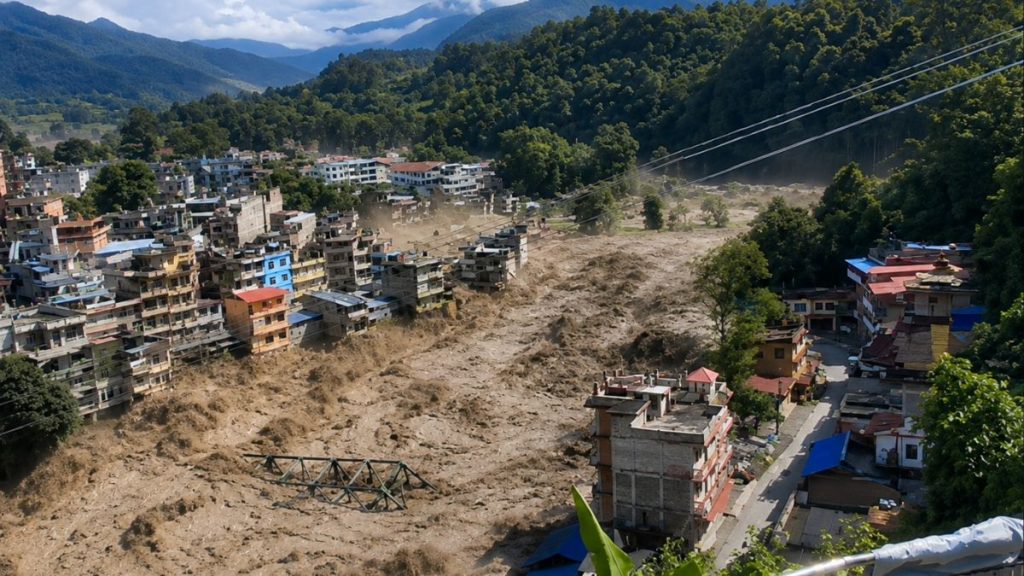
New Delhi: A flash flood tore through the Bhote Koshi River in Nepal’s Rasuwa district at around 8.30am on Wednesday, catching residents and travellers off guard. Nepal’s Department of Hydrology and Meteorology has said it wasn’t triggered by any rainfall in Rasuwa itself, and attention has turned instead to a suspected glacial lake outburst flood, or Glof, upstream on the Tibetan side of the border, though this has not been confirmed.
Timure and Syabrubesi, both close to the Nepal-China border, bore the worst of the damage. The Kathmandu Post reported that the flood also swept through roughly a dozen other settlements along the river, including Betrawati, Mailung and Trishuli Bazaar.
384 tourists missing, at least 8 dead
As the day went on, the scale of the disaster became clearer, both in terms of missing travellers and confirmed casualties. In a situation update issued on Wednesday, the Nepal Tourism Board said a preliminary count from tourism and travel companies had put the number of missing travellers at 384, out of which 291 are foreign nationals and 93 are Nepali nationals.
Separately, the human toll from the flood itself has climbed through the day. Nepal News reported that eight bodies had been recovered and 33 security personnel remained missing, up from the four-to-nine range reported earlier in the morning.
On the rescue side, the Nepal army said it had pulled at least 12 people to safety by Wednesday afternoon, though the Kathmandu Post later put that figure closer to 25.
The tourism board was careful to note the missing-traveller figure was still being checked and cross-verified with travel agencies, guides, local authorities and security agencies, so it may change. Among the nationalities listed as missing were travellers from India, Australia, the Netherlands, South Africa, the United Kingdom and Malaysia.
Indians make up a large share of that number. Samrat Tours & Travels and Leaf Holiday alone accounted for 59 and 46 missing Indian nationals respectively, while Himalayan Glacier, a trekking agency, separately listed 37 non-resident Indians among its missing travellers.
Several other agencies, including Kailash Journey, Trekkers Society and Richa Tours & Travels, said they hadn’t yet confirmed the nationalities of dozens more people on their lists.
The tourism board has set up a toll-free emergency number and a dedicated tourist police line for anyone trying to reach affected travellers, and is asking tourists in the area to stay calm and follow official instructions. Separately, the Trekking Agencies Association of Nepal said more than 500 tourists and pilgrims heading toward the Kailash Mansarovar route were passing through Rasuwa when the flood struck, and their status is still being established.
Glof suspected
A Glof occurs when a glacial lake, often held back by ice, loose rock or debris, suddenly breaches and releases a large volume of water at once. Because that water can travel fast down a mountain valley, it can cause severe flooding downstream even without any local rainfall, which is why the absence of rain in Rasuwa has made a Glof the leading theory so far.
Nothing has been confirmed yet. Authorities in Nepal are working with hydrological data from upstream to establish exactly what happened on the Tibetan side of the border before the surge reached Rasuwa.
The damage to infrastructure has also been significant. A recently built bridge was destroyed, and the Nepal Electricity Authority said several hydropower projects — including Rasuwagadhi, Chilime, and the Trishuli-3A and 3B plants — along with a major substation, were hit.
Given the scale of the disaster, Nepal’s Cabinet has declared the affected areas disaster crisis zones, a step that frees up additional emergency resources and coordination powers.
Nepal’s prime minister, Balendra Shah, has called emergency meetings and told district officers to move residents out of low-lying areas, while the president, Ram Chandra Paudel, has also pushed for the rescue effort to be intensified.
The Nepal army, armed police force and Nepal police have all sent helicopters and ground teams to the area, and the government has waived the usual permission requirements so private helicopters can join the rescue effort too.
What it means for India
The reason this flood matters beyond Nepal comes down to where the water eventually goes. The Bhote Koshi feeds into Nepal’s Trishuli river, which becomes the Gandak river once it crosses into India.
So, whatever moves through Rasuwa today is headed toward Bihar and eastern Uttar Pradesh in the coming hours.
India’s Central Water Commission has already acted on this. In a special flood advisory dated August 26, the commission’s flood forecast monitoring directorate said a sudden rise in the Trishuli river had been recorded at Furke Khola in Nepal, around 160km from the Indian border, and flagged suspected Glof activity near the Nepal-China border as the likely cause.
The advisory said the resulting flood wave would travel downstream into the Gandak river, though it would lose some of its peak intensity along the way, and it asked local authorities in Bihar and Uttar Pradesh along the Gandak to stay alert and monitor the situation closely. It also recommended that the gates of the Gandak barrage be operated so the incoming flood wave can pass through safely.
This kind of warning isn’t unusual for the region. Bihar’s northern districts sit downstream of several rivers that originate in Nepal, and sudden releases or surges from that side of the border have triggered flooding in Bihar before, including a 2014 landslide-blockage of a Kosi tributary that forced the precautionary evacuation of around 150,000 people.
So far, there’s no report of casualties on the Indian side, and the advisory is precautionary rather than a sign that flooding has already reached Indian territory.
But with the cause of Wednesday’s surge still unclear and hundreds of travellers, including a large number of Indians, still unaccounted for in Nepal, authorities on both sides of the border are likely to be watching the Gandak closely over the next few days.