


New Delhi: The last British and American troops have left Iraq, ending the international coalition’s military mission against Islamic State as Iraqis celebrated a withdrawal long associated with demands for national sovereignty. As RNA Media reported on Tuesday and confirmed on Wednesday, the departure places primary responsibility for security with Iraqi forces, while opening a new phase of defence cooperation with Washington and London.
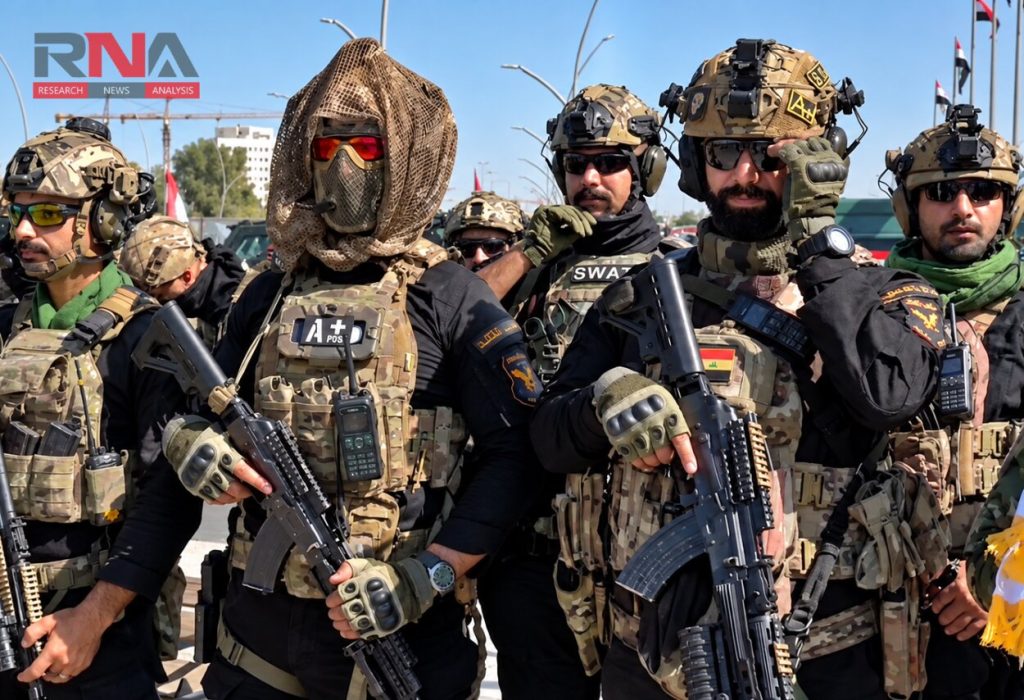
Iraqi security personnel paraded through Baghdad and the Shia holy city of Najaf to mark the occasion, bringing a public display of celebration to a country scarred by invasion, insurgency and prolonged foreign military involvement. However, the jubilation was accompanied by concern among some Iraqis about Islamic State remnants and the influence of armed groups operating beyond effective government control.
The US military said its forces and equipment had completed their departure from Irbil airbase, the coalition’s principal operational hub in Iraq’s semi-autonomous Kurdistan region. Britain’s defence ministry separately confirmed that its personnel had also left as the coalition’s Iraq mission concluded.
The prime minister of Iraq, Ali al-Zaidi, presented the handover as a milestone towards stronger institutions and national control over security decisions. At the handover ceremony, he said Iraqi forces would continue fighting Islamic State and pledged to ensure that weapons no longer remained in the hands of non-state groups.
The departure follows a transition framework announced in 2024, which envisaged replacing the coalition’s military role with bilateral security partnerships. Its phased timetable distinguished between ending the coalition mission in Iraq and temporarily retaining facilities there to support counter-Islamic State operations in neighbouring Syria until at least September 2026.
That distinction explains why the withdrawal unfolded over an extended period rather than through a single departure. According to US Central Command, American and coalition forces began leaving federal Iraq in October 2025, with the final stage involving the removal of personnel and equipment from Erbil during September.
Operation Inherent Resolve was established in 2014 to help Iraqi and Syrian partners confront Islamic State, whose territorial expansion had overwhelmed local security forces. Over the following decade, the coalition combined military operations with training and assistance intended to enable those partners to prevent the organization’s return.
Britain’s contribution, known as Operation Shader, included training and assistance for more than 111,000 Iraqi security personnel, including over 21,000 members of the Kurdish Peshmerga. The ministry of defence said this covered infantry skills, weapons maintenance, countering improvised explosive devices, medical support and engineering.
The Royal Air Force also conducted thousands of sorties and struck more than 2,300 Islamic State targets, alongside surveillance and reconnaissance supporting ground operations. London said future cooperation would encompass counterterrorism, military education, capability development and defence industrial collaboration, while Operation Shader would continue as part of the wider effort against the group.
The end of the Iraq deployment therefore does not terminate the coalition’s regional counterterrorism operations. US Central Command said the combined joint task force remained operational, with its headquarters now in Jordan, while American forces continued their mission against Islamic State in Syria alongside coalition partners and the Syrian government.
Washington has assessed that the Iraqi forces, including Kurdish security units, now possess the operational independence required to manage threats within their country. It nevertheless said coalition forces elsewhere in the region would remain ready to respond to emerging Islamic State threats, underscoring the continuing need for vigilance after the handover.
The more difficult political question concerns Baghdad’s ability to bring powerful armed factions under state authority. A UK House of Commons Library briefing records that the government has extended its militia disarmament deadline to June 30, 2027, after initially linking the process to the foreign troop withdrawal.
The government’s proposed measures include integrating members of armed factions into state forces, offering posts to those surrendering weapons and continuing a weapons buyback programme. Yet major groups have resisted disarmament, making the transfer of actual command and allegiance to national institutions a more demanding task than announcing a timetable.
Celebrations have also exposed differences between political constituencies: Iran-aligned factions welcomed the withdrawal, while Kurdish officials expressed anxiety over the removal of American air defence systems. Those contrasting responses underline the challenge ahead – translating the departure of foreign troops into security that Iraq’s different communities can trust.