


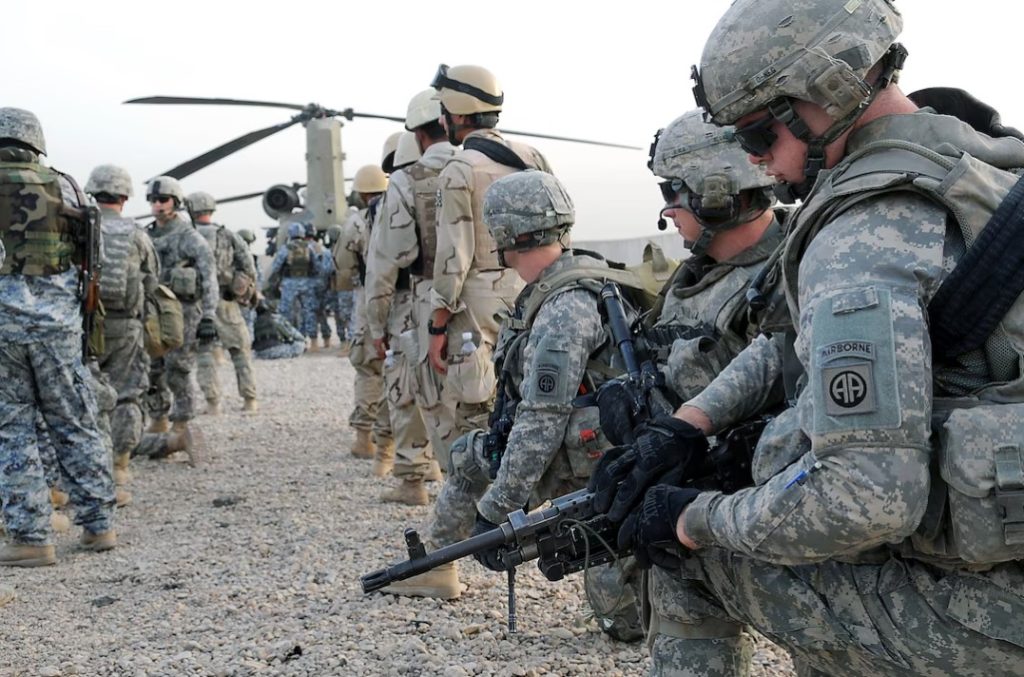
New Delhi: The last US troops in Iraq are due to leave their remaining bases by Wednesday, ending a military presence that began with the 2003 invasion and cost about 4,500 American lives. Tehran and its allied armed groups are already presenting the exit as a victory, even as Washington fights a war against Iran and Iraqi security officials warn of a widening security vacuum.
The pullout follows an agreement reached in September 2024 under the then US president, Joe Biden, and is being carried out by the administration of the US president, Donald Trump. On August 12, the Iraqi prime minister, Ali al-Zaidi, reaffirmed after meeting the commander of US Central Command, Admiral Brad Cooper, that September 30 was the fixed and final date for the coalition’s mission to end.
A US official said Washington expected to finish the withdrawal on time but declined to say how many troops were still in the country or where they would be redeployed. About 2,500 American soldiers had stayed on after coalition combat operations ended in 2021, training Iraqi forces and supporting counterterrorism work.
American forces entered Iraq in 2003 to topple the regime of the Sunni president, Saddam Hussein, stayed on to install a Shia-led government and fought a long counterinsurgency before leaving at the end of 2011. They returned in 2014 at Baghdad’s invitation, when the Islamic State group overran large parts of Iraq and Syria, and helped Iraqi forces defeat it in a war that lasted until 2017. Roughly twice as many Americans died in Iraq as in the parallel war in Afghanistan, which ended with a chaotic US exit in 2021.
Iraq has long been the only country to keep close political and military ties with both Washington and Tehran, and each has used its soil as a proxy arena. The US killed Iran’s top commander, Qasem Soleimani, in a strike at Baghdad airport in 2020, and Iran-backed groups repeatedly fired on American bases, sometimes drawing retaliation. In the current war against Iran, seven of the 18 US service members killed died in Iraq, the last of them a soldier who was killed in July during the controlled detonation of a drone at a base near Irbil.
Iran, which says it wants American forces out of the entire Middle East, has cast the departure as a win for its “axis of resistance” of allied armed groups. The deputy chairman of the National Security Commission of Iran’s parliament, Amir Hayat Moqaddam, said on Monday that Tehran welcomed the withdrawal and expected lasting security to follow. He added that resistance groups were “sometimes targeting and confronting American troops” at present.
Abu Mojtaba al-Yasiri, a commander in the Islamic Resistance in Iraq, an umbrella body of Iran-backed factions, called the exit a historic victory and “a crushing defeat for the American project”. He said the groups would mark September 30 as the closing of a black page in Iraqi history. Baghdad itself has made the date a new national holiday by the name of “Sovereignty Day”.
Iraqi security analysts see a strategic gain for Tehran. Jasim al-Bahadli, who studies Shia armed groups aligned with Iran, said the coalition had for years acted as a counterweight to Iranian influence and predicted that the militias would try to convert the moment into greater sway over security and political decisions. Analysis published by Arab News makes a similar argument, saying the groups are after lasting political, security and economic influence and will not simply fold once the Americans are gone.
That question is tied to Baghdad’s plan to bring armed groups under state control, which the government had linked to the same deadline on the logic that the departure of foreign troops removes any justification for holding weapons. Powerful factions such as Kata’ib Hezbollah, Kata’ib Sayyid al-Shuhada and Harakat Hezbollah al-Nujaba have rejected disarming by September 30, although not disarmament itself. A senior adviser to Zaidi has since said the committee overseeing the process has no fixed deadline and that the date applies only to the coalition’s exit.
Iraqi media have reported that the effort will begin with a 90-day halt to all militia attacks from September 30, according to the Soufan Center. Two Iraqi government sources also told Kurdistan24 that Washington could halt dollar transfers to Iraq if the factions do not disarm, a threat that carries weight because Iraq’s oil revenue is held in an account at the Federal Reserve Bank of New York. Neither report has been officially confirmed.
Washington accuses Iran-backed militias in Iraq of striking neighbouring countries at Tehran’s direction, most recently a major Saudi oil pipeline this month. Baghdad says it is trying to curb their influence, and Iraq has denied that the attacks on Saudi facilities came from its territory.
Iraqi officials in Baghdad and in the Kurdish north also fear that the withdrawal will give fresh life to the Islamic State, whose sleeper cells survived the collapse of its self-declared caliphate nearly a decade ago. At its peak, the group held a third of Iraq. The Kurdish commander Sirwan Barzani said the loss of American intelligence, logistics and drones would give it room to regroup, and that his forces had noticed sleeper-cell movement for more than two weeks after the withdrawal was publicized.
Iraqi security forces have said a suspected Islamic State cell was preparing suicide attacks to coincide with the pullout, according to four Iraqi security and army officials. Colonel Khalid al-Bayati, a senior security official in Kirkuk, said the group wanted to show it could still carry out deadly attacks.
The departure itself is broadly popular among Iraqis, but many worry about its timing. Abdulrahman al-Zobaie, a Sunni tribal leader in Fallujah, once a stronghold of anti-American resistance, said Iraq was not yet ready to take charge of its own security and that a vacuum was what people feared most.
The developments also matter beyond the region. Iraq has for years been among India’s largest suppliers of crude oil, and any renewed instability in Iraq or attacks on Gulf energy infrastructure bear directly on India’s energy security.
The coming weeks will show whether the militias honour the proposed truce, whether Baghdad can advance disarmament without American pressure turning into economic penalties, and whether the Islamic State can exploit the gap.