


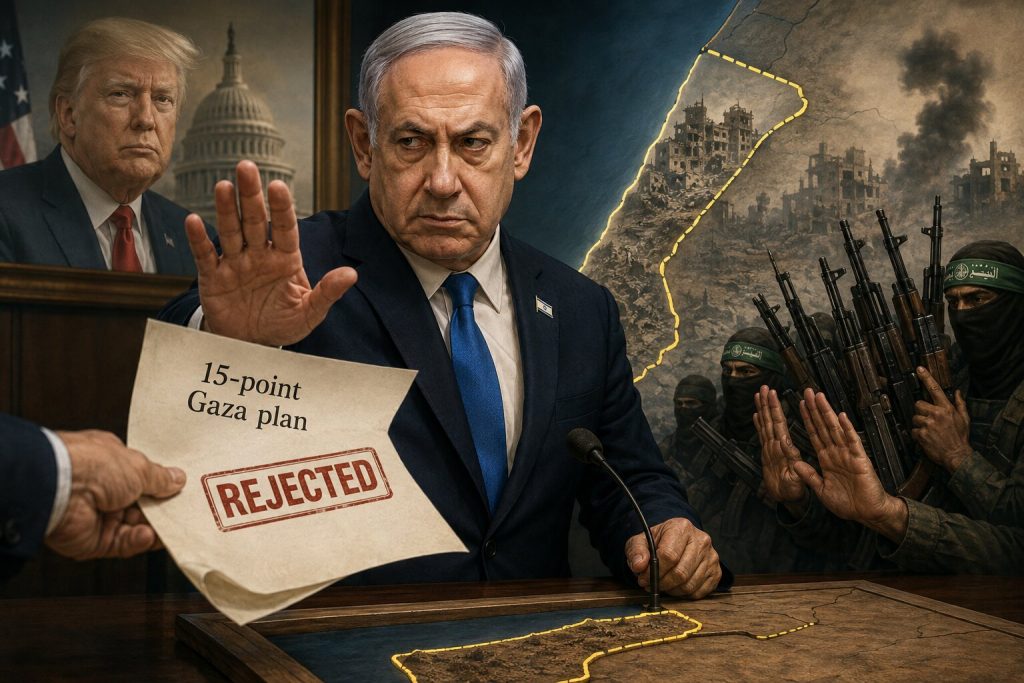
New Delhi: Israel has formally rejected the 15-point Gaza roadmap put forward by the administration of the US president, Donald Trump, with the prime minister, Benjamin Netanyahu, telling his cabinet on Sunday that Israeli forces will not withdraw from Gaza until Hamas is fully disarmed. The statement, delivered at the weekly cabinet meeting in Jerusalem, puts an end to weeks of deliberate ambiguity over Israel’s position on the disarmament framework drawn up by the Trump-appointed “Board of Peace”.
“Israel rejects the 15-point document,” Netanyahu told ministers, pushing back against suggestions that his government had quietly signed on to the plan. He said Israeli troops would not move an inch from their current positions until Hamas surrenders every category of weapon it holds.
That, he clarified, means heavy weapons and light ones alike, and nothing short of what he called genuine decommissioning. Netanyahu also used the occasion to rule out a Palestinian state for as long as he remains in office, extending that position to both Gaza and the West Bank.
No pullback without full disarmament, says Netanyahu
Sunday’s remarks were Netanyahu’s most direct yet on a document that had, until now, been contested largely through unnamed officials and political proxies. On August 4, he had gone only as far as a recorded video statement insisting Israel had “not agreed” to the terms, without using the word “reject” outright.
His government has separately told Washington that its concerns have been formally conveyed, and that some American proposals to bridge the gap are workable while others are not. Netanyahu described discussions with US counterparts as ongoing, even as he ruled out compromise on the central sequencing question.
The 15-point document builds on the 20-point Gaza plan that Trump unveiled in late 2025 and which underpinned the ceasefire reached that October. It sets out the mechanics for decommissioning Hamas’s arsenal and shifting Gaza to civilian governance under the oversight of the Board of Peace, a body Trump established in January 2026 and which is led by its high representative for Gaza, Nickolay Mladenov.
Under the roadmap, an Israeli withdrawal beyond the so-called Yellow Line – the demarcation set by the October 2025 ceasefire – is meant to follow, not precede, Hamas’s disarmament. Netanyahu’s position effectively inverts that sequence in practice, since he has offered no timeline for withdrawal even as decommissioning talks continue.
Mladenov met Netanyahu in Jerusalem on August 3 for what the Board of Peace described as constructive discussions on the decommissioning process. He is also understood to have urged Israel to scale back its strikes on Gaza, a request that has gone largely unheeded.
Hamas says ‘honouring’ roadmap
Hamas maintains that it has kept its side of the bargain. A senior politburo member, Bassem Naim, wrote on X on Sunday that the group remains committed to the roadmap set out by Trump’s Board of Peace, and called on mediators and Washington to press Netanyahu to fall in line rather than stall the process for domestic political reasons.
The group had earlier said its disarmament would proceed in stages, with heavier weapons surrendered only after a full Israeli withdrawal and a durable halt to hostilities, and full compliance conditional on progress toward Palestinian statehood. Gaza’s health ministry says Israeli strikes have killed more than 1,200 Palestinians since the October 2025 ceasefire took hold, including at least 36 since the disarmament roadmap was announced in July.
Netanyahu’s rejection was welcomed by the hardliners in his coalition. The finance minister, Bezalel Smotrich, said the Israel Defense Forces could not retreat “one millimetre” in Gaza, a line that echoes long-standing demands from the settler wing of the government for permanent Israeli control over parts of the territory.
The timing is not incidental. Netanyahu faces elections due in October 2026, and his handling of both the Gaza file and the earlier conflict with Iran is widely expected to weigh heavily on the outcome.
From 20 points to 15
The war itself dates back to October 7, 2023, when Hamas-led fighters killed around 1,200 people in Israel and took 251 others hostage, triggering an Israeli military campaign that Gaza’s health ministry says has killed more than 73,000 Palestinians. A ceasefire brokered under Trump’s original 20-point plan took hold in October 2025, bringing phased hostage-for-prisoner exchanges and a partial Israeli pullback to the Yellow Line.
Trump announced what he called a historic breakthrough on the follow-on disarmament deal at the end of July, saying Hamas had agreed to lay down its weapons. Sunday’s cabinet statement makes clear that Israel views that framework very differently from how it was first presented to the public.
This is not the first US-brokered Gaza framework Israel has balked at. The original 20-point plan itself required weeks of quiet renegotiation before Netanyahu endorsed it in September 2025, and the follow-on 15-point disarmament document has now met the same fate.
By insisting on complete Hamas disarmament as a precondition rather than a negotiated outcome, Netanyahu is effectively asking Hamas to surrender its principal source of leverage before substantive talks even begin. Analysts tracking the process say that stance narrows the room for a near-term breakthrough considerably.
For now, the practical picture on the ground remains unchanged. Israeli forces continue to hold more than half of Gaza’s territory, reconstruction remains stalled, and a document that Washington had billed as a historic turning point sits rejected by one of its two principal signatories.