


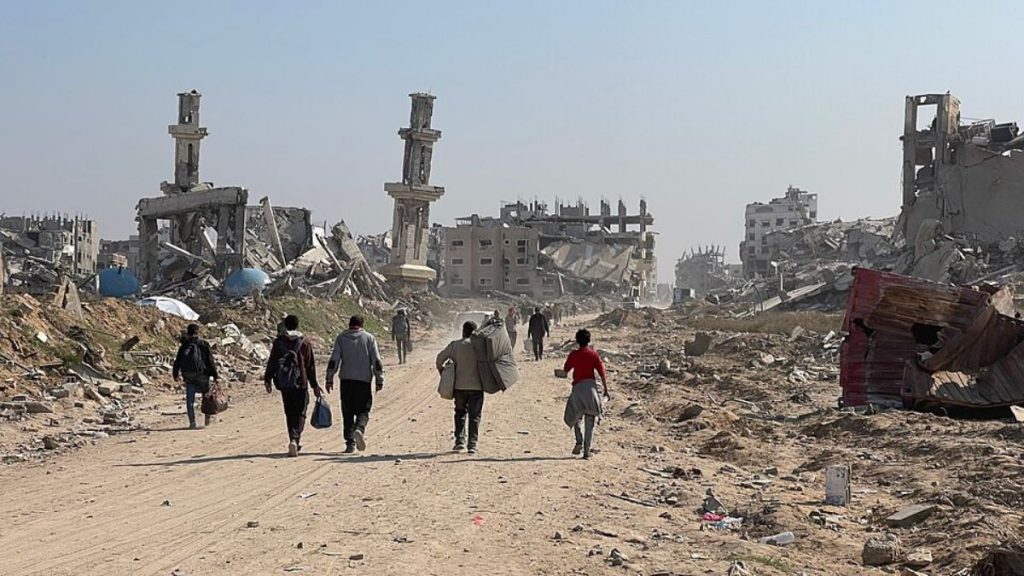
New Delhi: The US president, Donald Trump, said on Thursday that his Board of Peace, the international body he set up to oversee the Gaza ceasefire, had reached an agreement covering the complete disarmament of Hamas and all other armed groups in the territory. He wrote on Truth Social that the deal was “a critical step towards Gaza finally being governed by a new Palestinian government that will work closely with the Board of Peace to help the Palestinian people.”
Trump described the agreement as a major milestone in his broader 20-point Gaza peace plan, first agreed nine months ago. He said it would be carried out in structured phases rather than all at once.
He said Israeli forces would withdraw as disarmament was completed, with the International Stabilization Force then working alongside a new Palestinian police force to secure Gaza. The deal was mediated by Egypt, Qatar and Turkey through the Board of Peace.
As of Thursday evening, Hamas had not formally confirmed the agreement. The Board of Peace itself said in a statement that Hamas had, for the first time, committed to an actionable plan for giving up all its weapons.
Why it matters
Hamas’s disarmament has been the toughest sticking point in ceasefire talks. Israel has insisted on it as a precondition for further steps, while Hamas has resisted for years, calling armed resistance central to its identity.
Under the plan, weapons would be handed over to a verification committee in stages, with police weapons transferred first and personal weapons last. Officials say the full process could take roughly seven to eight months to complete.
A Board of Peace official said the agreement was designed around “zero trust”, since Hamas and Israel have each distrusted the other from the outset, so monitors will verify that both sides have met their obligations before each stage advances. Under the arrangement, Israeli forces would first pull back to the so-called “yellow line” established after last October’s ceasefire, with any further withdrawal to follow only once Hamas’s disarmament is complete.
Unresolved questions
Israeli officials remain deeply sceptical that Hamas will actually surrender its weapons, and comments from a senior Hamas official suggest the sequencing of disarmament and Israel’s withdrawal could still be contested. Israel has not officially responded to Trump’s announcement.
US and Board of Peace officials described the deal as the outcome of an eight-month process to turn Trump’s 20-point plan into a workable framework for a rebuilt Gaza. Officials said Hamas had been reluctant to give up its weapons and tunnels, fearing Israel would not follow through on its own commitments.
The war began after Hamas’s October 7, 2023 attack on Israel, which killed about 1,200 people and saw 251 taken hostage. Israel’s campaign in Gaza has since killed tens of thousands of Palestinians, according to Gaza’s health ministry, figures the UN has generally regarded as reliable.
Gaza’s maternal health crisis deepens
A separate UN report finds a sharp deterioration in maternal health in Gaza through the first half of 2026, a trend that has continued despite the ceasefire. Miscarriages more than tripled to 3,950 between January and June, up from 1,197 in the previous six months, a rate of 208.5 per 1,000 live births, or roughly one in six pregnancies.
April was the worst month, with more than a quarter of pregnancies reportedly ending in loss. About 74% of miscarriages occurred in the first trimester.
Births have fallen 3.2% since late 2025. Nearly half of deliveries are now by caesarean section, largely due to severe bleeding, hypertension and infection, while 57% of pregnant women are anaemic, doctors say.
The UN Population Fund has not identified one definitive cause. Doctors point to several possible factors, including prolonged malnutrition and unsafe water, Dr Ahmed al-Farra of Nasser Hospital said residents get just three litres of water a day, 90% of it unfit to drink.
Chronic wartime stress and possible environmental contamination are also being examined, though there is no conclusive evidence yet on the latter. One physician, Dr James Smith, suggested part of the rise may reflect better hospital screening now possible under the ceasefire.
A separate food security report found conditions have eased since more aid began entering Gaza, though 1.4 million people remain acutely food insecure and 212,000 are at emergency levels. Gaza’s health ministry says more than 450 people have died of malnutrition during the war, far fewer than earlier projections had warned.