


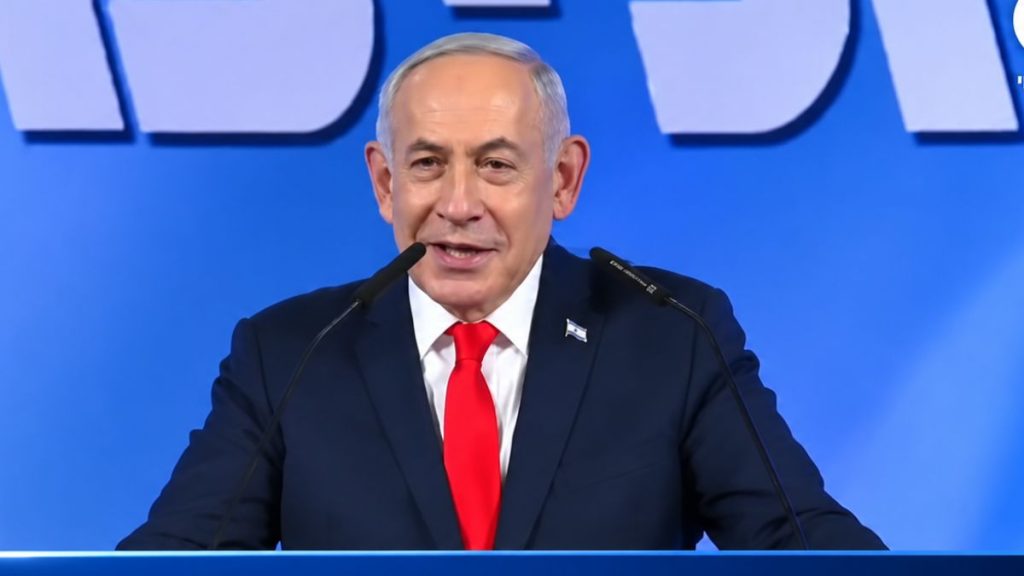
New Delhi: Israel’s general election has left prime minister, Benjamin Netanyahu, and opposition leader Gadi Eisenkot without a parliamentary majority, setting up difficult coalition negotiations. Projected record gains for Arab-led parties have made their support potentially decisive, although major disagreements could prevent an alternative government.
With counting continuing on Thursday, the latest projections gave Netanyahu’s right-wing and religious bloc 53 seats, Eisenkot’s opposition bloc 48 and Arab-led parties 19. The 120-member Knesset requires 61 seats for a majority, while separately counted absentee ballots could still alter the provisional figures.
Netanyahu’s Likud remained the largest individual party, but that does not automatically secure him another term. He has called for a “strong right-wing national government” and rejected an administration dependent on Arab-led parties, while his far-right and ultra-orthodox allies also complicate potential unity arrangements.
Netanyahu warned against a “dangerous government” involving Arab-led parties, whose constituents account for approximately 20 per cent of Israel’s population. Although Likud remained the largest party, its vote share stood at 20.7 per cent in Wednesday’s partial count, down from 23.4 per cent in the 2022 election. His far-right ally, national security minister, Itamar Ben-Gvir, also appeared to have lost electoral support.
His Likud party accused Arab-led parties of stealing the election through widespread irregularities. It said it had submitted supporting material, but no evidence establishing systematic fraud has been made public. A police source told Israeli media on Thursday that there was no investigative or intelligence evidence supporting the broader allegations. An elections committee official also dismissed them.
The central elections committee said reports of voting irregularities were substantially lower than in previous elections
Eisenkot faces an uneasy coalition choice
Eisenkot, a former military chief who leads the centrist Yashar party, has left open cooperation with Arab-led parties if they recognize Israel as a Jewish state and Hamas as an extremist organization, according to Associated Press. Several potential Jewish-led opposition partners, including Naftali Bennett and Avigdor Lieberman, have rejected reliance on those parties.
The joint list and Mansour Abbas’s Ra’am are separate political formations with differing priorities. Joint list leader, Yousef Jabareen, has indicated willingness to support an anti-Netanyahu government from outside, while Abbas has previously joined a governing coalition and focused his campaign on crime and public services in Arab communities.
Their projected 19 seats would exceed the previous record of 15, helped by unusually strong Arab voter participation. Nationwide turnout stood at approximately 77.7 per cent at the close of polling, the highest at that stage since 1999.
The campaign was shaped by disputes over accountability for the October 7, 2023, Hamas-led attacks, subsequent wars and exemptions from compulsory military service for ultra-Orthodox Jewish men.
What happens next
As RNA Media reported on Wednesday, early counting already pointed towards a coalition impasse. Once results are certified, expected by November 4, president, Isaac Herzog, will consult parties and task a lawmaker with forming a government. The candidate normally has 28 days, extendable by 14.
The president, Isaac Herzog, urged political parties to prevent another election, saying, “We must do everything we can, certainly after yesterday, to avoid another round of elections.” Although Likud remained the largest party, the president is not legally required to nominate its leader to form the next government.
Netanyahu could seek additional partners, Eisenkot could explore direct or external Arab-party support, and rivals could discuss a unity government. If successive attempts fail, another election remains possible.
For now, Netanyahu stays in office in a caretaker capacity, but the election has settled neither the premiership nor the composition of Israel’s next government.