


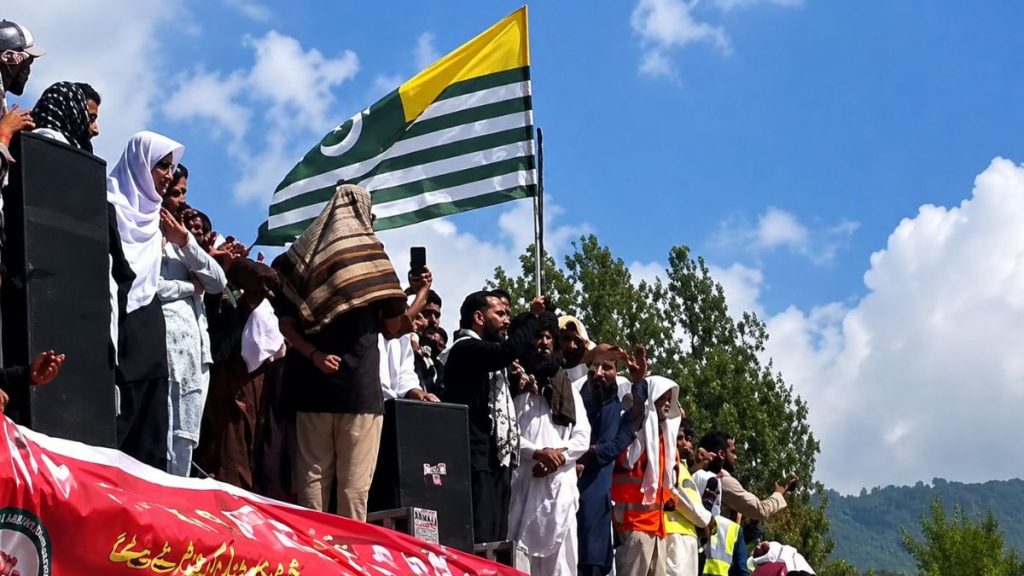
New Delhi: Pakistan’s August 14 Independence Day celebrations unfolded in Pakistan-occupied Kashmir (POK) amid a deepening confrontation between Pakistani authorities and the Joint Awami Action Committee (JAAC), the region’s main protest movement. Reports have alleged threats and coercion on residents to participate in official programmes, though communications restrictions and limited independent media access make individual claims difficult to verify.
According to reports emanating from several parts of POK, the JAAC had called for August 13 and 14 to be observed as “Black Days”, with demonstrations planned against what the group describes as repression, excessive use of force and Islamabad’s political control over the territory. The call placed official Independence Day celebrations against an unusually visible campaign of dissent.
Blackout clouds picture
The difficulty in establishing what happened on the ground is itself part of the story. Amnesty International said on July 28 that mobile internet services in POK had remained suspended since June 5 and warned that the communications blackout was preventing independent verification of reports of lethal force against protesters.
International media separately documented internet blackouts, road closures and restricted access during the unrest and regional elections. On August 10, it reported that road and internet access to Rawalakot remained largely cut off after deadly clashes, while voting in seven constituencies had been postponed because of security concerns.
Journalists have also faced tighter restrictions. The Committee to Protect Journalists (CPJ) said on August 6 that Pakistan had introduced rules requiring journalists working for international media organisations to obtain government authorization before reporting outside Islamabad, Karachi and Lahore. CPJ said the measures were likely to restrict coverage of the unrest in POK.
CPJ has also documented the detention of journalists covering developments linked to the protests. Syed Farhad Ali Shah was detained after reporting on JAAC demonstrations, while journalist Sohrab Barkat was arrested in June over reports on the political situation and protests in Pakistan-occupied Kashmir.
From economic anger to political confrontation
The unrest grew out of grievances over electricity prices, subsidised flour, economic conditions and political representation before increasingly focusing on the region’s electoral structure. The JAAC has opposed 12 seats in the 45-seat directly electedassembly reserved for constituencies representing refugees from Jammu & Kashmir who live elsewhere in Pakistan.
JAAC argues that the arrangement dilutes local representation and gives Islamabad undue influence over regional politics. Pakistani government officials have rejected allegations that the reserved seats are used to manipulate the political process.
The confrontation escalated after JAAC was banned under anti-terrorism laws in June. As RNA Media had reported, nearly 100 people have been killed and hundreds injured during crackdown on protesters, so far. Hundreds more have been detained.
Pakistani authorities have disputed allegations of deliberate attacks on peaceful protesters. Officials told Reuters during clashes in July that security forces had acted in self-defence after protesters blocked a convoy and attacked officials.
India points to bullets and blackouts
India has used the unrest to intensify criticism of Pakistan’s occupation of the territory. On August 11, the Ministry of External Affairs spokesman, Randhir Jaiswal, said public discontent in POK had been answered with “bullets and blackouts and repression and oppression”, and called on the international community to hold Pakistan accountable.
The claims surrounding Pakistan’s Independence Day therefore sit inside a wider contest over political representation, state authority and control of information. What can be established is that August 14 arrived while parts of POK were under severe communications restrictions and an organised protest movement was calling on residents to reject the official narrative.
What remains harder to establish is the scale and method of any coercion used to secure participation in official celebrations. The same internet shutdowns and restrictions on journalists that have accompanied the unrest have also made it difficult for independent observers to determine precisely what is happening inside affected areas.