


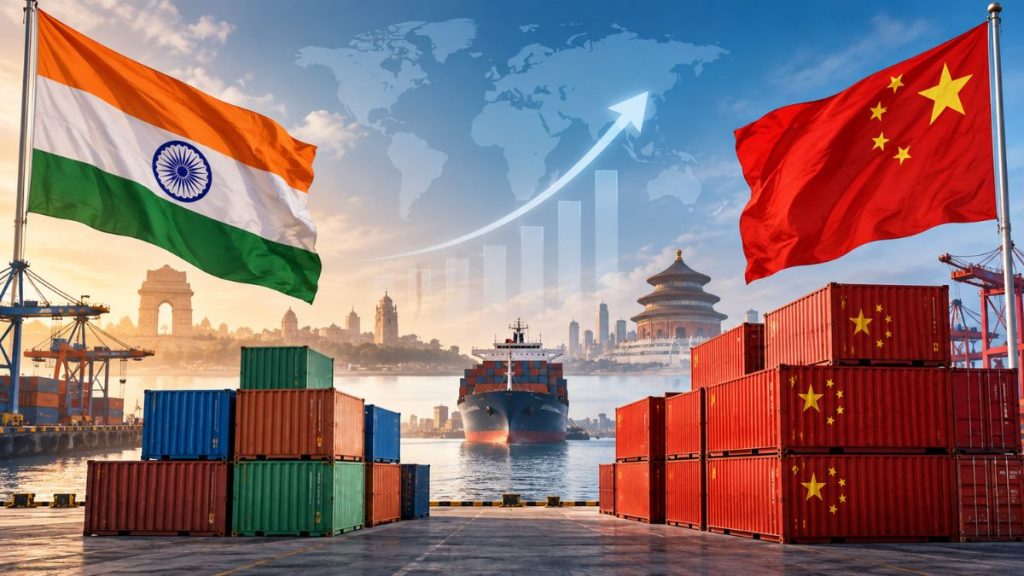
New Delhi: India’s merchandise exports to China rose 38.71 per cent year-on-year to $9.61 billion during April-August 2026, driven by stronger shipments of electronics, engineering goods and other industrial products. The rise has come as New Delhi and Beijing reopen discussions on structural trade imbalances, supply chain concerns and market access.
The headline number is striking, but the trade arithmetic remains heavily skewed. Imports from China rose 27.01 per cent to $65.49 billion during the same five months, taking India’s bilateral deficit to about $55.9 billion. In the financial year 2025-26, India exported $19.47 billion of goods to China but imported $131.63 billion, leaving a record $112.16 billion deficit.
Why 39% growth does not change the arithmetic
The latest increase matters because it is coming from sectors in which India has traditionally depended heavily on Chinese supplies. Engineering goods accounted for 20.73 per cent of the increase in exports to China during April-August, followed by electronic goods at 15.4 per cent, petroleum products at 13.55 per cent, chemicals at 10.53 per cent and iron ore at 9.97 per cent.
Electronics is the clearest example. India’s printed circuit board assembly exports to China rose from about $36 million in financial year 2024-25 to $1.5 billion in 2025-26, nearly 80 per cent of India’s total exports in that category. Industry executives cited in recent media reports have linked part of the demand to the expansion of artificial intelligence infrastructure and data centres.
But the low base matters. A 39 per cent rise from roughly $6.9 billion a year earlier adds far less to India’s trade position than a 27 per cent increase in imports from a much larger base. The April-August deficit therefore widened rather than narrowed.
There is another complication. China is a major source of machinery, electronics, integrated circuits, telecom equipment, lithium-ion batteries, chemicals, active pharmaceutical ingredients and other intermediate or capital goods used by Indian manufacturers. In electronics alone, India imported about $46.4 billion from China in the financial year 2025-26.
Lower imports are therefore not automatically better. If Indian factories continue to rely on Chinese upstream inputs while exporting more assemblies or finished products, the relationship could evolve into a denser two-way supply chain without producing a dramatic fall in the deficit.
What would make the shift structural?
That will depend less on one strong five-month period than on whether export growth becomes broader and sustained. As RNA Media reported earlier, the prime minister, Narendra Modi, and the Chinese president, Xi Jinping, agreed on September 12 that both sides should address structural trade imbalances and supply chain issues and facilitate meaningful and predictable market access.
India has sought such access before. In 2018, the two sides agreed on a roadmap for more balanced trade and discussed greater access for Indian rice, oil meals, fruits, vegetables and pharmaceuticals. Some protocols followed, but the deficit, after falling to $48.65 billion in the financial year 2019-20, rose to $99.21 billion in 2024-25 and $112.16 billion last year.
Pharmaceuticals illustrate the scale of the untapped opportunity. Niti Aayog, using international trade data for pharmaceutical products, estimated that China imported $40.4 billion worth of such products in 2025, while India supplied only about $80 million, or 0.2 per cent of that market. Broader Indian trade data show pharmaceutical exports to China fell 11.54 per cent to $287.42 million in the financial year 2025-26, with exporters citing regulatory approvals, intense local price competition and procurement preferences among the barriers to greater market access.
A durable narrowing would require more than stronger electronics sales. India would need sustained gains across engineering goods, pharmaceuticals, chemicals, agriculture, marine products and industrial components, alongside higher domestic production of critical inputs now sourced from China.
Three outcomes remain possible. The current surge could fade if artificial intelligence related demand cools. Exports could keep growing while imports rise with Indian manufacturing, leaving the deficit broadly intact. Or a wider export base, better Chinese market access and deeper domestic value addition could gradually reduce the gap over several years.
The evidence to watch is whether export growth lasts across several quarters, spreads across sectors and moves towards higher-value products. For now, the rise is important, but it is too early to call it a structural reversal in India-China trade.