


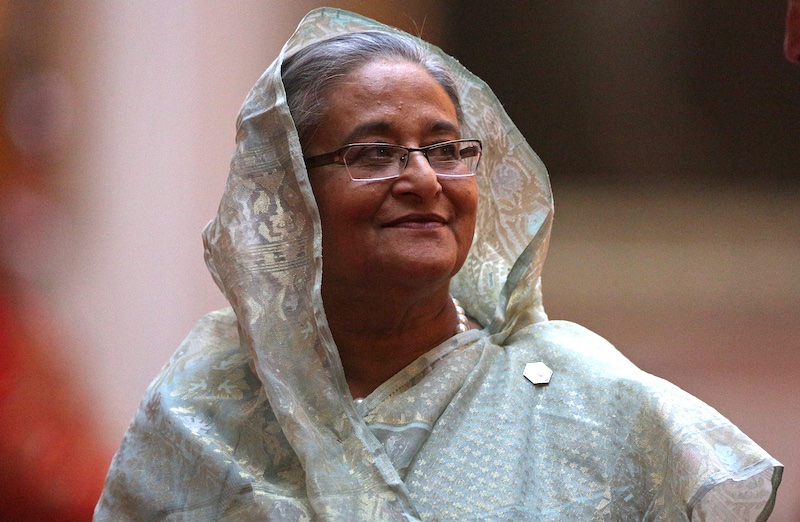
New Delhi: Bangladesh has disputed reports that its ousted prime minister, Sheikh Hasina, has formally applied for a new passport, saying a request submitted by a law firm on her behalf does not amount to a valid personal application. The clarification, issued on Tuesday, has raised fresh questions over the authenticity and legal standing of a communication sent to the Bangladesh high commission in New Delhi seeking travel and identity documents for the former leader.
The Bangladeshi prime minister’s information and broadcasting advisor, Zahed Ur Rahman, said Hasina had neither submitted a passport application herself nor completed the formalities required for the authorities to consider one. He explained that although a legal firm had approached Bangladesh’s diplomatic mission seeking arrangements to issue her a passport, the initiative could not be treated as an application made by Hasina.
Speaking at a weekly government briefing at the secretariat in Dhaka, Rahman rejected the premise of media reports suggesting that the former prime minister had already initiated the formal process. His remarks introduced an important procedural distinction into a controversy that had previously centred on whether Bangladesh would agree to issue fresh documents to a former leader convicted of crimes against humanity.
The controversy began after Matrix Chambers, a London-based legal firm claiming to represent Hasina, emailed the Bangladesh high commission on Monday, seeking a replacement passport and national identity card. The correspondence was widely interpreted as evidence that Hasina was preparing to return to Bangladesh in December, more than two years after fleeing to India following the collapse of her government.
However, Bangladesh’s diplomatic officials subsequently questioned whether the communication established that Hasina had personally authorized the request. The mission’s press minister, Mohammad Saidur Rahman, told the Daily Star that the email contained no documentary evidence confirming the law firm’s authority to act on her behalf, although it had been forwarded to the foreign ministry for consideration.
The issue is significant because an application for a passport involves verification of the applicant’s identity, eligibility and authorization, rather than merely a request for a document. A lawyer may communicate with diplomatic authorities on a client’s behalf, but such correspondence does not necessarily establish that the client has satisfied the formal requirements for obtaining a passport.
Passport dispute raises questions over due process
The latest clarification also marks a shift from the position outlined by Bangladesh’s home minister, Salahuddin Ahmed, on Monday, when he said the government was examining the legal basis of Hasina’s reported request. According to an AFP report, Ahmed had indicated that the authorities would assess whether the application followed proper procedures and whether Hasina was legally entitled to seek a passport.
Rahman’s statement, however, suggests that the government does not consider a formal application to have been made in the first place. This leaves two separate questions unresolved: whether the law firm can establish that it was authorized to act for Hasina and whether the former prime minister would be eligible for fresh travel documents even after submitting a valid application.
The adviser also maintained that Hasina’s possession of a passport was irrelevant to Bangladesh’s efforts to secure her return from India, where she has lived since August 5, 2024. He said Dhaka had already requested her extradition under the existing bilateral treaty and argued that her publicly expressed willingness to return should remove the need for prolonged legal proceedings.
Rahman further emphasized that Hasina had been convicted of crimes against humanity rather than an ordinary criminal offence, referring to Article 47 of Bangladesh’s Constitution when discussing the legal consequences of such convictions. His interpretation, however, represents the government’s position and does not independently resolve the constitutional and extradition questions that could arise if India agrees to consider her transfer.
Hasina was sentenced to death in absentia by Bangladesh’s international crimes tribunal in November 2025 over the violent suppression of the student-led uprising that ended her 15-year rule. She has denied wrongdoing and challenged the proceedings, while her announcement of a possible December return has renewed debate over her legal position and political future. The immediate issue, nevertheless, is narrower than the wider dispute over her conviction or extradition.
Bangladesh’s latest position is that no passport application can be attributed formally to Hasina merely because a law firm has requested documents in her name, leaving the reported initiative procedurally unresolved until her personal authorization and compliance with the prescribed application requirements are established.