


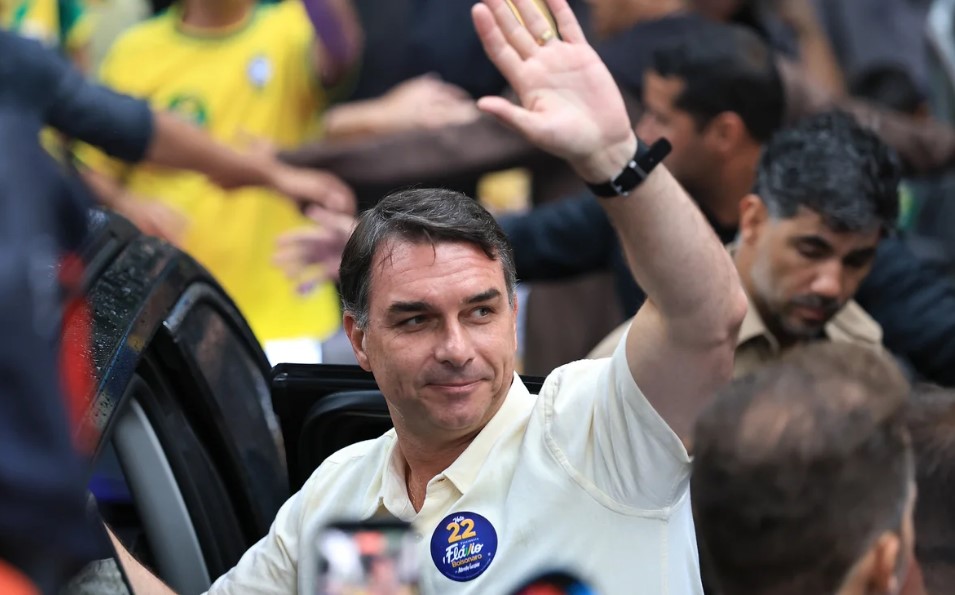
New Delhi: Brazil’s defeated presidential challenger, Flavio Bolsonaro, has left the country despite a court order barring his departure, with Argentine authorities confirming that he crossed their border before boarding a private flight bound for Ecuador. The development, following his election loss to the president, Luiz Inacio Lula da Silva, has widened a political controversy over his whereabouts as Washington prepares to issue visas to him and his family.
In the clearest official account of his movements so far, Argentina’s national migration directorate said Bolsonaro, his wife, Fernanda, and their two daughters entered the country through the Tancredo Neves international bridge at 10.50pm local time on Tuesday. The crossing links Brazil’s Foz do Iguacu with Puerto Iguazu in Argentina’s Misiones province, close to the frontier with Paraguay.
The authority said the family presented valid travel documentation and encountered no legal impediment to entering Argentina. At 11.30pm, they boarded a private flight operated by Baires Fly, whose declared destination was Guayaquil in Ecuador, according to the migration statement reported by Folha de S Paulo.
That account substantially revises the earlier picture, when Argentine officials said they had no record of Bolsonaro entering their territory and reports circulated that he had already reached Florida. Although several international outlets subsequently reported a US arrival, citing unnamed sources, the Argentine statement establishes a journey towards Ecuador without confirming the family’s eventual destination.
A senior US state department official separately confirmed that Washington would issue visas allowing Bolsonaro and his family to enter the United States. That announcement did not establish their location, and the provision of visas does not itself amount to a grant of political asylum.
Bolsonaro’s departure followed his failure to meet a deadline to surrender his passports to Brazil’s federal police on Tuesday morning. The supreme court justice, Alexandre de Moraes, had ordered him to hand over the documents within 24 hours and prohibited him from leaving Brazil in connection with an investigation into suspected money laundering and illegal transfers of funds.
Police cancelled his passports after he failed to comply, but their cancellation did not necessarily prevent him from crossing into Argentina, where Brazilian citizens can enter using an accepted identity document. Argentina’s statement that his entry met its requirements therefore addresses a different question from whether he breached the Brazilian court’s restriction on leaving his own country.
The exit also contradicted the position Bolsonaro had publicly set out a day earlier, when he said he would remain in Brazil, surrender his passports and organize opposition to Lula’s government. He denies wrongdoing in the investigation and has characterized the restrictions against him as an attempt at intimidation.
The money-laundering inquiry examines alleged links between Bolsonaro and the lawyer, Willer Tomaz, involving betting businesses. Agencia Brasil reported that investigators were examining references to the senator in communications concerning an account linked to Alcazar Holdings, a company based on Portugal’s Madeira island.
Bolsonaro also faces a separate investigation into financing for “Dark Horse”, a film about his father, the former president, Jair Bolsonaro, involving payments from the former banker, Daniel Vorcaro. He has denied arranging any improper benefit and maintained that the money concerned was private funding.
Leaving Brazil does not terminate those proceedings, which are before the supreme court. Agencia Brasil reported that the court could retain jurisdiction after his Senate term ends where the alleged offences are connected to his public functions, under its current interpretation of the rules governing former parliamentarians.
The controversy comes after a reversal in the presidential contest: Bolsonaro led the first round but lost the October 25 runoff. With counting complete, Lula secured 51.79 per cent of valid votes against Bolsonaro’s 48.21 per cent, winning approximately 64.26 million votes to his rival’s 59.83 million and securing a fourth presidential term.
Bolsonaro challenged the outcome, pointing to an extension of polling hours in areas affected by difficulties reaching voting stations. AFP reported that Lula’s campaign had sought an extension over transport problems, while Bolsonaro’s side had also requested additional voting time because of bad weather in parts of the country.
Although Bolsonaro had not formally conceded, his Liberal Party acknowledged Lula’s victory on October 26. His reported departure surprised allies who had expected him to assume leadership of the opposition, leaving uncertainty over how a candidate backed by almost 60 million voters would exercise that role from abroad.
The campaign manager, Rogerio Marinho, said he had received a text message from Bolsonaro on October 27 saying he would speak to colleagues later, but had obtained no further explanation of his whereabouts. Lula, meanwhile, condemned the departure as “shameful” during celebrations marking his 81st birthday in Brasilia.
The episode carries echoes of Jair Bolsonaro’s departure for the United States after his own defeat by Lula in 2022. He later returned to Brazil and received a 27-year prison sentence for plotting a coup, providing a politically charged backdrop to his son’s decision to leave.
Washington’s willingness to receive the younger Bolsonaro adds a diplomatic dimension to the dispute, given Lula’s accusations that the US administration supported the family’s return to power. For now, the most firmly documented development is Argentina’s confirmation of the border crossing and Ecuador-bound flight, while the family’s subsequent movements and the Brazilian judiciary’s response remain central unresolved questions.