


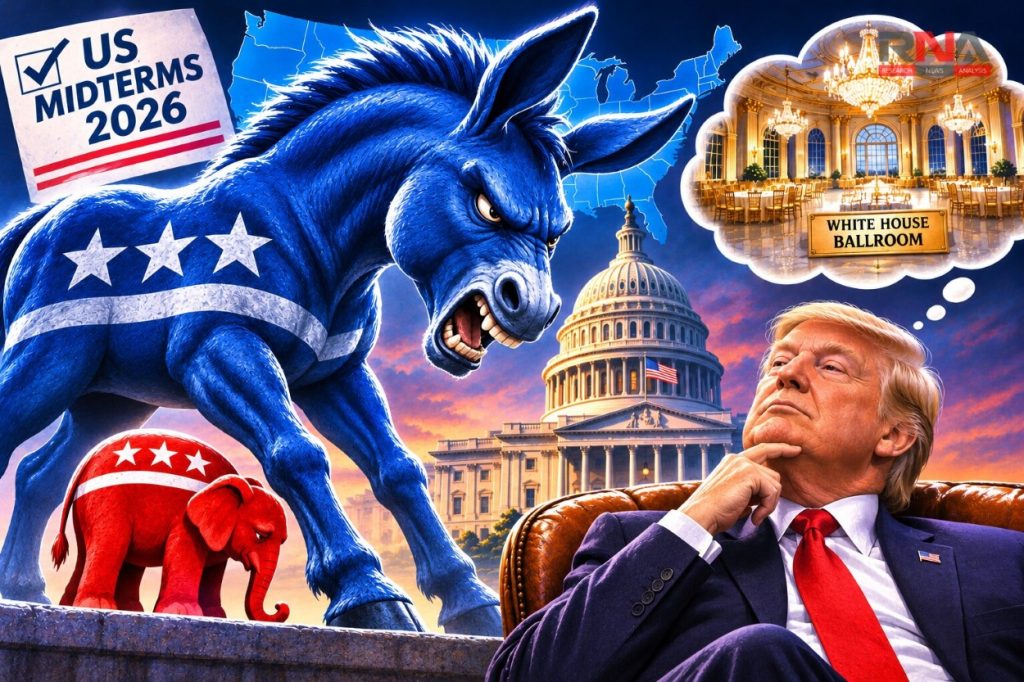
New Delhi: The Democrats have pledged to use their sweeping victory in the United States midterm elections to curb the political authority of the president, Donald Trump, setting up a confrontation with the White House over legislation, government spending and congressional oversight. The Republican president, meanwhile, spent much of his first public appearance after the electoral defeat showcasing his ambitious White House ballroom project, offering only brief comments on the political setback that has fundamentally altered the balance of power in Washington.
The November 3 elections handed Democrats control of both chambers of Congress, ending Republican dominance on Capitol Hill and substantially restricting Trump’s ability to push through his domestic agenda during the remaining two years of his presidency. According to the latest election figures reported by Reuters, Democrats have secured at least 54 seats in the 100-member Senate and gained at least 30 seats in the House of Representatives, with counting continuing in several constituencies.
The scale of the Republican defeat has been particularly striking because Democratic candidates registered victories in traditionally conservative states that had strongly supported Trump in the 2024 presidential election. As RNA Media reported in its detailed account of the Democratic sweep, the opposition made significant breakthroughs in Texas, Kansas and South Carolina, demonstrating that dissatisfaction with the administration had spread well beyond the usual electoral battlegrounds.
The House Democratic leader, Hakeem Jeffries, who is positioned to become the first Black speaker of the House of Representatives, said the incoming congressional majority would concentrate on reducing household expenses and restoring accountability in government. Addressing reporters on Wednesday, Jeffries declared that the legislature would no longer operate as an extension of the Trump administration and that elected representatives owed their allegiance to the American public rather than the president.
The Democrats are preparing to use their control of congressional committees to examine the administration’s decisions, business dealings and relationships with influential individuals and corporations. Their agenda is expected to include investigations into possible conflicts of interest, scrutiny of government contracts and spending, and closer examination of executive actions that Republicans largely supported or declined to challenge during the first two years of Trump’s second term.
Trump showcases ballroom as Republicans confront rout
At the White House on Wednesday, Trump chose to focus much of his attention on the construction of a new ballroom, inviting journalists to witness the installation of the building’s final steel beam. The president discussed the structure’s design, security arrangements, materials and underground facilities, defending the project as an improvement to one of the country’s most recognizable public buildings.
The ceremony came after the demolition of the White House’s East Wing to accommodate the development, a decision that had already generated controversy over the historic presidential complex. Trump described the renovation work as personally satisfying and argued that the White House should be maintained to the highest possible standards, even as questions continued about his administration’s priorities.
During the nearly hour-long encounter with journalists, Trump briefly addressed the election results and suggested that cooperation with the incoming Democratic leadership remained possible. However, he warned that he would use his constitutional authority to reject legislation he considered unacceptable, signalling that the new congressional majority would not necessarily translate into sweeping changes in federal policy.
The president also sought to distance himself from the Republican losses, arguing that he had not personally appeared on the ballot and that enthusiasm at his campaign rallies had failed to produce equivalent support for individual Republican candidates. That explanation contrasted with his repeated appeals during the campaign for voters to treat the midterms as a referendum on his presidency, a message he had delivered at numerous rallies across the country.
An AP examination of Trump’s campaign appearances found that he had encouraged voters to imagine him on the ballot in 30 of his 39 speeches and rallies between September 1 and election day. His subsequent attempt to separate his political standing from the Republican defeat has consequently added to the debate within the party over who should bear responsibility for the losses.
Iran war and rising prices dominate GOP post-election debate
The electoral reversal has intensified divisions within Republican ranks, particularly over the military campaign against Iran, which began with joint American-Israeli strikes on February 28. The conflict’s economic consequences, including higher petrol and diesel prices, have reinforced voter dissatisfaction with inflation, tariffs and the administration’s handling of household expenses.
The vice-president, JD Vance, directly attributed the party’s defeat to the Iran conflict, arguing that a substantial number of Americans who supported Republicans in 2024 had subsequently shifted their votes to Democratic candidates. In a lengthy social media statement, Vance identified the war, inflation, the cost of living and concerns about Washington’s relationship with Israel as important reasons behind the change in voter preferences.
His assessment received support from the president’s eldest son, Donald Trump Jr, who publicly endorsed Vance’s criticism of the political consequences of the military campaign. The development, as reported by RNA Media earlier on Thursday, has sharpened questions about the administration’s foreign-policy priorities and their domestic political costs.
Trump himself acknowledged that the war had contributed to Republican losses but defended the decision to attack Iran, insisting that the military operation was necessary to prevent Tehran from acquiring nuclear weapons. He indicated that he would not have approached the conflict differently despite the election result, making clear that the administration was not preparing an immediate policy reversal.
However, voter research conducted by AP suggests that the Republican defeat cannot be attributed to the war alone. Economic dissatisfaction and concerns about government corruption were more widely identified as decisive electoral considerations, with approximately two-thirds of respondents saying Trump’s policies had worsened economic conditions.
The polling also found that roughly seven in 10 voters believed Congress had failed to provide adequate checks on presidential authority, suggesting considerable public support for stronger legislative scrutiny of the White House. Nevertheless, the findings offered a warning to Democrats, whose victories appeared to reflect widespread dissatisfaction with Republicans rather than uniformly enthusiastic support for the opposition party.
The Republican backlash has extended to the defence secretary, Pete Hegseth, whose handling of the Iran campaign has become a subject of political criticism following the electoral defeat. As RNA Media reported, the result has triggered renewed scrutiny of the administration’s military decisions, although Trump has defended Hegseth and indicated that he has no intention of replacing him.
Democratic victories redraw America’s political map
The election results have transformed the political landscape in states that Republicans had long regarded as dependable strongholds, exposing weaknesses in the party’s electoral coalition. In Texas, the Democrat, James Talarico, defeated the Republican attorney general, Ken Paxton, to become the state’s first Democratic senator since 1988, marking one of the most significant reversals of the election.
The Republican setback in Texas extended to the governor’s office, where the three-term incumbent, Greg Abbott, lost his bid for another term. In Kansas, Democrats won a Senate seat for the first time since 1932, while South Carolina rejected a Republican Senate candidate supported by Trump despite having given the president a substantial electoral margin two years earlier.
The geographical reach of the Democratic advance was reflected in a Reuters analysis of county-level voting patterns, which found that Republicans had lost ground in approximately 99 per cent of the roughly 2,100 counties where most votes had been counted by Wednesday morning. The figures suggest that the result was not simply a collection of narrow defeats in competitive constituencies but part of a broader national movement away from the governing party.
The magnitude of the losses has prompted unusually strong reactions from senior Republicans, including the Florida governor, Ron DeSantis, who characterized the result as an exceptionally serious threat to the party’s electoral future. The House speaker, Mike Johnson, has also indicated that he will relinquish his position as Republican leader in the next Congress, adding an internal leadership contest to the party’s immediate difficulties.
The elections have simultaneously produced important changes in political representation, with several candidates securing historic victories in congressional and state-level contests. These include the election of the country’s first Muslim senator and first Native American woman senator, developments examined in RNA Media’s report on the historic breakthroughs.
What Democratic control means for rest of Trump’s term
The immediate significance of the Democratic victory lies in its potential to restore congressional checks on the executive branch, particularly in areas where Trump previously benefited from Republican control of both chambers. When the new Congress convenes on January 3, Democrats will be able to determine committee leadership, issue subpoenas, conduct investigations and exercise substantially greater influence over federal spending and legislation.
In the Senate, the incoming majority will also acquire the authority to block or delay presidential appointments requiring confirmation, including senior administration officials, federal judges and potential supreme court nominees. This could become especially consequential if a vacancy arises on the supreme court, where the future of the conservative majority has attracted renewed attention because of the ages of Justices Clarence Thomas and Samuel Alito.
Democrats are also preparing an initial legislative programme focused on reducing the cost of fuel, groceries and healthcare, alongside efforts to reverse Republican reductions in federal healthcare programmes. According to AP, the party intends to pursue an ambitious agenda during its first 100 days in control of Congress while expanding investigations into the administration’s conduct.
However, the party’s congressional majorities will not eliminate Trump’s ability to influence government policy, particularly because he retains the presidential veto and extensive executive powers. Overriding a veto generally requires a two-thirds majority in both chambers, a threshold Democrats are not expected to command, meaning legislation without sufficient bipartisan support could be blocked even after passage through Congress.
The Senate’s procedural rules present another obstacle, as most ordinary legislation requires 60 votes to overcome a filibuster, although certain budget-related measures can proceed under special procedures. Consequently, Democratic control is likely to produce a combination of tougher oversight, negotiations over essential legislation and political deadlock rather than an unrestricted opportunity to reverse the president’s policies.
The change in congressional leadership could also affect Trump’s trade and foreign-policy agenda, including the scope of congressional scrutiny of tariffs, military expenditure and the continuing conflict with Iran. Congress retains significant constitutional authority over federal appropriations and certain aspects of international commerce, although the president continues to exercise considerable independent authority in conducting diplomacy and directing military operations.
For India, the transition will be worth watching because American policy on tariffs, trade negotiations, defence cooperation and strategic relations with China could face greater congressional examination. However, there is no automatic reason to expect a fundamental change in Washington’s relationship with New Delhi, given that the broader strategic partnership has attracted support from both major American political parties.
GOP retains narrow window before power changes hands
Despite the election outcome, Republicans will continue controlling Congress until the new legislature takes office in January, leaving them a limited opportunity to advance outstanding measures before surrendering their majorities. One immediate challenge involves legislation to fund the federal government beyond December, an issue that could develop into another confrontation over spending priorities and the possibility of a partial government shutdown.
Republican lawmakers could attempt to use this final legislative period to complete pending appointments or advance measures supported by the White House, although the approaching change in congressional control may complicate negotiations. The leadership turmoil following the election is also likely to make it harder for the party to maintain unity during the remaining weeks of the current Congress.
Meanwhile, two closely contested Senate races, in Alaska and Mississippi, remained unresolved in the latest confirmed Reuters figures, leaving open the possibility that the Democratic majority could increase from 54 seats to 56. Alaska’s ranked-choice voting procedures could prolong the counting process, while the final outcome in Mississippi also remained uncertain as election officials continued their work.
Beyond the immediate struggle over Congress, the results are already shaping speculation about the 2028 presidential election, in which Trump is constitutionally barred from seeking another term. Vance, regarded as a potential Republican contender, now faces the challenge of defending his administration’s record while distinguishing his political priorities from decisions that have proved unpopular with voters.
For Democrats, the challenge will be to translate their electoral gains into tangible improvements in living standards without allowing confrontation with the White House to dominate their legislative programme. Their victory has given them the institutional power to challenge Trump, but their longer-term political prospects will depend on whether they can meet the expectations of voters who shifted away from Republicans.
The election has therefore opened a difficult new phase of Trump’s second presidency, with the White House and Congress preparing to operate under competing political mandates for the first time since his return to power in January 2025. Whether that produces negotiated compromises or prolonged institutional confrontation will become clearer when the Democratic-controlled Congress begins work in January.