


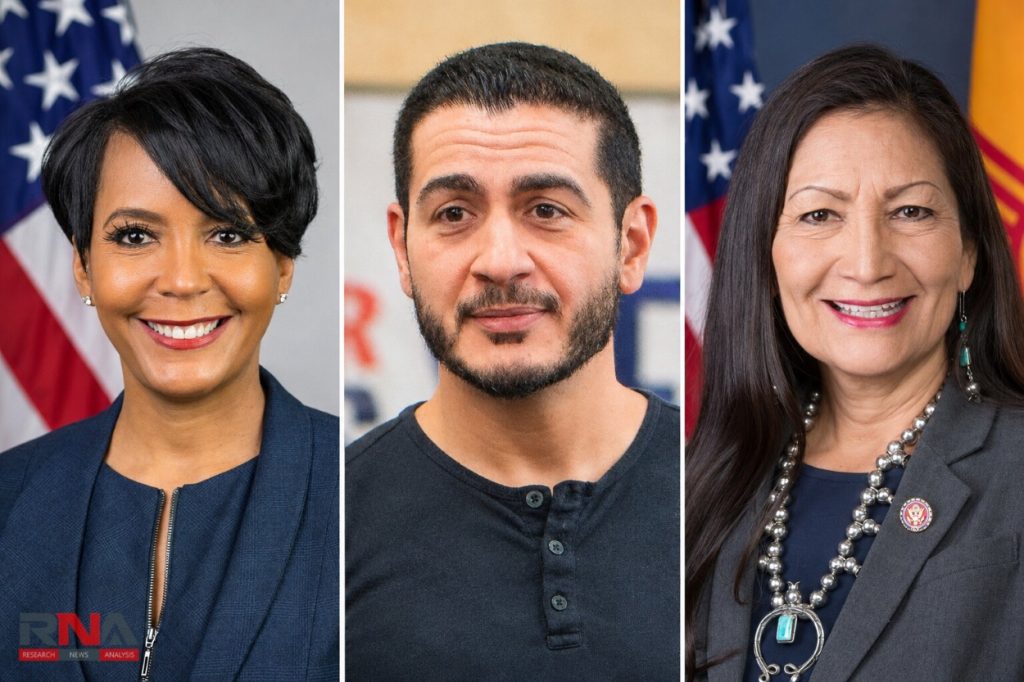
New Delhi: American voters elected the country’s first black woman governor, first Native American woman governor and first Muslim senator in Tuesday’s midterm elections, delivering several breakthroughs in political representation alongside major Democratic gains. The results also produced the first openly gay man elected to the US Senate, as Republicans suffered setbacks during the second term of the US president, Donald Trump.
The victories extended from Georgia and Texas to New Mexico, Michigan and New Hampshire, combining nationally significant firsts with changes in states long dominated by Republicans. Reports available on Wednesday also confirmed that Michigan’s Abdul El-Sayed had won his Senate contest, resolving a race that remained undecided in earlier coverage.
Georgia elects America’s first black woman governor
In Georgia, the former Atlanta mayor, Keisha Lance Bottoms, defeated the Republican healthcare billionaire, Rick Jackson, to become the first black woman elected governor of any US state. Her victory also made her the first woman and the first black person elected to Georgia’s highest office.
The result ended a Republican winning streak stretching back to Sonny Perdue’s defeat of the Democratic incumbent, Roy Barnes, in 2002. It returned the governorship to Democrats after more than two decades and marked a substantial political reversal in a state central to recent presidential contests.
Bottoms served as Atlanta’s mayor from 2018 to 2022 before becoming an adviser to the former US president, Joe Biden. She therefore entered the contest with experience in municipal government and the White House, defeating a wealthy Republican opponent in one of the night’s most consequential state elections.
Haaland and Hinojosa secure landmark victories
In New Mexico, the Democrat, Deb Haaland, defeated the Republican, Gregg Hull, to become the first Native American woman elected governor in the United States. A member of the Pueblo of Laguna, Haaland had already made history as one of the first Native American women elected to Congress and subsequently as the country’s first Native American cabinet secretary.
Haaland served as interior secretary under Biden, taking charge of a department whose responsibilities include public lands, natural resources and federal relations with tribal nations. Her confirmation in 2021 was itself a milestone in Native American participation at the highest levels of the federal government.
Texas delivered another major Democratic victory, with the state legislator, Gina Hinojosa, defeating the Republican incumbent, Greg Abbott, to become the state’s first Latina governor. The result denied Abbott a fourth term and returned the office to Democrats for the first time since Ann Richards held it in the 1990s.
Hinojosa’s campaign emphasized affordability, public schools and allegations of corruption, seeking to connect with voters through everyday economic concerns. Her breakthrough was specifically a Texas first – a distinction that matters when separating the election’s state-level milestones from its national records.
Michigan sends the first Muslim senator to Washington
In Michigan, El-Sayed defeated the former Republican congressman, Mike Rogers, becoming the first Muslim American elected to the Senate. NPR’s report, carried by Michigan Public, cited an Associated Press race call confirming his victory in one of the country’s most closely watched contests.
The 42-year-old former public health official contested the election as a progressive Democrat in a fiercely competitive midwestern state. His victory gave the party an important Senate win and answered a central question surrounding his candidacy: whether a politician campaigning from its left could prevail in a battleground general election.
El-Sayed’s success adds a religious-representation milestone to an election already distinguished by breakthroughs in gubernatorial races. It also updates the initial account of the night’s results, which described him as still competing in a tight contest rather than as the winner.
In New Hampshire, the Democratic congressman, Chris Pappas, defeated the former Republican senator, John E Sununu, to become the first openly gay man elected to the Senate. He is due to succeed the retiring Democratic senator, Jeanne Shaheen, in January.
Pappas’s achievement is distinct from being the chamber’s first openly gay member, a milestone reached by Wisconsin’s Tammy Baldwin in 2012. Baldwin’s official Senate biography records that earlier breakthrough, placing the New Hampshire result within a longer expansion of LGBTQ representation in Congress.
Wider gains reshape the political landscape
The state-level breakthroughs extended beyond the candidates featured in the initial reports, with the Democrat, David Crowley, elected Wisconsin’s first black governor and the Democrat, Xavier Becerra, elected California’s first Latino governor. Republicans also recorded a landmark victory in Florida, where Byron Donalds defeated David Jolly to become the state’s first black governor.
Alongside these individual milestones, Democrats secured control of both chambers of Congress, as RNA Media had reported earlier. That shift gives them greater scope to scrutinize the administration and challenge its legislative priorities during the remaining two years of Trump’s term.
Another potential first remains dependent on a separate vote: the House Democratic leader, Hakeem Jeffries, could become the country’s first black speaker if elected by the new House of Representatives. Unlike the electoral victories already reported, that milestone cannot be treated as accomplished before the speakership vote takes place.