


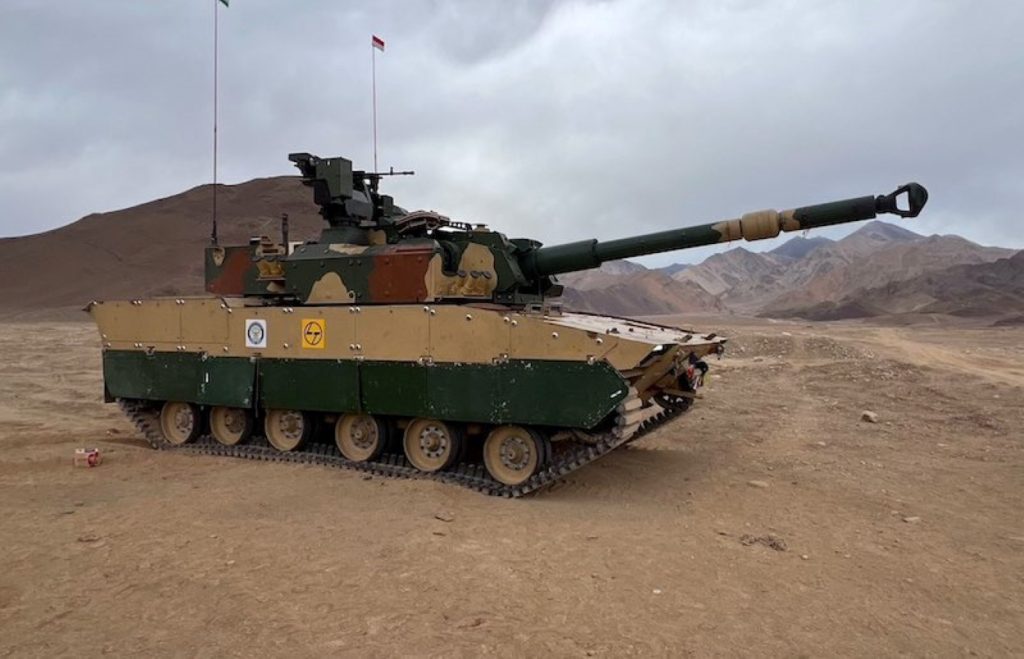
New Delhi: India’s Zorawar light tank faces an extended wait before entering service, with demands for stronger protection complicating the development of a vehicle intended for the Himalayan frontier with China. The projected induction window of 2028–2029 places its arrival up to two years beyond the earlier 2027 target, prolonging the Indian Army’s wait for purpose-built light armour.
An ET report describes the central difficulty: protecting the crew against heavier ammunition without adding enough weight to compromise mountain mobility. Additional armour could require changes to the engine and further testing, complicating the balance between protection, firepower and agility.
The chronology, however, needs clarification: the 2028–2029 window was already public in June this year. The October coverage therefore does not establish an additional two-year postponement beyond that revised schedule, nor does it announce a separately confirmed date for serial production.
Developed by the Defence Research and Development Organisation (DRDO) and Larsen & Toubro (L&T), Zorawar was conceived around a combat weight of approximately 25 tonnes. Its intended advantage is the ability to bring substantial direct firepower to areas where heavier tanks impose greater movement and logistical demands.
According to Times of India’s latest account, the proposed protection requirement includes resistance to 30mm armour-piercing ammunition, described as STANAG 4569 Level 6, against reported Level 4 frontal protection in the initial configuration. Stronger protection for the sides and rear is also under consideration, although the report does not provide a publicly released final Army specification.
The distinction matters because the eventual weight increase remains uncertain, rather than an established feature of a redesigned tank. Reporting discusses modular armour and a possible rise to 30–32 tonnes, but neither that weight nor a replacement engine should be treated as a finalized configuration.
The existing vehicle reportedly uses a Cummins diesel engine producing around 760 horsepower and a Belgian-designed Cockerill 3105 turret with a 105mm gun. John Cockerill’s own description of the turret identifies an autoloader and digital fire-control system, combining substantial armament with a design intended for integration onto relatively light vehicles.
Zorawar has already demonstrated important capabilities during development, rather than remaining a design on paper. The defence ministry announced successful preliminary automotive and firing trials on September 13, 2024, saying the vehicle met the intended objectives in desert terrain and achieved the required firing accuracy.
Subsequent trials included firing at elevations above 4,200 metres and an airlift demonstration, establishing progress towards its intended mountain role. These were developmental milestones, however, and did not by themselves establish acceptance of the complete vehicle for operational service.
The wider requirement covers 354 light tanks, with an initial 59 associated with the DRDO–L&T programme and the remainder pursued through a separate competitive acquisition process. Development and procurement are therefore interlinked but distinct challenges; the whole requirement cannot be assumed to translate into deliveries when Zorawar first enters service.
The operational urgency grew from the 2020 confrontation in eastern Ladakh, when Chinese light-armour deployments sharpened India’s requirement for a comparable mountain capability. India deployed its heavier T-72 and T-90 tanks, demonstrating that armour could be sustained in the region while also exposing the value of a lighter complementary platform.
Why stronger armour costs time – and what the delay means along the LAC
The engineering problem begins with a simple constraint: a light tank has a limited weight allowance within which to accommodate its gun, ammunition, engine, crew protection and other equipment. Increasing one element leaves less room for the others unless designers find lighter materials, accept reduced performance or revise the vehicle more substantially.
There is a straightforward illustration using the reported specifications: 760 horsepower divided by 25 tonnes gives approximately 30.4 horsepower per tonne. At 30 tonnes, the same calculation produces 25.3 horsepower per tonne, falling to 23.8 at 32 tonnes – a reduction of roughly one-fifth from the original figure.
Those are illustrative calculations, not measured results from a heavier Zorawar prototype, and power-to-weight ratio alone does not determine battlefield mobility. They nevertheless explain why adding several tonnes cannot be treated as a minor adjustment, especially when the vehicle must accelerate, climb and manoeuvre under demanding conditions.
Altitude makes the assessment more complicated because an engine’s advertised output does not automatically describe its performance in thin air. Cummins’s technical guidance on high-altitude operation explains the effects of reduced atmospheric pressure and oxygen availability, although Zorawar’s actual performance must be established through testing of its particular engine installation.
A more powerful engine could help compensate for additional weight but fitting one would raise further integration questions. Engineers would need to establish whether the transmission, cooling arrangements, suspension, brakes and other components could accommodate the revised loads reliably throughout the vehicle’s operating envelope.
This is the likely mechanism by which a protection change lengthens development: alterations must be validated together, rather than assessed as unrelated improvements. Earlier successful firing or mobility trials remain useful, but they cannot automatically certify the behaviour of a substantially heavier or differently powered vehicle.
The Army’s concern about protection is understandable because mobility cannot compensate for every threat encountered by a crew. However, the available reporting does not disclose enough of the original requirement, threat assessment or trial findings to determine whether the change represents an avoidable late demand or a necessary correction.
That distinction should prevent an easy assignment of blame either to the Army for seeking greater survivability or to the developers for needing more time. The question requiring an answer is whether the revised protection requirement can be met while preserving the operational advantages that justified a light tank in the first place.
Modular armour offers one possible route, allowing protection packages to be adapted to a mission and potentially fitted after transportation. Its usefulness still depends on the final installed weight, handling arrangements and tested protection, so modularity does not remove the need to make difficult choices.
Similarly, a heavier Zorawar would not automatically become unsuitable for mountain warfare, but it could lose part of its intended deployment advantage. The relevant comparison is how quickly a complete, supported unit can reach and operate in a particular sector, rather than whether an individual tank can negotiate a demonstration course.
For India’s northern borders, the immediate consequence is a longer wait for additional options in moving protected firepower between threatened areas. Existing armour remains available, but commanders must continue planning around its transportation, maintenance and route requirements where a lighter vehicle might offer greater flexibility.
This is a capability gap, not evidence that the frontier has become undefended or that one delayed programme determines the military balance. Infantry, artillery, anti-tank weapons, surveillance, aviation and logistics all contribute to preparedness, and the value of Zorawar will depend on how effectively it operates alongside them.
The diplomatic situation also requires a measured assessment: India-China relations currently can be described as improving contacts while emphasizing that border stability remains the condition for wider normalization. The October 21, 2024, patrolling agreement addressed the remaining 2020 friction points at Depsang and Demchok, but did not settle the boundary dispute.
Likewise, RNA Media’s September report on military talks in Arunachal Pradesh highlighted efforts to expand communication and prevent local disagreements from escalating. These mechanisms can reduce risk, but their existence does not eliminate the requirement for forces capable of responding if the situation deteriorates.
There is also a longer-term cost to delayed induction: operational units gain experience with a new platform only after crews, maintainers and commanders begin using it routinely. Postponement can therefore defer the development of training practices, repair arrangements and tactics, extending the distance between a successful prototype and a dependable battlefield capability.
A phased introduction deserves consideration if an initial configuration meets an explicitly accepted operational requirement and later improvements can be incorporated without disruptive redesign. It would be counterproductive, however, to field inadequately protected vehicles merely to meet a calendar target, just as repeatedly reopening specifications could keep a useful capability indefinitely out of reach.
The practical priority is to settle a realistic protection standard, validate the resulting vehicle and align production with training, ammunition and support arrangements. For the Army, the decisive milestone will be the arrival of equipped, sustainable units that can deploy where required – a more meaningful measure of preparedness than the completion of another prototype trial.