


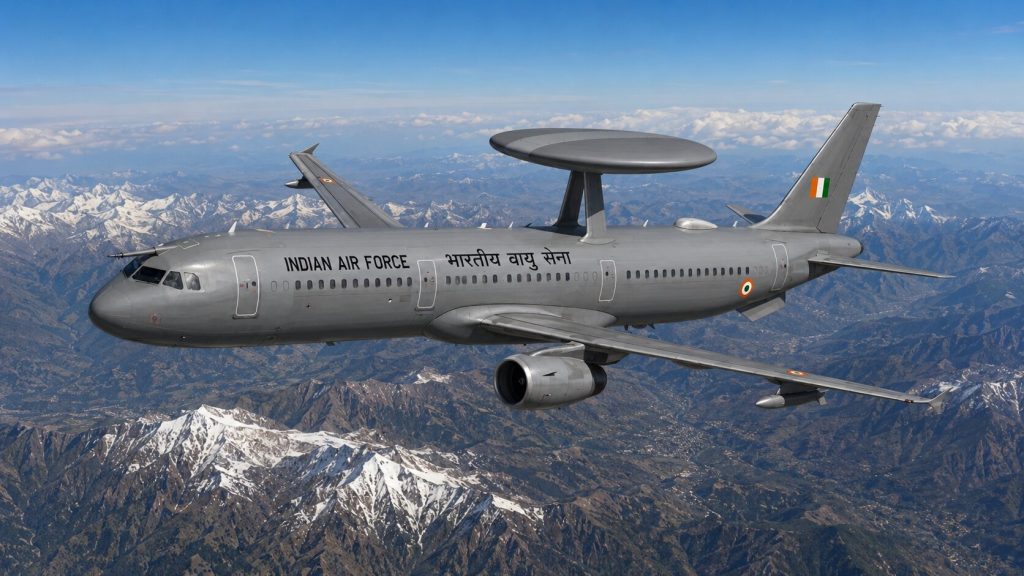
New Delhi: The Defence Research and Development Organisation (DRDO) has signed two contracts to advance its airborne early warning and control (AEW&C) Mk2 programme. This project will eventually give the Indian Air Force six large surveillance aircraft built on decommissioned Air India passenger jets.
The Centre for Air Borne Systems (CABS), the DRDO laboratory leading the programme, signed the first contract with AI Engineering Services Limited (AIESL) of New Delhi for converting six Airbus A321 aircraft from commercial to what officials describe as “green configuration” – essentially, stripping the jets down to bare airframes to prepare them for military systems. The second contract was signed with Adani Defence Systems and Technologies Limited (ADSTL), based in Ahmedabad, which has been brought in as the development-cum-production partner for the mission systems that will eventually be fitted onto the aircraft.
Both agreements were signed in New Delhi on Wednesday in the presence of the defence secretary and chairman of DRDO, Rajesh Kumar Singh, who holds additional charge of the DRDO chairmanship since May 2026 following the retirement of Samir V Kamat. The contracts were formalized by the director of CABS along with the chief executive officer of AIESL and the head of airborne platforms at ADSTL.
Under the arrangement, CABS will lead the integration of mission systems onto the modified aircraft, with ADSTL’s support, once Airbus Defence and Space – the original manufacturer of the A321 – completes the aircraft-level modifications. CABS and ADSTL will then jointly carry out flight testing alongside the Air Force, before seeking airworthiness certification from the Centre for Military Airworthiness and Certification and the Directorate General of Aeronautical Quality Assurance.
Long-pending programme
The AEW&C-Mk2 project has been under discussion for several years and marks a considerable scaling up of India’s airborne surveillance ambitions. The six A321s earmarked for conversion were transferred from Air India’s commercial fleet between 2021 and 2022, and have been awaiting military conversion since. The Cabinet Committee on Security is understood to have cleared the programme at a cost running into thousands of crores of rupees, with the first aircraft not expected to enter service before the early 2030s.
Once operational, the Mk2 aircraft are expected to carry a derivative of DRDO’s indigenously developed Uttam active electronically scanned array radar, offering close to all-round coverage – a marked improvement on the roughly 240-degree coverage of the existing Netra-Mk1 fleet, which is built on the smaller Embraer platform. The larger A321 airframe will also allow for longer endurance and greater power capacity to run the radar and associated sensor suites.
The programme runs alongside a separate, more advanced order for six Netra-Mk1A aircraft, also on the Embraer platform, which DRDO is developing independently as a lower-risk, nearer-term addition to the Air Force’s surveillance fleet. Between the two tracks, the Air Force is looking to add a dozen AEW&C aircraft to its existing arrangement of three Netra-Mk1 systems and three Israeli-origin Phalcon airborne warning and control systems.
For Adani Defence, the contract represents a significant entry into one of the more technically demanding segments of India’s defence-industrial base, adding to the group’s expanding footprint in aerospace and defence manufacturing. For DRDO, the twin contracts mark a concrete step in a programme that has, until now, remained largely at the planning stage.