


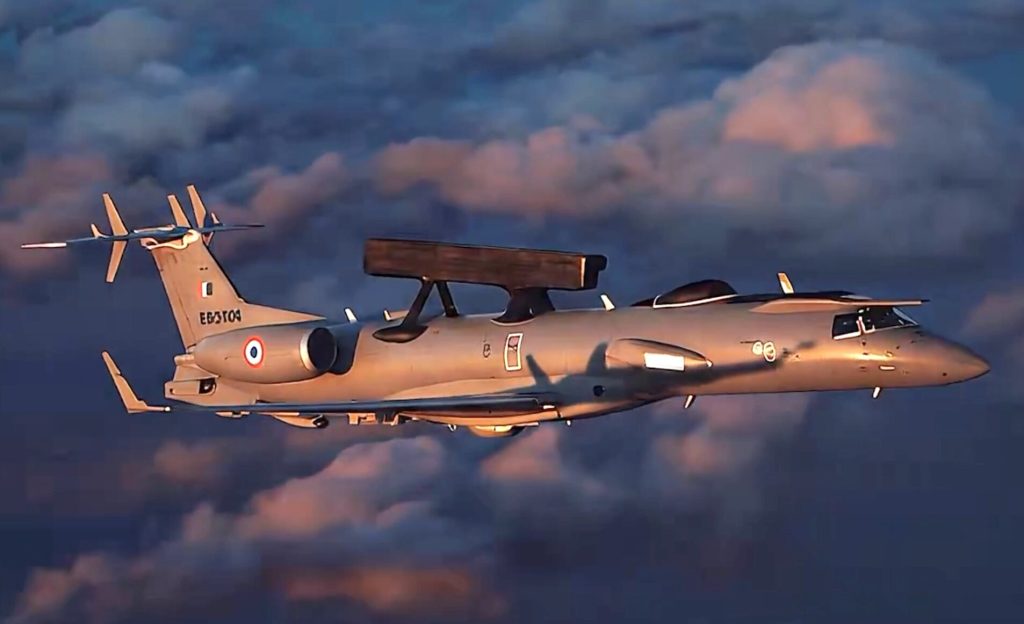
New Delhi: The Defence Research and Development Organisation (DRDO) handed over the final operational clearance (FOC) certificate for the indigenously developed Netra airborne early warning and control (AEW&C) system to the Indian Air Force on Thursday, at a ceremony in Bengaluru. The platform is now formally certified as fully combat-ready after more than two decades of development.
The Air Force currently operates three Netra-Mk1 aircraft, based on the Embraer ERJ-145 platform, which are stationed at Bhisiana Air Force Station near Bathinda in Punjab with No. 200 Squadron. The first aircraft was delivered to the Air Force at the Aero India event in February 2017, and initial operational clearance was awarded by October that year. The FOC, coming nearly nine years after induction, marks the completion of the programme’s qualification cycle and confirms the system meets all air staff qualitative requirements set at the programme’s outset.
The ceremony was presided over by the deputy chief of the air staff, Air Marshal Awadhesh Kumar Bharti. Among those present were the former chief of the air staff, Air Chief Marshal Rakesh Kumar Singh Bhadauria (retired), and former DRDO chairman Dr S Christopher, along with serving and retired senior Air Force officers and DRDO scientists.
Addressing the gathering, Bharti drew specific attention to the system’s track record in live operations – citing its deployment during the Balakot airstrikes and, more recently, during Operation Sindoor. The first combat usage of the Netra AEW&C by the Air Force was on February 26, 2019, during the Balakot airstrike. He emphasized that an indigenous system offers operational flexibility that imported platforms cannot – the ability to modify and adapt the system to changing battlefield conditions without dependence on foreign vendors for clearances or software updates.
Mounted on modified Embraer ERJ-145 regional jets, the Netra integrates active electronically scanned array (AESA) radars providing approximately 240-degree coverage, electronic support measures, and data links for real-time target tracking up to 250 kilometres, enabling battle management and force multiplication in contested airspace. Its endurance exceeds eight hours and can be extended further through in-flight refuelling.
Dr K Rajalakshmi Menon, distinguished scientist and director general of DRDO’s aeronautics cluster, traced the system’s development arc – from the technical challenges of integrating complex mission avionics onto a civilian jet platform to the flight-test programme that ultimately validated the system’s operational credentials. She underscored the role of systems engineering as the discipline that held the programme together through its more difficult phases.
Dr BK Das, distinguished scientist and director general of DRDO’s electronics cluster, described the Netra AEW&C as a tangible demonstration of India’s capacity to build complex, networked defence systems indigenously.
Before Netra’s development, India relied heavily on imported airborne warning systems – principally the Phalcon Awacs (airborne warning and control system), mounted on Russian Il-76 aircraft, which offers 360-degree coverage and longer endurance. Netra fills a complementary role, providing a lighter and more flexible domestically developed capability. The Netra fleet is complemented by three Beriev A-50 Phalcon AWACS aircraft that form the backbone of India’s airborne surveillance capability.
The FOC also arrives at a moment when India is already moving on its next generation of airborne surveillance. The Cabinet Committee on Security approved the Netra-Mk2 programme, valued at ₹19,000 crore, on July 17, 2025. The project will involve six Airbus A321 aircraft acquired from Air India, which will be modified in collaboration with Airbus Defence and Space in Spain before being fitted with indigenous AESA radars in India.
The Netra-Mk2 will feature a dorsal fin-mounted AESA radar providing 300-degree radar coverage, with a secondary antenna in the nose to enhance forward coverage. With an expected detection range exceeding 500 kilometres, the Mk2 will be capable of detecting not only conventional aircraft and missiles but also low-observable platforms such as drones and stealth fighters. Delivery of the first Mk2 aircraft is expected in 2026–27, with the full fleet due by 2033–34.
The FOC of Netra, while long in coming, carries significance beyond the paperwork. It closes one chapter in India’s protracted effort to build sovereign capability in one of the most technically demanding categories of military aviation – and it does so with a system that has already seen active service.