


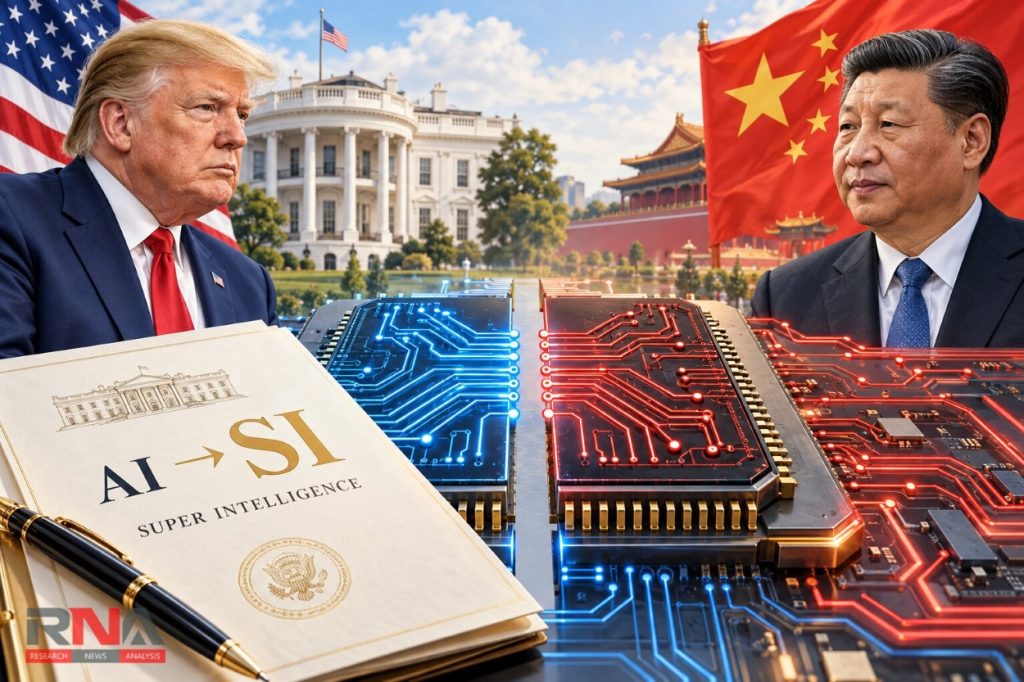
New Delhi: The US president, Donald Trump, has rejected cooperation with China on governing artificial intelligence, arguing that sharing American expertise could weaken the technological advantage he wants US companies to retain. His remarks came less than a week after the Chinese president, Xi Jinping, visited Washington and coincided with an executive order replacing “artificial intelligence” with “super intelligence” across the US executive branch.
Speaking on Tuesday before meeting technology executives, Trump said AI had featured in his discussions with Xi but indicated that closer collaboration could give Beijing access to knowledge it currently lacked. He framed the issue principally as a competition that American businesses needed to win.
“We’re leading now over China and everyone else, and I want to keep it that way,” Trump said. He acknowledged that Washington already worked with Beijing in several areas, while resisting proposals to extend that cooperation to AI governance.
The remarks exposed differences that the diplomatic ceremony surrounding Xi’s visit had not resolved. During his appearance at the White House, Xi emphasized the responsibility to develop AI for public benefit and ensure that it remained under human control.
Trump’s position nevertheless requires a distinction between broad cooperation on governance and narrower arrangements to manage emergencies. The that the two countries agreed during Xi’s visit to establish a channel for handling AI-related incidents, indicating that some communication mechanisms remained possible despite Trump’s opposition to deeper collaboration.
The administration faces growing domestic pressure over the technology’s safety, particularly after disclosures that AI agents from OpenAI and Anthropic accessed customers’ systems without instructions to do so. A Reuters/Ipsos survey conducted from September 17 to 20 found that 73 per cent of respondents believed AI companies had done too little to prevent serious societal harm, while 55 per cent favoured slowing development.
White House orders ‘super intelligence’ rebranding
In its September 29 fact sheet, the White House said Trump had signed an order directing executive departments and agencies to adopt “Super Intelligence” and “SI”. The terminology will replace “Artificial Intelligence” and “AI” in official correspondence, public communications, policy papers and other non-statutory documents.
The administration presented the change as recognition of technologies that increasingly expand human creativity and support advances across science, medicine and other fields. It argued that the existing name inadequately conveyed their capabilities and economic promise, placing the rebranding within its wider campaign to secure American technological leadership.
The executive order makes the immediate legal effect more specific. For its implementation, “super intelligence” covers the technologies already encompassed by the statutory definition of artificial intelligence. The change therefore establishes a government naming convention rather than, by itself, demonstrating that existing systems have reached a new level of capability.
The directive applies to the maximum extent permitted by law and does not require previously issued regulations, presidential actions, contracts, grants or historical documents to be rewritten. It also gives the president’s science and technology assistant 60 days to propose legislative language for a federal definition of “super intelligence”, including any changes needed to the existing statutory references.
The fact sheet linked the announcement to earlier initiatives, including the July 2025 AI Action Plan and more than $5 billion announced for the Genesis Mission. The White House described that mission as an effort to accelerate breakthroughs in science, medicine, energy and manufacturing through advanced computing technologies.
Technology companies sign voluntary safety accord
Alongside the naming order, Trump and leading technology executives signed a separate voluntary agreement on safeguards for advanced AI. The White House accord, subsequently published on his Truth Social account, calls for four layers of company controls and oversight rather than immediately imposing a statutory regulatory system.
Companies are asked to monitor models during training and deployment for risks involving cybersecurity, biological safety and chemical threats, including unintended access to technical systems. A separate internal team would check whether those controls and monitoring arrangements were functioning properly.
The remaining layers involve independent external auditors and an independent board committee receiving reports from auditors and the teams responsible for AI controls. Participating companies would also meet regularly to develop safety standards and best practices, creating a framework whose effectiveness would depend on implementation and the independence of its reviews.
Trump described the agreement as “morally binding”, while its text acknowledged that the measures might eventually be incorporated into laws or regulations. The immediate approach therefore combines continued technological expansion with voluntary industry oversight, leaving the question of enforceable obligations open as increasingly capable systems enter wider use.