


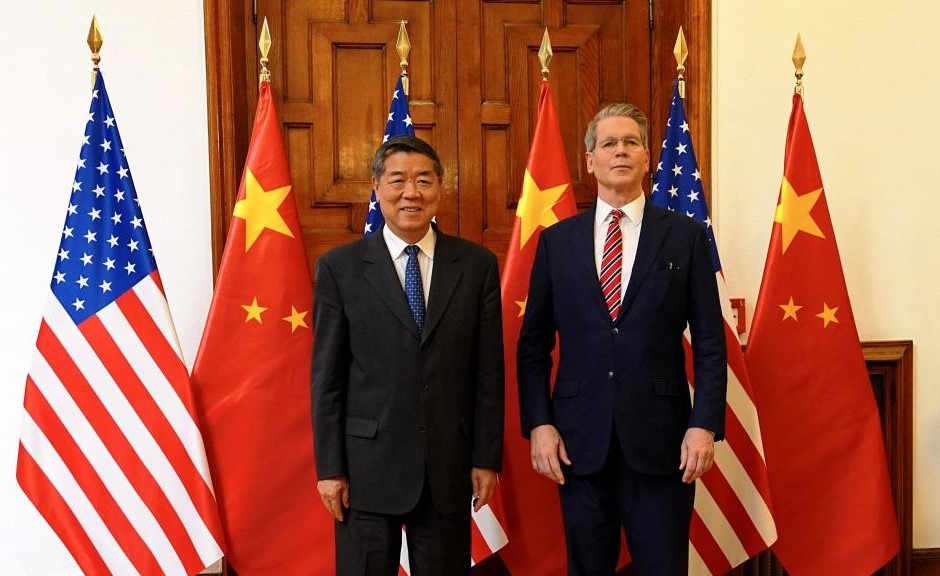
New Delhi: The United States has proposed a system for notifying China about serious artificial intelligence incidents that could affect national security, following talks between senior officials in New York on Sunday. The proposal is being prepared for consideration at this week’s Washington summit between the US president, Donald Trump, and the Chinese president, Xi Jinping, but Beijing has yet to say publicly whether it supports the idea.
The US treasury secretary, Scott Bessent, raised the proposed notification mechanism during a meeting with the Chinese vice-premier, He Lifeng, that also covered trade. Bessent said the aim was to give the two leading AI powers a clearer understanding of risks they might face in common and a way to communicate when an incident became a national security concern.
The proposal would form part of a broader US-China dialogue on AI, although officials have not set out its procedures or specified which events would trigger an alert. They have also not explained what information either government would have to share, leaving important questions about the mechanism for later negotiations.
A notification channel could matter if an AI-enabled cyber operation disrupted critical infrastructure or behaved in a way that one government mistook for a deliberate attack by the other. In such a case, prompt contact might help officials establish what had happened before an automated response or a political decision raised tensions further.
That is a potential use for the system, rather than an agreed feature of the US proposal. Bessent described its focus as incidents serious enough to reach the level of national security, without publicly defining that threshold.
China’s account of the New York meeting was more limited. The state news agency Xinhua acknowledged discussion of AI and described the wider economic and trade exchanges as constructive but did not announce an agreement on incident notifications or give a Chinese response to the US proposal.
The distinction between continuing a dialogue and accepting a reporting system is substantial. Any working arrangement would require the two governments to decide who could send an alert, how quickly it should be delivered and how much either side could disclose about sensitive civilian or military systems.
Trump and Xi discussed possible consultations on AI development during their meeting in Beijing in May, but that forum was not formalized, according to Reuters. The New York talks may give those discussions a more regular structure, even if the proposed notification system requires further work.
The security concerns are concrete. In a paper published this month, American and Chinese researchers involved in a separate dialogue proposed a dedicated channel for AI-related military emergencies, warning that automated cyber activity could be misread during a crisis.
Their recommendations also called for human control over decisions involving nuclear weapons and for clearer boundaries around AI operations affecting nuclear command systems and other critical infrastructure. Those are proposals from researchers, rather than commitments made by Washington or Beijing at the New York meeting.
The researchers identified a further difficulty: determining who was responsible for an incident. A government receiving an alert might still struggle to establish whether a disruptive AI operation was authorised by another state, carried out by an independent actor or caused by a malfunction.
The two countries have discussed AI risks before, including at government-level talks in Geneva in 2024. Their leaders subsequently affirmed that humans should retain control over decisions to use nuclear weapons, but translating broad principles into procedures for responding to an incident remains a separate task.
Any safety arrangement would also have to operate within a strained technology relationship. Washington restricts China’s access to some advanced AI chips and semiconductor manufacturing equipment, while Beijing regards US technology controls as an effort to hold back its development; the US trade representative, Jamieson Greer, said those export restrictions were not part of the discussions on the proposed AI mechanism.
Trade occupied much of the eight-hour New York meeting. Greer said officials had worked on putting a proposed bilateral “Board of Trade” into operation, with the aim of identifying a limited range of less sensitive goods that could be considered separately for tariff reductions.
He cited Chinese consumer goods and other low-technology products as possible candidates, alongside US energy, agricultural products and medical devices. No agreed product list or tariff reduction was announced, and the broader trade truce between the two countries is due to expire on November 10.
For the Trump-Xi summit, the immediate question is whether the leaders endorse a continuing AI dialogue and direct officials to work out the terms of an incident alert system. Until those terms are agreed, the New York talks represent an opening for crisis communication, rather than an operational safeguard.