


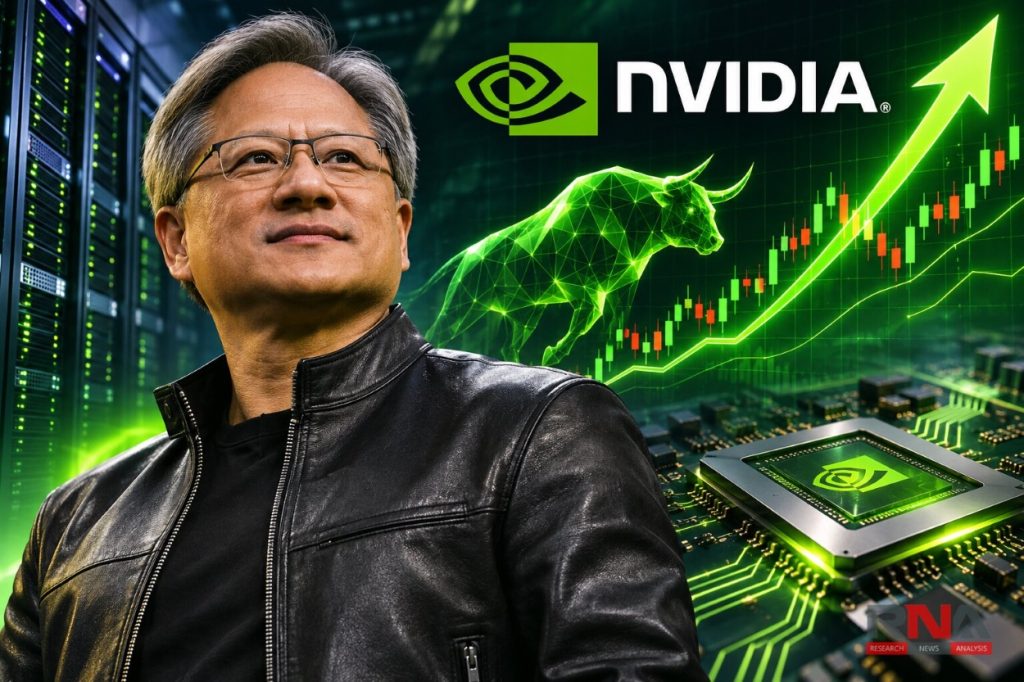
New Delhi: Nvidia shares rebounded sharply after the American semiconductor giant reported record quarterly revenue of $115.84 billion, more than doubling its earnings from a year earlier and comfortably beating Wall Street expectations despite the leadership crisis triggered by the departure of its co-founder, Jensen Huang. The company’s strong financial performance offered investors some reassurance about its business prospects, even as a fresh confrontation emerged over Huang’s possible return as chief executive.
Huang, who resigned last week following revelations about his personal relationships and allegations involving a suspected Chinese intelligence operative, said he would be honoured to lead the company again if its board considered his reinstatement beneficial. However, Nvidia’s directors swiftly ruled out that possibility, making it clear that the company intended to move forward under new leadership despite growing demands from employees, investors and influential figures in Silicon Valley for his return.
Nvidia’s shares climbed as much as 5 per cent in after-hours trading on November 17, 2026, after the company announced its third-quarter results, reflecting renewed investor confidence in the demand for its artificial intelligence processors. The gains followed a turbulent period during which the stock had lost more than 10 per cent following Huang’s departure, wiping hundreds of billions of dollars from its market valuation.
According to Nvidia’s official financial results, revenue for the quarter ended October 25 reached $115.84 billion, representing an increase of 103 per cent from the corresponding period last year and 20 per cent from the preceding quarter. The figure substantially exceeded analysts’ consensus forecast of approximately $109.1 billion, demonstrating that demand for advanced AI computing infrastructure remained strong despite concerns about the company’s management and the sustainability of global investment in artificial intelligence.
The chipmaker reported adjusted earnings of $2.68 per share, exceeding Wall Street’s expectation of approximately $2.47, with net income under generally accepted accounting principles reaching $65.3 billion. Its adjusted gross profit margin stood at 74.9 per cent, indicating that Nvidia continued to command substantial profitability from its dominant position in the market for high-performance AI computing hardware.
The company also projected fourth-quarter revenue of approximately $130 billion, with a possible variation of 3 per cent in either direction, against analysts’ expectations of around $125.25 billion. The forecast suggested that major technology companies were continuing to invest heavily in data centres, AI training systems and computing infrastructure despite concerns that the industry’s extraordinary capital expenditure could eventually outpace commercial returns.
A particularly important contributor was Nvidia’s data-centre division, which generated $107.6 billion in quarterly revenue, an increase of 110 per cent from the previous year. The division now accounts for approximately 93 per cent of the company’s total revenue, illustrating how extensively Nvidia’s business has shifted from graphics processors for gaming computers towards infrastructure supporting artificial intelligence, cloud computing and advanced scientific applications.
The company also highlighted the commercial rollout of its Vera Rubin computing platform, the successor to its earlier Blackwell architecture, as a major contributor to its future growth. Nvidia said systems based on the new platform were being deployed by technology and cloud-computing companies, including Microsoft, Google, Oracle and CoreWeave, with the latest processors designed to handle increasingly demanding AI workloads.
The interim chief executive and chief financial officer, Colette Kress, sought to reassure investors that Nvidia’s product development, customer relationships and expansion plans remained intact despite the sudden leadership change. She said the company’s technological momentum had not weakened and emphasized that its management team was capable of maintaining operations during the transition.
Kress also addressed concerns that Huang’s departure could affect employee morale and the retention of senior engineers, particularly because the former chief executive had exercised unusually direct control over Nvidia’s technology strategy and commercial relationships. She maintained that the company’s workforce remained committed and that management would support employees through the leadership transition.
Nvidia’s decision to maintain its ambitious expansion programme was reinforced by its substantial shareholder returns, with the company reporting approximately $227.3 billion remaining under its share-repurchase authorization. The board had approved an additional $150 billion for repurchases in September, giving the company considerable flexibility to return capital to investors as its AI business expands.
Nevertheless, the results did not eliminate broader concerns about Nvidia’s dependence on a relatively concentrated group of large technology customers and the enormous sums being committed to AI infrastructure. Investors are also examining its financial relationships with cloud-computing companies and AI developers, particularly arrangements in which Nvidia invests in businesses that subsequently purchase computing systems using its chips.
Another significant issue involves China, where American export restrictions have increasingly limited the sale of advanced processors with potential military or intelligence applications. Nvidia said its fourth-quarter revenue forecast did not assume any data-centre computing revenue from China, highlighting the commercial implications of Washington’s continuing restrictions on sensitive semiconductor technology.
The company’s leadership turmoil has also affected sentiment across the wider AI industry, with investors reassessing the risks associated with businesses heavily dependent on Nvidia’s processors and technology roadmap. As RNA Media previously reported, Huang’s resignation triggered a sharp sell-off in AI-related shares and raised questions about the vulnerability of an industry concentrated around a handful of dominant companies.
Jensen Huang offers to return, but Nvidia board says no
The strong earnings announcement came hours after Huang broke his silence over his resignation, expressing regret for his personal conduct and declaring that he was prepared to return as Nvidia’s chief executive if the board wanted him back. In a statement released on November 17, he acknowledged the controversy surrounding his departure but argued that the company remained central to his professional life and that he continued to enjoy substantial support from employees, customers and shareholders.
“If the Board of Directors decides that my return is in the best interest of our shareholders, our employees, the company, and America, I would be honored to answer these calls and return as CEO,” Huang said in the statement, which was reported by the Guardian and other American news organizations. He also acknowledged making serious personal mistakes, accepted responsibility for his conduct and said he would cooperate with the independent investigation initiated by the company’s directors.
Huang’s appeal followed a growing campaign for his reinstatement, with sections of Nvidia’s workforce and prominent technology executives arguing that his leadership remained critical to the company’s success. The controversy had also attracted the attention of the US president, Donald Trump, who indicated that he would not oppose Huang’s return, suggesting that the former executive had learned from the episode.
However, the chairman of Nvidia’s board, Harvey Jones, delivered an unequivocal response during the company’s earnings conference call, saying the directors had no intention of reinstating Huang. Jones also made clear that the company would not entertain questions concerning the circumstances of Huang’s departure during the financial presentation, seeking to separate Nvidia’s commercial performance from the controversy involving its former chief executive.
The board has engaged the executive recruitment firm Heidrick & Struggles to identify a permanent successor, considering candidates from both inside and outside the company. Jones indicated that the directors wanted to conclude the search promptly but would not sacrifice the quality of the appointment merely to resolve the uncertainty surrounding Nvidia’s leadership.
The board’s position places it at odds with prominent voices in the technology industry who believe that replacing Huang would be exceptionally difficult because of his intimate knowledge of Nvidia’s engineering capabilities, customer relationships and strategic direction. Among those expressing concern was Amazon founder Jeff Bezos, who argued that Nvidia’s complexity made an internal leadership choice preferable if the board was unwilling to bring Huang back.
Huang co-founded Nvidia in 1993 and transformed it from a specialist graphics-chip company into one of the most strategically significant enterprises in the global technology industry. His leadership was central to the development of its accelerated-computing architecture, which subsequently became indispensable to the rapid expansion of generative artificial intelligence.
The controversy began after reports emerged concerning Huang’s relationship with Alice Huang, a Chinese businesswoman whose alleged links to Beijing’s intelligence establishment have attracted scrutiny from American authorities. Subsequent disclosures concerning his relationships with Nvidia employees intensified concerns about corporate governance, potential conflicts of interest and the security implications of his personal associations.
Huang resigned on November 12 after acknowledging an extramarital relationship, with the board subsequently pursuing an independent investigation into the allegations and their potential consequences for the company. As RNA Media reported, the resignation created an immediate leadership crisis at a company whose influence extends across global AI development and the American technology sector.
The espionage-related allegations remain subject to investigation, and the existence of a personal relationship does not, by itself, establish that Huang knowingly compromised sensitive information or participated in wrongdoing involving foreign intelligence. China has rejected allegations of an intelligence operation targeting the former Nvidia chief executive, making it important to distinguish verified disclosures about his conduct from claims that have not been conclusively established.
The US justice and commerce departments have also been examining the activities of Megaspeed, a Singapore-linked data-centre company associated with Alice Huang, over concerns that advanced American AI chips could have been diverted to Chinese entities in violation of export restrictions. Nvidia reportedly placed Megaspeed on an internal restricted-sales list in June 2025, although the allegations concerning the company and the wider investigation remain separate from any determination of Huang’s personal culpability.
Nvidia’s board has now established a committee dedicated to national security and export controls, reflecting the growing importance of these issues to the company’s business and regulatory obligations. The development comes as Washington tightens oversight of advanced semiconductor exports and seeks to prevent American-designed AI processors from being transferred to restricted Chinese end-users through intermediaries.
For India, the developments have wider implications because Nvidia’s computing platforms underpin much of the global infrastructure used for advanced AI development, including applications relevant to scientific research, defence technologies and sovereign computing capabilities. New Delhi’s ambitions under the IndiaAI Mission and its efforts to expand domestic semiconductor and data-centre capacity make stability in the international AI hardware supply chain an increasingly important strategic consideration.
The immediate financial results suggest that Nvidia’s commercial foundations remain strong, with demand for its processors continuing to grow despite the controversy surrounding its former chief executive. However, the board’s rejection of Huang’s return means the company must now demonstrate that it can preserve its technological advantage, manage sensitive international relationships and sustain investor confidence without the executive who guided its development for more than three decades.