


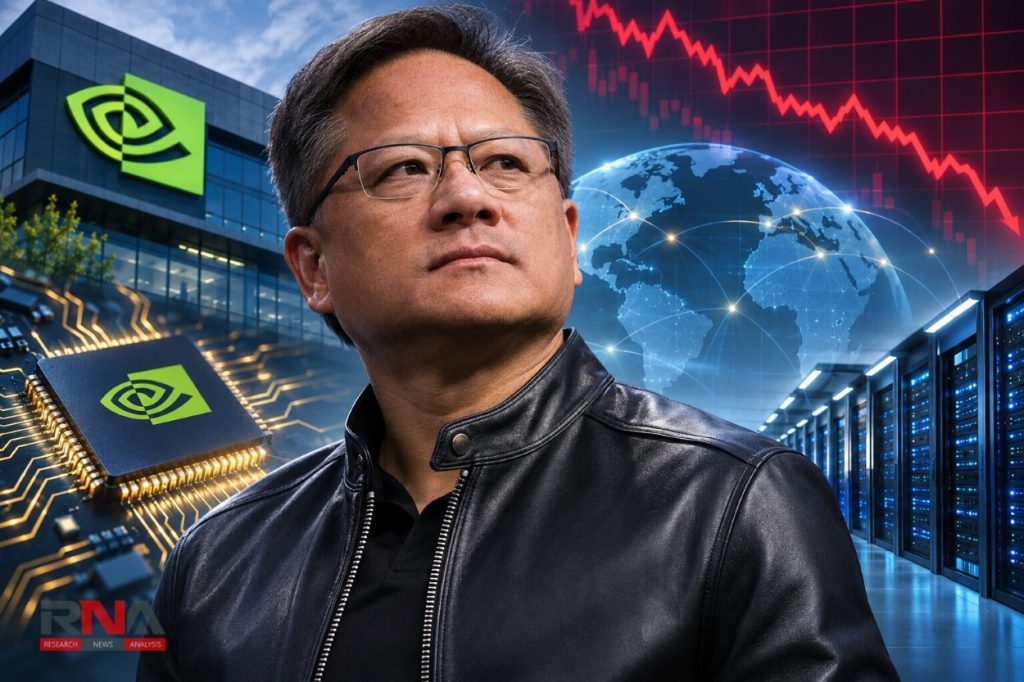
New Delhi: Jensen Huang, the co-founder and chief executive of Nvidia, has resigned from the company. His sudden resignation has plunged the world’s most influential artificial intelligence chipmaker into a leadership crisis, raising concerns over the future of the global AI industry. His departure on Thursday followed allegations involving extramarital relationships, suspected Chinese intelligence activities and questions about corporate oversight, triggering a sharp sell-off in technology stocks.
The company confirmed Huang’s immediate resignation as president, chief executive and board member, bringing an abrupt end to his 33-year leadership of the semiconductor giant. Nvidia appointed its chief financial officer, Colette Kress, as interim chief executive and named veteran technology executive Harvey C Jones as its first board chairman.
The decision rattled Wall Street, where Nvidia shares plunged more than 12 per cent in early trading, threatening to erase approximately $500 billion from the company’s market capitalization. The sell-off spread across AI-linked businesses, reflecting investors’ concerns that Huang’s departure could disrupt the technology ecosystem built around Nvidia’s processors.
The leadership crisis followed reports that Huang, 63, had an extramarital relationship with Alice Huang, a former executive at Singapore-based cloud-computing company Megaspeed International, whom US intelligence authorities reportedly suspect of working for Beijing. Chinese authorities have denied that she was a spy, and Nvidia has said it has no evidence that its confidential information or American national security was compromised.
The scrutiny intensified after reports emerged of another alleged relationship involving Kimberly Powell, Nvidia’s vice-president of healthcare, who reported to Huang. The allegations raised separate questions about corporate governance, conflicts of interest and the possible exposure of strategically important American technology to foreign intelligence operations.
On November 8, Nvidia’s board announced an independent investigation into whether its chief executive had been targeted by foreign intelligence operatives, although it initially expressed confidence in his leadership. Huang subsequently acknowledged being unfaithful to his wife in an internal message, apologized to his family and colleagues, and promised to cooperate with the inquiry.
The controversy acquired greater significance because Megaspeed, an Nvidia cloud partner with privileged access to advanced chips, has reportedly faced scrutiny over suspected violations of American export restrictions. Those restrictions are intended to prevent China from acquiring high-performance processors that could accelerate its military modernization, intelligence capabilities and development of sophisticated AI systems.
Why Huang’s departure matters beyond Nvidia
Huang transformed Nvidia from a graphics-chip manufacturer primarily serving computer gamers into the central supplier of processors powering advanced AI models, supercomputers and enormous data centres. Its dominance of accelerated computing made the company a cornerstone of the global technology industry, with its market value reaching approximately $4 trillion.
His influence extended beyond technological development to investment decisions, supply-chain relationships and American semiconductor diplomacy. Nvidia’s extensive commercial partnerships with cloud providers and AI laboratories helped establish an interconnected industrial ecosystem whose growth increasingly depended on the company’s hardware and software.
The immediate concern is not necessarily that Nvidia will lose its technological advantage, but that its new leadership could struggle to coordinate this complex network of customers, manufacturers and investors. The company must also reassure markets that its product-development schedule, including next-generation AI computing platforms, will remain intact despite the abrupt transition.
Kress, who joined Nvidia in 2013, brings considerable financial experience from Microsoft and Cisco and has overseen the company’s finances through its rapid expansion. Nvidia’s board has begun examining internal and external candidates for a permanent successor, although replacing Huang’s combination of engineering vision, industry relationships and political influence presents an unusual challenge.
The departure also comes at a sensitive moment in Washington’s technology confrontation with Beijing, particularly over restrictions on exports of advanced semiconductors. Huang had repeatedly advocated preserving commercial access to China, arguing that American technological leadership could be weakened if Chinese companies were pushed towards developing competing systems.
His removal could therefore influence the debate over semiconductor export controls, although American policy ultimately remains determined by the government rather than individual technology executives. For countries such as India, which are expanding domestic AI infrastructure and semiconductor capabilities, developments at Nvidia could have consequences for investment planning, access to computing hardware and the wider technology supply chain.
Meanwhile, Nvidia faces an immediate test of investor confidence when it announces its quarterly financial results on November 17. The figures will provide an important assessment of the company’s underlying business strength, but its longer-term challenge will be demonstrating that the AI empire Huang created can continue operating effectively without him.