


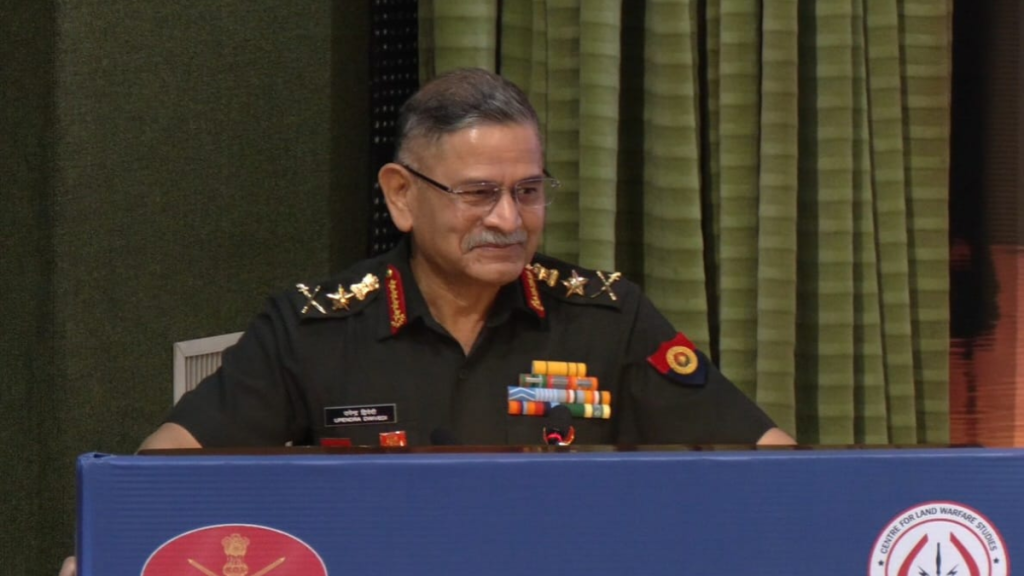
New Delhi: In yet another move towards modernizing its battlefield capabilities, the Indian Army is set to raise dedicated drone units called “Baaz” battalions. The chief of the Army staff, General Upendra Dwivedi, announced this in an interview with ANI.
The Army has been expanding its unmanned aerial systems ecosystem in recent times.
Speaking on the initiative, Gen Dwivedi said the new battalions would be built on the foundation of existing remotely piloted aircraft flights, housing a specialist cadre of personnel trained specifically to operate and manage drone systems. It is aimed at significantly bolstering the Army’s intelligence, surveillance and reconnaissance (ISR) capabilities, enabling persistent battlefield awareness and faster response times.
Gen Dwivedi said, “The Army will require continuous induction, upgrades and replenishment of drones on a large scale. To maintain pace with this requirement, one of the most important initiatives is raising the Baaz battalions. This will be built upon the existing remotely piloted aircraft flights. These battalions will comprise a specialist pool of personnel trained to operate and manage the ecosystem of remotely piloted aircraft.”
The Baaz battalions represent the next layer of the Indian Army’s existing pyramid of moving from platoon-level integration to dedicated, battalion-strength drone formations for persistent ISR across the battlefield.
He also highlighted the dramatic growth in the force’s drone inventory. From just a few hundred units roughly two years ago, the fleet has now surpassed 50,000 drones and is projected to double within the next two to three years. Gen Dwivedi noted that as technology advances and costs continue to fall, drones are expected to become as standard on the battlefield as radios and night-vision equipment.
On the subject of Pakistan’s drone capabilities, ANI quoted General Dwivedi as saying the Army keeps a close watch on adversarial developments and investments in unmanned systems. He stressed, however, that India’s priority lies not in matching numbers but in its ability to detect, track and neutralise drone threats across all operational scenarios.
General Dwivedi, who is being increasingly referred to as the “Drone General”, retires on Tuesday. As RNA Media reported earlier, Lieutenant General Dhiraj Seth, who will be promoted as general, will succeeded as him as the new Army chief and take charge in the same day.
The Army has undertaken sweeping drone reforms in recent years, fundamentally restructuring how unmanned systems are integrated at the tactical level. Beginning in 2025, the Army started raising Ashni Platoons as part of its broader force modernization programme, embedding them across every infantry battalion. Each platoon is equipped with a mix of surveillance UAVs and loitering munitions capable of real-time intelligence gathering, target acquisition, and precision strikes.
Alongside Ashni, the Army has also raised Bhairav light commando battalions, Rudra all-arms brigades, and Shaktibaan artillery regiments as part of a connected modernization framework. On the training front, the Army plans to train five lakh soldiers in drone warfare over the next five years, having already trained around 5 lakh personnel in remotely piloted aircraft systems in just one year.